

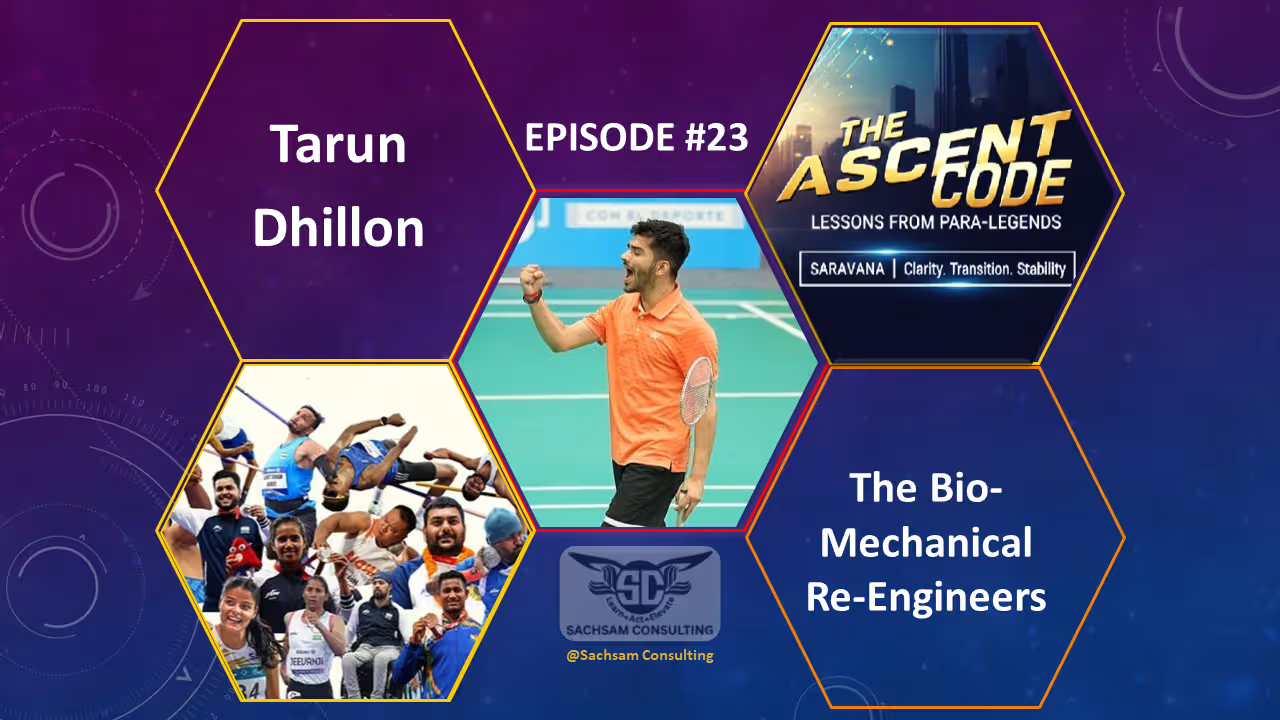
ASCENT CODE: Episode 23
The Agility Pivot
Tarun Dhillon, The Bio‑Mechanical Re‑Engineers. A school footballer whose serious knee injury closed one sport and opened another. Under Pullela Gopichand, he rebuilt into a World No. 1 SL4 para‑badminton player with two World Championship Golds.
EXECUTIVE SUMMARY
Tarun Dhillon was a young footballer when a knee injury permanently changed his mobility. Multiple surgeries. A permanent impairment. Football at the level he had been playing was no longer compatible. The sport that had defined his athletic identity was now physically inaccessible.
He chose para‑badminton as a recovery sport. Under coach Pullela Gopichand, he rebuilt his game from the foundation the football years had built: explosive lateral movement, court vision, competitive composure. He reached World No. 1 in the SL4 category. He won two World Championship Gold medals.
⚙️ THE ATHLETIC ARCHITECTURE METRIC: Football and badminton share explosive lateral movement, spatial pattern recognition, and split‑second opponent reading. The injury removed the sport, not the neural architecture the sport had built. The architecture transferred. The sport changed.
THE ASCENT CODE: THE RE‑ENGINEER CODE OF CROSS‑SPORT TRANSFER: Physical trauma in one sport can be the starting point for world‑leading excellence in another with a similar athletic base. Map the shared athletic architecture. Rebuild around it in the new arena. The injury ends the sport. It does not end the athlete.
THE CRISIS: THE TACKLE THAT CHANGED THE SPORT
Tarun Dhillon was playing school football when the knee injury happened. A specific sound, the particular crack that a knee makes when the ligaments give way on a wet school ground, the cold sting of turf on skin as he went down: these are the sensory coordinates of a moment that closed the sport he had been building toward without warning or preparation.
Multiple surgeries followed. A permanent mobility impairment in the leg. Football at the level he had been playing, with the directional speed and explosive contact that the sport demands, was no longer compatible with the reconstructed knee. The sport was over. But the athlete the football years had been producing was not. The explosive lateral movement capacity, the court vision built through years of reading a moving ball and multiple bodies in space, the competitive instincts sharpened by team sport: all of that remained intact.
At the World Championships, Tarun Dhillon won two Gold medals and reached World No. 1 in the SL4 para‑badminton category. The football career ended on a school ground. The badminton career began in its place and surpassed it at every measurable level.
THE ORIGIN: FROM RECOVERY SPORT TO GOPICHAND
The shadow phase was the uncertain period between the end of football and the beginning of direction. Tarun chose badminton as a recovery sport, a lower‑impact context to rehabilitate movement and maintain competitive engagement. That choice, made without grand design, turned out to be correct. The athletic base football had built was transferable to badminton in ways that only became apparent once he began competing seriously.
The turning point was the national camp and Pullela Gopichand. Gopichand’s approach is technical and systematic: movement pattern analysis, game architecture, pressure management under match conditions. For a player whose athletic instincts were already formed through football, that level of structural coaching accelerated development at a rate a late‑entry player without the football foundation could not have matched.
THE GRIND: FROM RECOVERY TO WORLD NO. 1
The transition from football to para‑badminton required specific technical reconstruction: the SL4 category demands agility and movement from a player with leg impairment, meaning every footwork pattern, every recovery position, every split‑step had to be engineered around the permanent constraint of the reconstructed knee.
- Rebuilding movement mechanics adapted to the SL4 category, converting the explosive lateral capacity from football into the court coverage patterns that para‑badminton demands.
- Training under Gopichand at national camp level, absorbing the analytical framework that elevated his game from talented regional competitor to world‑class technical player.
- Competing consistently at the highest international levels, including Paralympic and Asian Para Games circuits, building the match experience that World No. 1 and World Championship Gold require.
Verified Achievements
• Two World Championship Gold medals, SL4 para‑badminton
• World No. 1 ranking, SL4 category
Two Golds. World No. 1. From a football career ended by a school‑ground tackle. The sport changed. The athlete did not.
THE ASCENT CODE: THE RE‑ENGINEER CODE
Here is the assumption most injury narratives carry: that the sport the athlete lost is irreplaceable, and the transition to another sport is always a lesser version of the original career. The substitute sport. The consolation arena. Tarun Dhillon’s World No. 1 ranking and two World Championship Golds are evidence against that framing.
Football and badminton share an athletic architecture most people do not examine: explosive lateral movement, spatial pattern recognition, split‑second opponent reading, competitive emotional regulation under pressure. The football years built all of these. Badminton accessed them. The injury removed the sport. The generalised athletic capability remained. Under a world‑class coaching system, that capability found its highest expression.
I see this pattern often in professionals who lose a role and believe what they built is now worthless. I ask them to map the architectural capability under the domain: the systems thinking, the stakeholder reading, the pressure management. That transfers. The domain changes. The capability does not. Find the new arena that accesses it. Then find your Gopichand.
THE HOW-TO FRAMEWORK: THE RE‑ENGINEER CODE IN 4 STEPS
- Map the Athletic Architecture Beneath the Sport
Before accepting that a career change means starting from scratch, map what the previous domain built. Tarun’s football years built explosive lateral movement, spatial reading, and competitive emotional regulation. Not football skills. Athletic capabilities. List what your previous domain built at the capability level, not the skill level. That list is your transferable asset. - Choose the New Arena by Architectural Fit
Evaluate potential new arenas against the architectural fit with what you have already developed. The arena that requires capabilities you already hold in depth will accelerate faster than one that requires starting from zero. Tarun chose badminton because the physical demands overlapped with what football had built. - Find the Gopichand in Your New Domain
Raw capability transferred from a previous domain gets you to the national camp level. A world‑class structural coaching system gets you to World No. 1. Identify who provides the analytical framework that raw capability alone cannot construct. Seek that relationship early in the new domain. - Engineer the Constraint Into the Technique
The permanent knee impairment was not managed around. It was engineered into every footwork pattern. Design your professional technique around your actual constraints, not against them. The technique built for your specific profile will outperform an adapted version of the standard approach.
THE REFRAME: THE INJURY DID NOT END THE ATHLETE
Return to that school football ground. The wet turf. The particular sound of a knee giving way. A young athlete looking up from the ground at a career that had just ended without warning.
The injury ended the sport, not the athlete. The explosive lateral movement, the spatial reading of bodies in motion, the competitive composure under pressure: all of that remained. None of those capabilities live in the knee. They live in the neural architecture that years of serious sport builds, and that architecture has no sport‑specific address.
Two World Championship Golds and World No. 1 said something precise: the football career had been building something more valuable than football. It had been building an athlete. As of 2026, Tarun Dhillon serves in the Haryana Police, competes at the top of the SL4 circuit, and mentors young players. The injury redirected the athlete. The athlete chose the direction.
SELF AUDIT
- • What did your most significant previous professional domain build at the capability level, not the skill level? List the architectural capabilities: pattern reading, pressure management, systematic thinking, competitive drive. Which of those are you currently deploying in your new arena?
- • In your current professional arena, who is the Gopichand? Who has the analytical framework that could convert your raw transferred capability into world‑class technical execution? Have you sought that relationship?
- • Is your current professional technique designed around your actual constraints, or is it an adapted version of the standard approach built for a different profile? What would a technique designed specifically for your constraints look like?
👇 Drop your answer in the comments. The #AscentYouTribe learns together.
THE SCIENCE OF CROSS‑SPORT ATHLETIC TRANSFER
Sports science research on cross‑sport athletic transfer documents a consistent finding: athletes who transition between sports with overlapping movement demands show significantly faster development curves in the new sport than athletes who begin that sport without prior competitive training. The mechanism is neural: competitive sport builds pattern recognition, anticipatory processing, and pressure management systems that are not sport‑specific but are selectively accessed by sports with similar movement and cognitive demands.
Tarun’s transition from football to SL4 para‑badminton represents a near‑optimal cross‑sport transfer: both sports recruit explosive lateral movement, spatial anticipation, and split‑second decision‑making under competitive pressure. The football years pre‑trained the neural systems that badminton required. Gopichand’s coaching then provided the sport‑specific technical overlay for neural systems that were already primed. The result was a development curve that compressed what would typically require a decade of sport‑specific training into a significantly shorter competitive window.
Next on The Ascent: Episode 24: Tek Chand, The System‑Hacking Outsiders.
SARAVANA KUMAR
Clarity | Transition | Inner Stability
The coaching question Tarun’s story poses is one I return to regularly: when a professional loses their primary domain, how many of them inventory what the domain built rather than just mourning what it was? Most professionals I work with can describe what their previous role was. Very few can map what it built at the capability level. That is where the Re‑Engineer Code begins. Not at the loss. At the inventory. What did your previous arena build in you that no one has yet asked you to bring into the new one?
#SaravanaSays
Your Growth Journey Starts Here
All the ways to connect, learn, and grow with the Tribe — in one place. Choose your favourite platform and stay plugged into daily momentum.
KEYWORDS: Ascent Code Tarun Dhillon, Re‑Engineer Code, Bio‑Mechanical Re‑Engineers, World Championship Gold SL4 badminton, World No 1 SL4 para‑badminton, football knee injury sport pivot, Gopichand coaching para‑badminton, Haryana Police athlete, cross‑sport athletic transfer, dynamic adaptation sport, football to badminton transition.
HASHTAGS: #AscentCode #AscentYouTribe #SaravanaSays #SaravanaKumar #ReEngineerCode #Clarity #Transition #InnerStability #HighPerformance #MindsetEngineering #ResilienceEngineered #SuccessSystems #DynamicAdaptation #LeadershipPrinciples #CareerPivot #SelfOptimization #TarunDhillon #ParalympicsIndia #ParaBadminton #IndianAthletes #WorldChampion #ReEngineerYourself #AgilityPivot



Comments
2[…] Read → […]
[…] Episode 23: Tarun Dhillon, The Bio‑Mechanical Re‑Engineers […]