

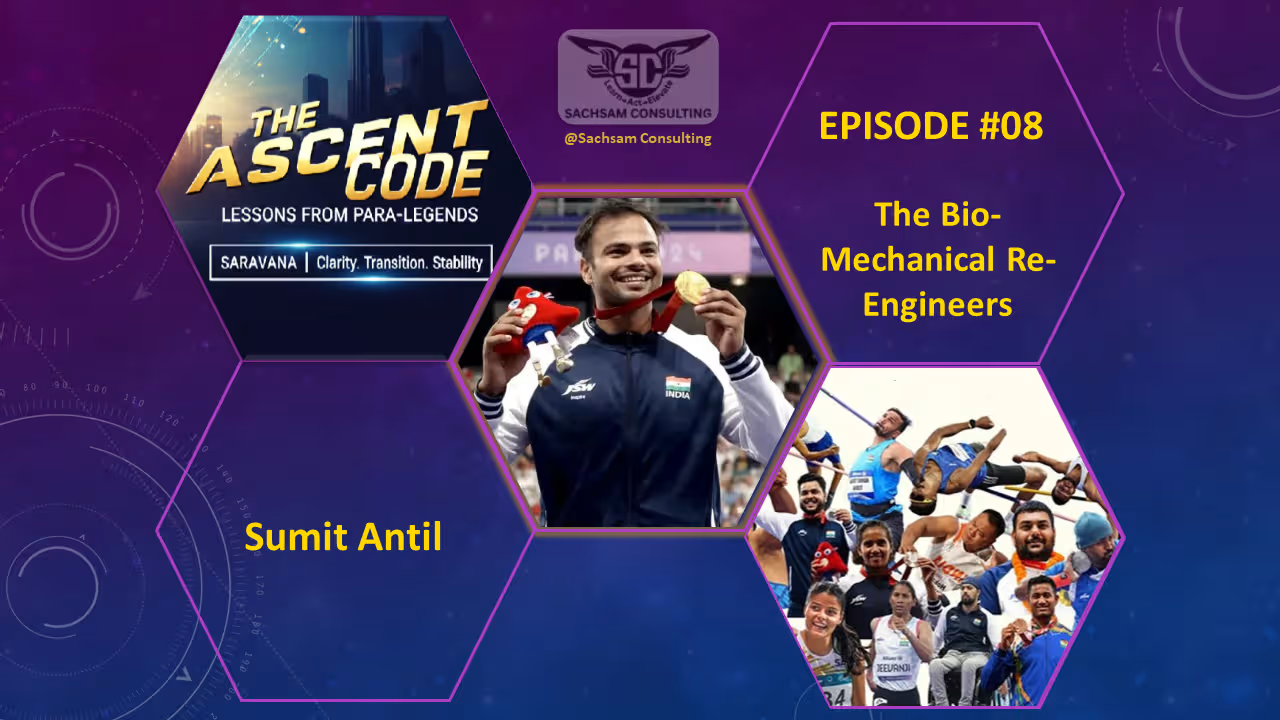
ASCENT CODE: Episode 8
Wrestler’s Strength in a Javelin Frame
Sumit Antil, The Bio-Mechanical Re-Engineers. How a wrestler who lost his leg rebuilt his raw power into back-to-back Paralympic Gold and three world records in a single competition.
EXECUTIVE SUMMARY
In 2015, Sumit Antil was a teenage wrestler from Sonepat, Haryana, returning from coaching when a motorbike accident took his left leg below the knee. The wrestling career ended. But the power built through years of training did not disappear.
His coach Naval Singh identified the mechanical transfer: wrestling builds explosive rotational shoulder power and deep core stability that javelin demands almost identically. At Tokyo 2020, Sumit broke the world record three times in one competition to win Gold. He defended that Gold at Paris 2024, breaking the world record again.
⚙️ THE POWER TRANSFER METRIC: Wrestling develops rotational torque measured in hundreds of foot-pounds. Javelin requires the same torque, delivered through a different release angle. The engine was identical. The vehicle changed.
THE ASCENT CODE: THE RE-ENGINEER CODE: Raw strength built in one domain does not disappear when that domain closes. Identify the mechanical transfer, point the power at a new discipline, and let the engine run.
THE CRISIS: THE ACCIDENT THAT ENDED ONE CAREER AND STARTED ANOTHER
It was 2015. Sumit Antil was returning from wrestling coaching in Sonepat when a motorbike accident took his left leg below the knee. The smell of dust and diesel on a Haryana highway, then the sharp antiseptic cold of the hospital ward: a silence that felt nothing like the training ground he had just left.
He was a teenager with a wrestler’s body and a wrestler’s ambitions. Both felt, in that ward, like they belonged to someone else. Wrestling demands a planted two-legged base. The diagonal drive, the explosive hip rotation, the locked stance: all built around a physical foundation that had just changed permanently.
At Tokyo 2020, Sumit Antil stepped into the F64 javelin circle. He threw 68.55 metres. World record. He threw again: 66.95m, world record. A third throw: 68.55m, world record again. Three world records in one competition. Gold. Then Paris 2024: Gold again, world record again. The wrestling career ended in 2015. What came after was larger.
THE ORIGIN: COACH NAVAL SINGH AND THE MECHANICAL INSIGHT
The shadow phase after the accident was real. Sumit had to grieve the wrestler before he could become anything else. The training medals, the identity built through years of competition: all of it belonged to a body that no longer existed in the same form. That limbo, neither wrestler nor athlete of any kind, is where most people stay. Sumit moved through it because one person saw the transfer before he did.
Coach Naval Singh introduced him to para-javelin during rehabilitation. Singh’s insight was mechanical, not motivational. He was not telling Sumit to stay positive. He was identifying a structural fact: wrestling develops explosive rotational shoulder mechanics and deep core stability. Javelin demands exactly these. The prosthetic leg changes the base. It does not change the power chain above it. Sumit’s years of wrestling had built an engine. Naval Singh showed him the new vehicle it could drive.
This is the real turning point. Not the accident. Not the prosthetic fitting. The moment a trained observer identified the mechanical transfer and gave the athlete a clear path from one discipline to the other.
THE GRIND: REBUILDING THE THROW
Transitioning from wrestling to javelin with a prosthetic leg meant rebuilding core stability from the ground up. High-quality sports prosthetics were expensive and difficult to source in rural Sonepat during his early training. Every upgrade was a significant financial commitment from his family.
- Rebuilding the rotational power chain from prosthetic base through hip, core, and shoulder; adapting javelin release mechanics to the new physical reality.
- Competing at national level, using each competition as a technical calibration rather than simply a results event.
- Breaking national records progressively, establishing the F64 category benchmark before arriving at the international stage.
Verified Achievements
• Tokyo 2020 Paralympics: Gold Medal, F64 Javelin (World Record broken three times in one competition)
• Paris 2024 Paralympics: Gold Medal, F64 Javelin (World Record)
Two Games. Two Golds. World records broken across both. He is the current world record holder and the global benchmark for the F64 category. That is not recovery. That is dominance.
THE ASCENT CODE: THE RE-ENGINEER CODE
Here is the assumption most people make after a major disruption: the skills built in the previous chapter are now irrelevant. New situation, start from scratch. Sumit Antil is direct evidence against that assumption.
Wrestling and javelin look nothing alike on the surface. Different rules, different equipment, different competitive context entirely. Underneath, they share a mechanical spine: explosive rotational power generated from the core and delivered through the shoulder. Sumit did not start from scratch. He transferred the engine. He changed only the vehicle.
I see this pattern repeatedly in professionals navigating difficult career transitions. A sales leader moving into operations carries negotiation instincts that first-time operators never develop. A military officer entering corporate life brings operational discipline that civilian organisations have never trained for. The mistake is treating the new domain as a blank slate. The correct move is identifying the mechanical transfer: which specific functional skill from the previous chapter creates disproportionate advantage in the new one?
Find that transfer. Name it precisely. Build the new technique around it. Three world records in one afternoon is what happens when you find the transfer early and build everything else on top of it.
THE HOW-TO FRAMEWORK: THE RE-ENGINEER CODE IN 4 STEPS
- Audit the Power Chain, Not the Job Title
When a chapter closes, do not list your skills by role. List them by function. What does each skill actually produce mechanically? - Map the Mechanical Transfer
Identify the new domain where your functional skill creates disproportionate advantage. - Rebuild the Technique Around the Transferred Skill
The transfer does not arrive fully formed. Build a new technical shell around your existing engine. - Compete Before You Feel Ready
Enter your new arena before your technique feels complete. Imperfect entry beats perfect readiness that never arrives.
THE REFRAME: THE ENGINE SURVIVED THE ACCIDENT
Return to that Haryana highway in 2015. Dust. Diesel. A teenage wrestler calculating what the accident had taken.
The leg was gone. The wrestling career was gone. But here is what the accident could not touch: the rotational power built through thousands of training repetitions, the core stability developed across years of competitive wrestling, the competitive instinct forged in a sport that rewards controlled aggression. None of that disappeared with the limb. It was waiting for a new vehicle.
Most people, when a chapter closes, ask: what can I still do? That is a loss-framing question. Sumit asked a different question: what is the most powerful thing I have built, and where does it go from here? The difference between those two questions is three world records and two Paralympic Golds.
As of 2026, Sumit Antil serves as an Officer in the Haryana Government and remains the world record holder and current Paralympic champion in the F64 category. The Re-Engineer Code is still running.
SELF AUDIT
- • What is the deepest functional skill you have built? Not the job title. The actual mechanical capability underneath it.
- • If your current domain closed tomorrow, which adjacent field rewards that specific functional skill most directly?
- • Are you asking the loss-framing question or the asset-framing question?
👇 Drop your answer in the comments. The #AscentYouTribe learns together.
THE SCIENCE OF MOTOR SKILL TRANSFER
Sports biomechanics research documents a well-established principle: motor skills that share underlying movement patterns transfer positively between disciplines. The rotational mechanics of wrestling and javelin share a common kinetic chain. An athlete with deep motor fluency in one pattern acquires the adapted version far faster than a beginner building from zero.
Sumit’s rapid progression reflects this mechanism. His wrestling background had wired the kinetic chain at a neurological level. The prosthetic leg created a new base input; the chain above it was already built for explosive output. The Re-Engineer Code works because the brain stores skills as transferable patterns, not fixed domain-specific tools.
Next on The Ascent: Episode 9: Devendra Jhajharia, The System-Hacking Outsiders.
SARAVANA KUMAR
Clarity | Transition | Inner Stability
Three world records in one competition. The skills you have built are not a sunk cost if the chapter closes. They are an engine waiting for its next vehicle. Find the vehicle before the chapter ends, not after.
#SaravanaSays
Your Growth Journey Starts Here
All the ways to connect, learn, and grow with the Tribe — in one place.
KEYWORDS: Ascent Code Sumit Antil, Re-Engineer Code, Bio-Mechanical Re-Engineers, Paralympic Gold Tokyo 2020, Paris 2024 Paralympics, para-javelin India, F64 category world record, motor skill transfer, wrestling to javelin, Naval Singh coach, power optimisation, career transition skills, functional skill transfer.
HASHTAGS: #AscentCode #AscentYouTribe #SaravanaSays #SaravanaKumar #ReEngineerCode #Clarity #Transition #InnerStability #HighPerformance #MindsetEngineering #ResilienceEngineered #SuccessSystems #CareerPivot #LeadershipPrinciples #SkillTransfer #SelfOptimization #SumitAntil #ParalympicsIndia #ParaJavelin #Tokyo2020 #Paris2024 #IndianAthletes #WorldRecord



Comments
2[…] Episode 8: Sumit Antil, The Bio-Mechanical Re-Engineers […]
[…] Read → […]