

I had finished a book that morning.
It was one of those books that quietly occupies your mind even after you close the last page. I had studied for a couple of hours before reading it, and I studied again afterward. On paper, nothing particularly terrible had happened.
But by the evening, I felt awful.
I felt lonely. Overwhelmed. Anxious. Unproductive. Stuck.
I couldn’t seem to understand what exactly I was feeling, and that made everything worse. My mind kept jumping from one thought to another: I wasn’t doing enough. I couldn’t maintain a routine. Other people seemed to be moving forward while I was repeatedly finding myself in the same place. I had things I wanted to accomplish, but somehow I couldn’t consistently work towards them. I was getting exhausted easily.
It felt as though every small problem had joined together and become one enormous problem called my life.
And when you don’t know what the problem is, even finding a solution becomes difficult.
By the evening, I knew I needed some kind of support. I considered reaching out to someone and asking them what I should do.
There is nothing wrong with asking for help. Sometimes you genuinely need another person’s perspective.
But while I was walking outside, I had another thought.
What if I keep reaching a point like this in the future?
What if I always need someone else to untangle my thoughts for me?
Realised something that I needed to sit down and figure out what problem I was actually trying to solve.
That distinction changed something for me.
So I kept walking.
I didn’t have my phone with me. I wasn’t listening to anything. I was just walking and thinking.
And eventually, I started asking myself a different question.
Not “How do I make myself feel better?”
But: “What is actually wrong?”
That sounds almost ridiculously simple.
It wasn’t.
Because when you’re overwhelmed, your brain rarely gives you one clean problem. It gives you a giant sentence:
Everything is wrong.
So I decided that when I got home, I would write everything down.
Not the version that sounded reasonable.
Not the version that would make other people say, “It’s okay, everyone feels like that.”
The actual version.
If I wasn’t happy, I would write that I wasn’t happy.
If I felt stuck, I would write that I felt stuck.
If I didn’t understand why I was procrastinating, I would write that too.
I wanted to stop softening my own problems just because they sounded uncomfortable.
THE PROCESS
The process I followed was simple.
First, I wrote down the problem.
Then I wrote down all the possible solutions to that specific problem.
And then came the most important part: I started eliminating the solutions.
First, I eliminated the options I knew I would never choose.
There was no point pretending every possible solution was equally realistic when I already knew some of them were not for me.
Then I looked at the remaining options in the context of my actual situation. I questioned them. I looked at what each choice could lead to. I tried to understand not only what I would gain, but also what I might have to give up.
Eventually, I chose the solution that made the most sense for me.
These were some of the questions I asked myself:
1. What are the good and bad possibilities if I choose this option?
2. What will I lose if I choose this option?
3. What consequences could come later?
4. If those consequences happen, will I be able to deal with them?
5. Will I regret this decision five or ten years from now?
6. Does choosing this option help me become a better version of myself?
The point wasn’t to find a perfect answer.
I don’t think perfect answers exist for most real-life problems.
The point was to find an answer I could consciously choose and accept the consequences of.
You need to understand that sometimes, “I feel terrible” is not a complete explanation. It is an invitation to ask why.
Writing everything down didn’t magically solve my life.
It did something more realistic.
It made the mess smaller.
I think we often underestimate the value of putting things into words.
When something exists only in your head, it can become distorted. Every thought overlaps with another. Every fear becomes evidence for another fear. A bad day starts feeling like evidence of a bad life.
Writing creates distance.
You can look at a thought instead of being completely inside it.
There is also something else I learned that evening.
Learning to handle your problems yourself does not mean refusing help.
I still believe in asking people for advice. I believe in mentors, friends, family, professionals, conversations and perspectives that you cannot give yourself.
But there is a difference between asking for help and outsourcing your life.
Someone can help you see a door.
They cannot walk through it for you.
Someone can give you advice.
They cannot live with the consequences of your decision for you.
Someone can listen to your problem.
But eventually, you have to understand what the problem means to you.
That is what I was trying to learn that evening.
Not how to become someone who never struggles.
Not how to solve every problem alone.
Just how to become someone who can sit with a difficult problem long enough to understand it.
So now, when everything feels tangled, I try to return to the same page.
I write what I am feeling.
I write what I think is causing it.
I separate the problems.
I write down possible solutions, even the unrealistic ones.
I look at the consequences.
I ask what each choice costs.
And then I ask myself what I am actually trying to protect, change, or build.
Sometimes the answer is uncomfortable.
Sometimes there isn’t a good option, only an option whose consequences I am more willing to accept.
Sometimes the problem genuinely cannot be solved immediately.
And sometimes, after writing everything down, I realize that I don’t need a solution yet.
I just needed to understand myself.
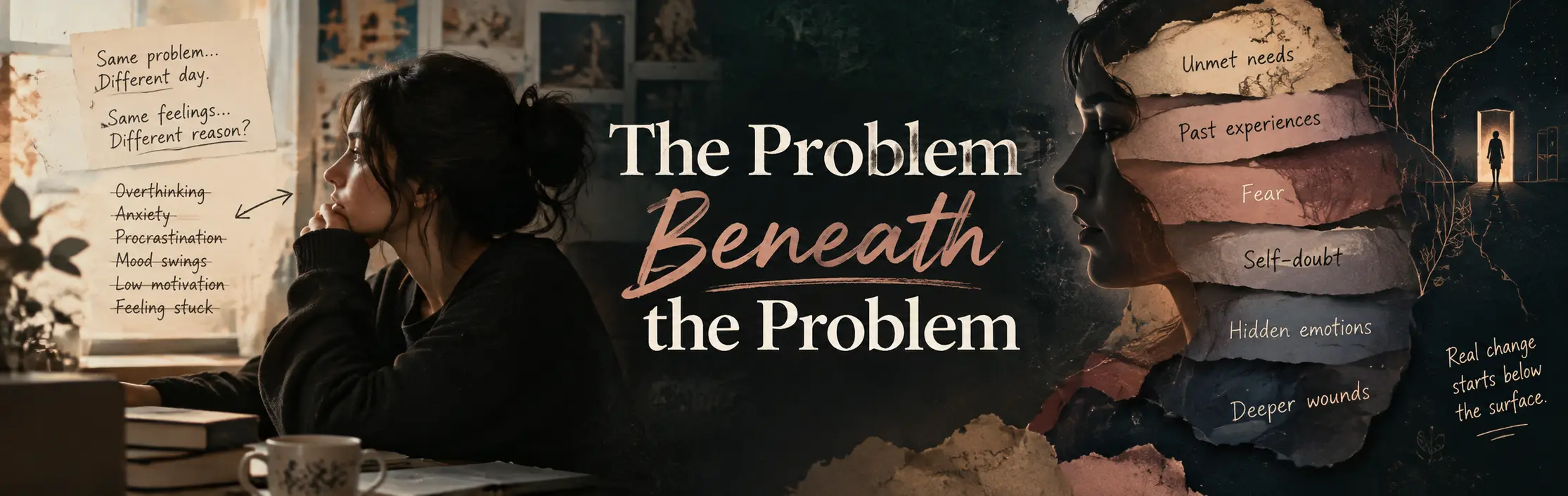
Because once you can name the problem beneath the problem, you can finally begin deciding what to do about it.
And sometimes, that first honest page is where things begin to feel a little less impossible.
Be kind. Be honourable
GHOST