

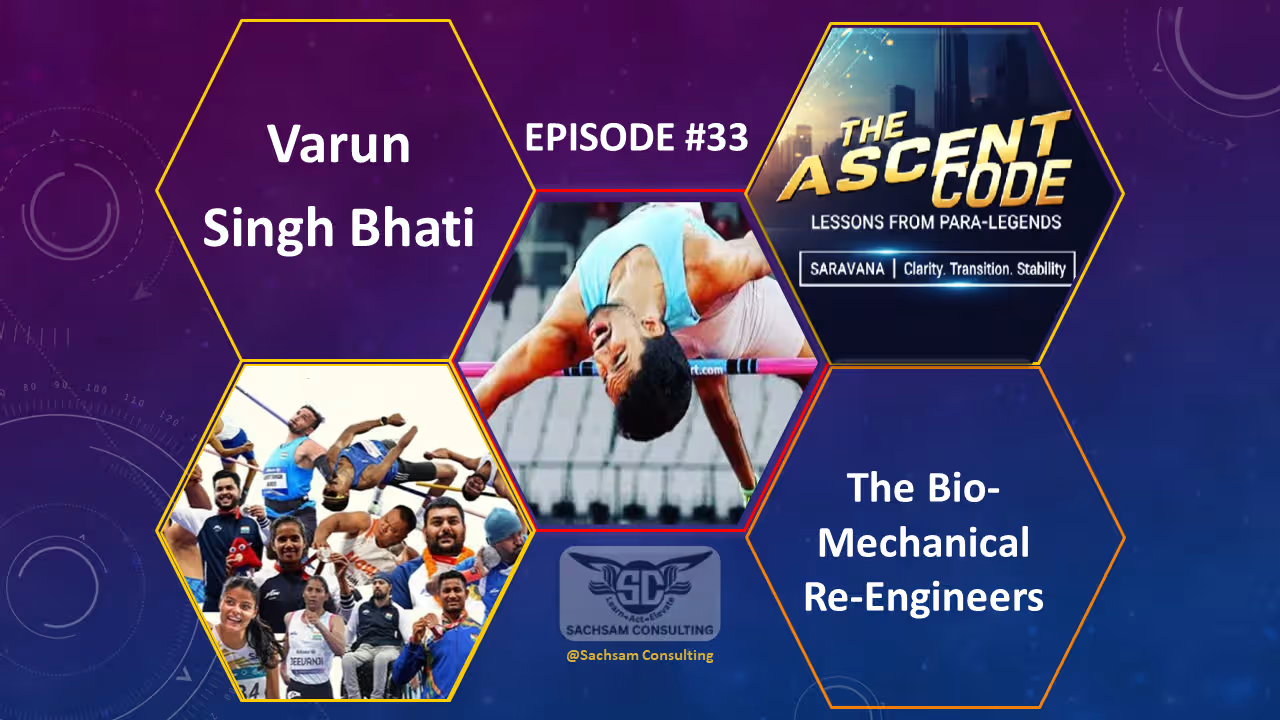
ASCENT CODE: Episode 33
The Mechanics of Gravity
Varun Singh Bhati, The Bio‑Mechanical Re‑Engineers. Affected by Polio in his left leg, active in multiple school sports, discovered an exceptional vertical leap that basketball could not fully use. He pivoted to high jump, trained under specialist coaches in Bangalore, and won Rio 2016 Bronze with a personal best 1.86m.
EXECUTIVE SUMMARY
Varun Singh Bhati had polio in his left leg at a very young age. Growing up in Greater Noida, he was active across school sports despite the impairment. During basketball, he discovered something unexpected: his vertical leap was exceptional. Not exceptional relative to his constraint. Exceptional in absolute terms. The sport he was playing could not fully access or reward that capability.
He pivoted to high jump, trained under specialist coaches in Bangalore, cleared 1.86m as a personal best at Rio 2016 to win Bronze, and spent nearly a decade in the world top five of the T63 category. The leap that basketball could not fully use had found its arena.
⚙️ THE COMPENSATORY LEAP METRIC: Polio redirected lower limb development, producing compensatory explosive hip extension capacity on the unaffected side. High jump, which relies on single‑leg takeoff power from a specific biomechanical position, accesses exactly this compensatory asset. The constraint built the very capability the sport rewarded.
THE ASCENT CODE: THE RE‑ENGINEER CODE OF COMPENSATORY EXPLOSIVE POWER: Identifying a specific physical advantage and focusing entirely on the discipline that rewards it most directly nullifies a generalised physical disadvantage. The sport that matches your specific mechanical profile is the one where your constraint becomes your competitive edge.
THE CRISIS: POLIO, GREATER NOIDA, AND AN UNEXPECTED LEAP
Varun Singh Bhati had polio in his left leg at a very young age. Growing up in Greater Noida, he was active across school sports despite the impairment: basketball, athletics, the general physical engagement of a child who had not accepted that the constraint was a reason to sit out. The particular sound of a basketball court, the grip of rubber soles on a gym floor, the specific moment when a jump that seemed too high for his profile cleared a height that surprised those watching: these are the sensory coordinates of an early career that was building toward a discovery it had not yet made.
The discovery arrived through basketball: his vertical leap was exceptional. Not exceptional relative to his constraint. Exceptional in absolute terms. The sport he was playing could not fully access or reward that capability. Basketball is a running sport where the jump is one tool among many. High jump is a sport where the jump is the entire event. The constraint that shaped his movement in basketball became the defining competitive asset when the right arena was identified.
At Rio 2016, Varun Singh Bhati cleared 1.86m as a personal best and won Bronze. He spent nearly a decade in the world top five of the T63 category. The leap that basketball could not fully use had found its arena.
THE ORIGIN: BASKETBALL TO BANGALORE
The shadow phase in Varun’s story is the period of athletic engagement without the matched arena: physically active, competitive, developing capacity across multiple sports, but not yet in the discipline where his specific mechanical advantage was the primary performance variable. The pivot from basketball to high jump was the structural moment that ended the shadow phase.
Moving to Bangalore to train under specialist high jump coaches was the turning point. The specialist environment gave him the technical framework for converting his exceptional vertical leap into competitive high jump performance: approach mechanics, takeoff technique, flight body position, bar clearance. The leap was the raw material. Bangalore provided the engineering. The combination produced a world top‑five career and a Rio Bronze.
THE GRIND: WORLD TOP FIVE, TRAVEL COSTS, CONSISTENCY
Maintaining a world top‑five ranking required competing consistently at international Grand Prix events to accumulate the ranking points Paralympic qualification demands. Travel costs were a significant constraint throughout his early career.
- Training under specialist high jump coaches in Bangalore, building the technical model of the jump alongside the physical conditioning that T63 high jump demands.
- Competing at international Grand Prix events despite the financial constraint, building the world ranking that Paralympic qualification required.
- Winning Bronze at Rio 2016 with a personal best of 1.86m, confirming the technical model and the physical capability at the highest competitive level.
Verified Achievements
• Rio 2016 Paralympics: Bronze Medal, T63 high jump (personal best 1.86m)
• Nearly a decade ranked in the world top five, T63 high jump
Bronze. Top five for a decade. From a basketball court in Greater Noida where the leap had no arena yet.
THE ASCENT CODE: THE RE‑ENGINEER CODE OF COMPENSATORY EXPLOSIVE POWER
Here is the assumption most sport participation frameworks carry: that physical impairment reduces competitive ceiling across all sports equally. That the constraint is uniform in its limiting effect regardless of which sport it is applied to. Varun Singh Bhati’s career disproves that assumption precisely.
His left leg polio impairment limited his horizontal speed and agility in basketball. In high jump, the primary physical requirements are vertical explosive power, hip extension mechanics, and approach speed concentrated into a single takeoff. The specific mechanical consequences of his polio were far less constraining in high jump than in basketball. The same physical profile that was a significant disadvantage in one sport was a manageable constraint in another, combined with a vertical leap that was exceptional in absolute terms.
I see this pattern often in professionals who have been in the wrong arena for their specific capability profile, managing a constraint the right arena would make far less significant. The Re‑Engineer Code begins: in which domain does your combination of capability and constraint create the best competitive position? Varun found his answer through basketball’s inadvertent gift of revealing the leap. What is yours revealing?
Patterns like this are not limited to sport. I often see them in professionals who have been told their profile is a disadvantage in one domain, when the same profile would be an asset in another. The arena changes everything.
THE HOW-TO FRAMEWORK: THE RE‑ENGINEER CODE IN 4 STEPS
- Identify the Hidden Asset in the Wrong Arena
Basketball revealed the vertical leap that basketball could not fully reward. The wrong arena sometimes produces the most important data about what the right arena would be. When you are performing at a level that feels below your capability ceiling, ask whether the current domain is revealing an asset that a different domain would reward more fully. - Find the Arena That Makes Your Constraint Irrelevant
His left leg polio was far less constraining in high jump than in basketball. Identify the domain where your constraint creates least disadvantage and your capability most advantage. The constraint does not disappear. The domain changes how much it matters. - Invest in the Technical System of the New Arena
The move to Bangalore for specialist coaching was the necessary investment in the new arena’s technical system. When you pivot professional domains, technical investment in the specific mechanics converts raw capability into world‑class performance. - Compete Through the Financial Constraint
He competed at Grand Prix events despite the travel cost constraint, because the ranking points those events provided were the only route to Paralympic qualification. Identify the essential competitions or experiences in your professional domain and compete in them regardless of the resource constraint. The pathway to the highest stage requires participation in the qualification events, even when they are expensive.
THE REFRAME: THE POLIO MADE THE LEAP POSSIBLE
Return to that Greater Noida basketball court. The rubber soles. The specific moment of the jump that surprised the observers. A child with polio in his left leg demonstrating a vertical capability that the constraint was supposed to have made impossible.
The polio had redirected his lower limb development in ways that produced, among other things, a compensatory explosive hip extension capacity on the unaffected side. That compensation, built across years of navigating daily movement with one impaired leg, was exactly the mechanical property that world‑class high jumping rewards. The constraint built the asset. Basketball revealed it. High jump rewarded it.
As of 2026, Varun Singh Bhati competes nationally and works as a sports administrator advocating for better urban accessibility. The boy who discovered his leap in a Greater Noida basketball gym is among the longest‑serving top‑five T63 high jumpers in history.
SELF AUDIT
- • Is there a capability your current professional arena is revealing but not fully rewarding? What domain would reward that capability most directly?
- • In which professional domain does your specific combination of constraint and capability create the most favourable competitive position? Are you in that domain?
- • What technical investment in your current domain would convert your raw capability into world‑class execution? Have you made that investment, or are you operating on talent without the technical system?
👇 Drop your answer in the comments. The #AscentYouTribe learns together.
THE SCIENCE OF COMPENSATORY EXPLOSIVE POWER IN UNILATERAL IMPAIRMENT
Sports biomechanics research on athletes with unilateral lower limb impairments documents that the intact limb frequently develops explosive power outputs significantly above the population average, due to the compensatory loading and neural recruitment that asymmetric movement demands over years of development. This compensatory hypertrophy and neural drive is most pronounced in the explosive hip extension and plantarflexion movements that sprinting and jumping require.
Varun’s exceptional vertical leap reflects this precisely. Years of asymmetric movement built explosive capacity in the intact right leg’s hip extension chain that typical bilateral development does not produce. High jump, which relies heavily on single‑leg takeoff power from a specific biomechanical position, accesses exactly this compensatory asset. His constraint built the very capability that his world top‑five career required.
Next on The Ascent: Episode 34: Rinku Hooda, The System‑Hacking Outsiders.
SARAVANA KUMAR
Clarity | Transition | Inner Stability
The basketball moment is the one I use in coaching when professionals tell me their current context is limiting. The constraints in your current arena are revealing something — a capacity that your domain cannot fully reward or access. Varun’s leap was obvious in retrospect once the right arena was identified. For most professionals, the inadvertent gift of the wrong arena is the most important career data they are currently ignoring. Pay attention to what your constraint is revealing.
#SaravanaSays
Your Growth Journey Starts Here
All the ways to connect, learn, and grow with the Tribe — in one place. Choose your favourite platform and stay plugged into daily momentum.
KEYWORDS: Ascent Code, Varun Singh Bhati, Re‑Engineer Code, Compensatory Explosive Power, Bio‑Mechanical Re‑Engineers, Rio 2016 Bronze high jump, T63 para‑high jump world top five, polio vertical leap Greater Noida, basketball to high jump pivot, Bangalore specialist coaching, compensatory explosive power.
HASHTAGS: #AscentCode #AscentYouTribe #SaravanaSays #SaravanaKumar #ReEngineerCode #Clarity #Transition #InnerStability #VarunSinghBhati #ParalympicsIndia #ParaHighJump #Rio2016 #CompensatoryExplosivePower