

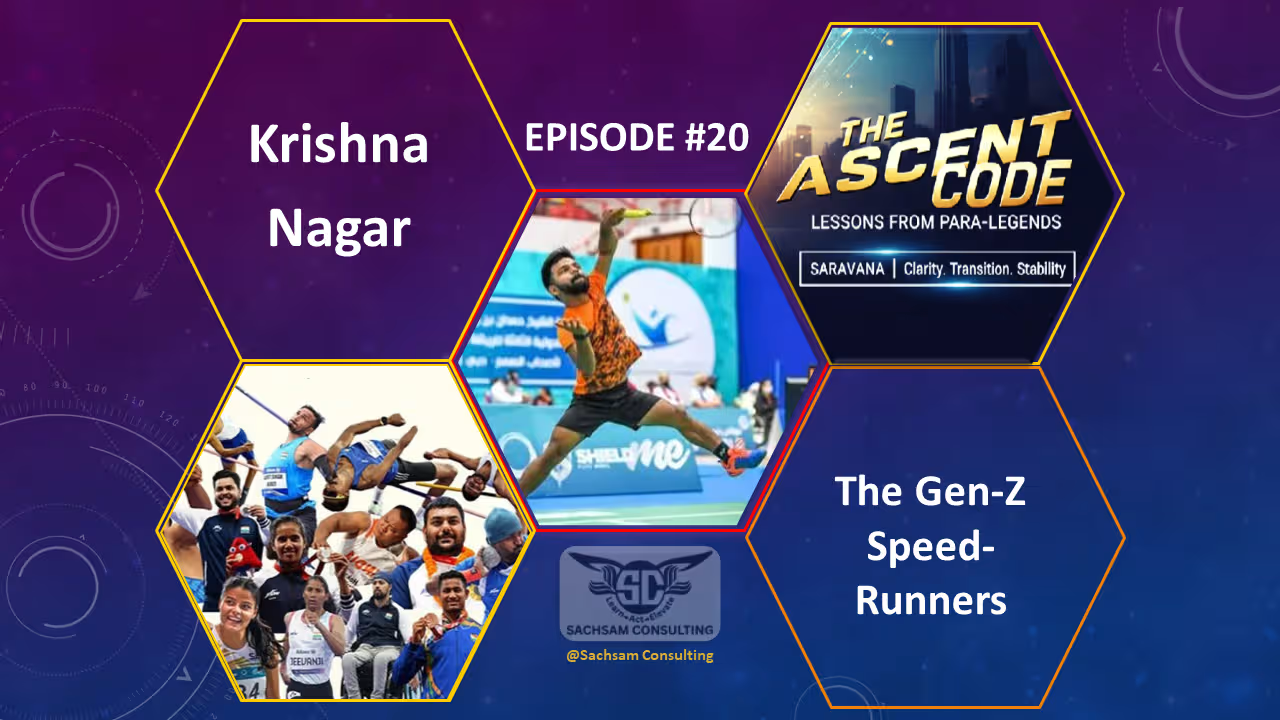
ASCENT CODE: Episode 20
The Short-Stature Speed King
Krishna Nagar, The Gen‑Z Speed‑Runners. Bullied through school in Jaipur, dismissed by a world built for taller players, he converted his low centre of gravity into a mechanical advantage and won badminton’s first‑ever SH6 Paralympic Gold at Tokyo 2020.
EXECUTIVE SUMMARY
Krishna Nagar was born with dwarfism. In Jaipur schools, he faced bullying and social dismissal. The world was built for taller people. He was built differently. His family’s support brought him to the Jaipur Badminton Association, where coaches saw something the school environment had missed: a low centre of gravity producing faster lateral movement and better stability.
Standard badminton training is designed for taller players. He invented his own footwork patterns. At Tokyo 2020, he won Gold in SH6 para‑badminton’s first‑ever Paralympic final, in a thrilling three‑set match. The first champion in the category’s Olympic history.
⚙️ THE CENTRE OF GRAVITY METRIC: Lower centre of gravity produces measurably faster lateral acceleration, reduced ground contact time during split‑steps, and greater stability during rapid direction changes. The same physical property that bullies mocked became the mechanical engine of his Gold medal.
THE ASCENT CODE: THE SPEED‑RUN CODE OF MECHANICAL ADVANTAGE: Physical characteristics dismissed as limitations often contain mechanical advantages that the standard training pathway never identifies. The label is social. The reality is mechanical. The mechanical is what the arena rewards.
THE CRISIS: BUILT DIFFERENTLY IN A WORLD BUILT FOR OTHERS
Krishna Nagar was born with dwarfism. Growing up in Jaipur, school was the arena where the gap between how the world was built and how he was built became most visible. The particular sound of classroom corridors when a group of children is being cruel, the fluorescent weight of institutional spaces that were not designed with his body in mind: these are the sensory coordinates of a childhood that built a psychological resilience through sustained exposure to social dismissal.
Bullying during the school years made him withdrawn. The instinct was retreat. His family’s response was the counter‑force: steady support that held the direction open rather than closing it. They connected him to the Jaipur Badminton Association, where coaches saw a physical profile with specific mechanical properties worth building a game around.
At Tokyo 2020, Krishna Nagar won Gold in SH6 para‑badminton’s first‑ever Paralympic final, in a thrilling three‑set match. He had converted the low centre of gravity that bullies had used to define him into the mechanical engine of a world championship performance.
THE ORIGIN: WHEN A COACH SEES WHAT THE WORLD MISSED
The shadow phase is the period of social withdrawal during the school years. The bullying had not taken his capability. It had taken his visibility. The family support that brought him to the Jaipur Badminton Association was the structural intervention that ended it.
Professional coaches read what the school environment had categorised as limitation as a mechanical asset: a low centre of gravity means faster lateral change of direction, greater split‑step stability, and a lower defensive position taller players cannot hold across extended rallies. The coaches built his game around these properties systematically.
Standard footwork is designed for taller stride lengths. Krishna invented patterns that covered the same court distance from his own stride length. That reinvention produced mechanics uniquely adapted to his body, not borrowed from a model built for someone else.
THE GRIND: INVENTING THE FOOTWORK, WINNING THE GOLD
Training without a local partner in his height category meant every practice session required adaptation. He trained against taller players, using the physical mismatch as a sharpening tool rather than an obstacle. No ready‑made template, no experienced SH6 coach to follow. The development was original at every stage.
- Developing custom footwork patterns that maximised court coverage from his stride length, building a movement system that no standard coaching manual contained.
- Competing against able‑bodied and taller para‑badminton players in training, using the physical disadvantage of those contexts to sharpen the tactical and mechanical advantages his height provided.
- Qualifying for and competing in the Tokyo 2020 Paralympic Games, winning Gold in a three‑set final in the sport’s debut Paralympic appearance.
Verified Achievements
• Tokyo 2020 Paralympics: Gold Medal, SH6 para‑badminton (sport’s first‑ever Paralympic champion in the category)
First. In a category that had no Olympic history before him, he wrote the first result. The footwork he invented is now what others in the SH6 category study.
THE ASCENT CODE: THE SPEED‑RUN CODE
Here is the assumption embedded in most talent assessment systems: physical characteristics that deviate from the standard model are liabilities to be managed. Dwarfism in a sport designed for taller players means disadvantage. That is the standard read. It is also wrong, when you examine the mechanics precisely.
A lower centre of gravity produces measurably faster lateral movement, better split‑step stability, and a defensive crouch position that taller players cannot maintain across a full match without muscular fatigue. These are not small compensating advantages. They are the specific mechanical properties that high‑level badminton rewards. The sport does not exclusively reward height. It rewards court coverage speed and directional change efficiency. Krishna’s height gave him both at levels a taller player’s physiology cannot match.
I see this pattern often in professionals who believe their background is a disadvantage: wrong sector, wrong pedigree, wrong network. I ask them to examine what their specific background gives them that the standard candidate profile does not. The answer is usually an asymmetric advantage the assessment system never examined. Do not manage your disadvantages. Discover the advantage inside them. Then build your game around it.
THE HOW-TO FRAMEWORK: THE SPEED‑RUN CODE IN 4 STEPS
- Identify the Mechanical Advantage Inside the Label
Get specific about what your dismissed characteristic actually produces, not the social label attached to it. In Krishna’s case: faster lateral movement, better split‑step, lower defensive position. The label is what others see. The mechanical output is what the arena rewards. - Find the Coach or Context That Reads Correctly
School read his height as limitation. The Jaipur Badminton Association read it as mechanical asset. The difference was not Krishna. It was the interpretive framework of the observer. If your current environment consistently reads your profile as liability, the problem may be the environment, not the profile. - Invent Your Footwork
Standard programmes are built for the standard profile. When the standard programme does not fit your profile, it is not a gap in preparation. It is an invitation to build something that fits you specifically. Your customised approach will outperform an adapted version of someone else’s system. - Compress the Timeline by Competing Early
Krishna trained against taller players from the start, using the physical mismatch as a sharpening tool. Early competitive exposure in challenging contexts is where rapid development happens. Do not wait for the arena that matches your level. The arena that stretches you is where the speed‑run occurs.
THE REFRAME: THE BULLIES DESCRIBED THE ADVANTAGE
Return to those Jaipur school corridors. The fluorescent hum. The particular cruelty of children pointing at what is different. A boy learning to be small in a world that was making smallness into a social liability.
The bullies were pointing at the wrong thing. They saw short stature and registered disadvantage. They were describing a low centre of gravity, faster lateral movement, better split‑step stability. They were pointing at the property that would produce a Paralympic Gold. They did not have the mechanical vocabulary to read what they were looking at.
Most professionals carry a version of this. A characteristic that was used to dismiss or diminish them in one context, that turns out to be a competitive asset in the right arena. The Speed‑Run Code works because it identifies that inversion early and builds on it at full intensity before the competition has understood what they are facing. As of 2026, Krishna Nagar works as a Rajasthan Government Officer and mentors young athletes through the Mission Olympic programme. He now identifies what others have missed.
SELF AUDIT
- • What characteristic of yours has been consistently used to dismiss or define you as a disadvantage in certain contexts? What does that characteristic actually produce mechanically or professionally when examined precisely?
- • Is your current environment reading your specific profile as asset or liability? If consistently liability, what professional context would read the same profile as competitive advantage?
- • Where have you been adapting someone else’s standard programme when your actual profile demands that you build your own footwork? What would a system designed specifically for your capabilities look like?
👇 Drop your answer in the comments. The #AscentYouTribe learns together.
THE SCIENCE OF CENTRE OF GRAVITY IN COURT SPORT PERFORMANCE
Biomechanics research on lateral movement in court sports documents a clear relationship between centre of gravity height and direction‑change efficiency. Lower centre of gravity athletes demonstrate measurably faster lateral acceleration, reduced ground contact time during split‑steps, and greater stability during rapid direction changes. These advantages compound over the course of a match: taller players expend more energy maintaining low defensive positions, producing greater fatigue in the later stages of long rallies.
Krishna’s customised footwork, built for his specific stride length, is an applied optimisation of these principles. Sports science research shows athletes who develop movement patterns adapted to their own physical parameters demonstrate superior movement economy over those who adopt standard templates. The label said disadvantage. The biomechanics said competitive edge.
Next on The Ascent: Episode 21: Deepa Malik, The Zero‑to‑One Pioneers.
SARAVANA KUMAR
Clarity | Transition | Inner Stability
Krishna’s story returns me to a question I ask regularly in coaching: what did they say about you that you are still carrying as damage, that a more precise examination reveals to be advantage? The bullies in those Jaipur corridors described a low centre of gravity. They called it a problem. The Tokyo podium called it a Gold medal. Their vocabulary was social. The reality was mechanical. And the mechanical is what the arena rewards.
#SaravanaSays
Your Growth Journey Starts Here
All the ways to connect, learn, and grow with the Tribe — in one place. Choose your favourite platform and stay plugged into daily momentum.
KEYWORDS: Ascent Code Krishna Nagar, Speed‑Run Code, Gen‑Z Speed‑Runners, Tokyo 2020 Paralympic badminton Gold, SH6 para‑badminton champion, dwarfism athlete India, low centre of gravity advantage, custom footwork badminton, centre of gravity biomechanics, bullying resilience sport, first SH6 Paralympic Gold.
HASHTAGS: #AscentCode #AscentYouTribe #SaravanaSays #SaravanaKumar #SpeedRunCode #Clarity #Transition #InnerStability #HighPerformance #MindsetEngineering #ResilienceEngineered #SuccessSystems #MechanicalAdvantage #LeadershipPrinciples #SpeedRunners #SelfOptimization #KrishnaNagar #ParalympicsIndia #ParaBadminton #Tokyo2020 #IndianAthletes #GenZLeaders #MissionOlympic



Comments
2[…] Read → […]
[…] Episode 20: Krishna Nagar, The Gen‑Z Speed‑Runners […]