
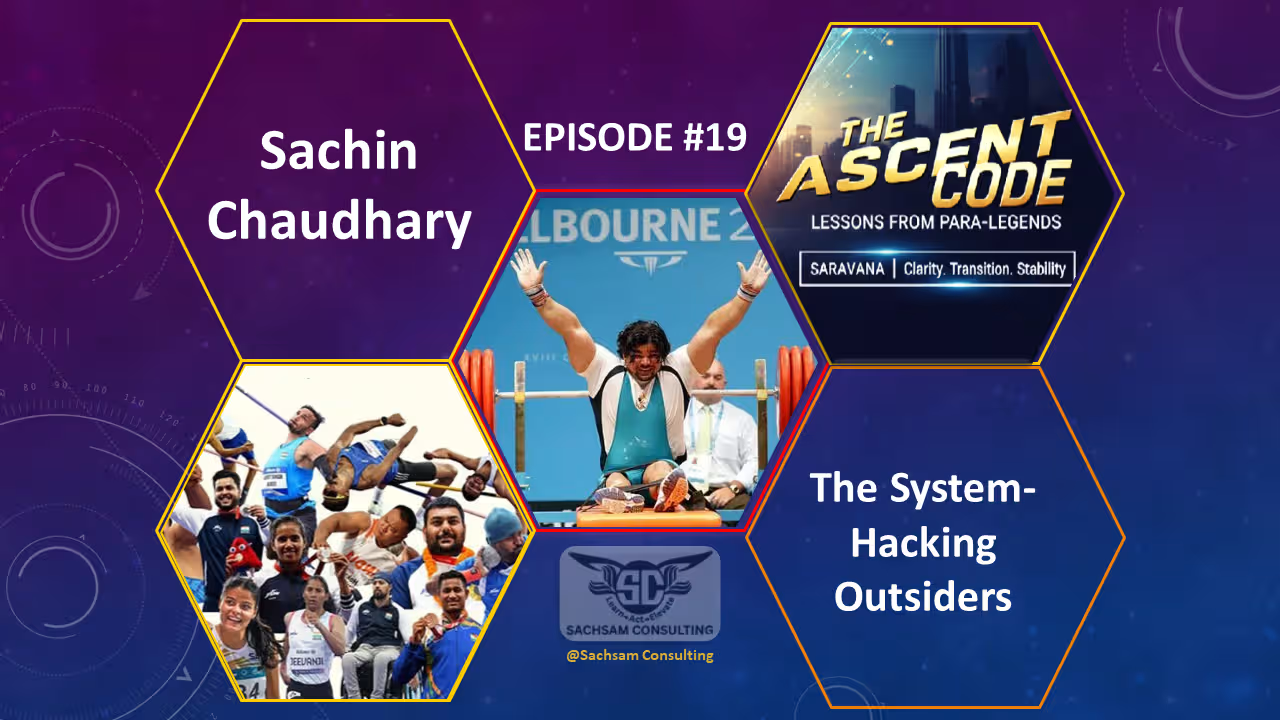
ASCENT CODE: Episode 19
Wrestling Heritage to Powerlifting
Sachin Chaudhary, The System‑Hacking Outsiders. How a wrestler from a North Indian wrestling family carried his ancestors’ strength legacy into para‑powerlifting after a spinal cord injury redefined what his body could do.
EXECUTIVE SUMMARY
Sachin Chaudhary came from a wrestling family in western Uttar Pradesh, where physical strength is not just an athletic asset but an identity, a community standing, a form of respect passing between generations. A severe spinal cord injury made wrestling inaccessible. The sport that had defined his family’s identity was now physically impossible.
He transferred into para‑powerlifting. Not as a substitute. As a continuation. At the 2018 Gold Coast Commonwealth Games, he won Bronze. He represented India at the 2012 London Paralympics. He has been ranked among India’s top para‑powerlifters for over a decade.
⚙️ THE VALUES TRANSFER METRIC: Skill transfer frameworks ask “what skills are portable?” Values transfer asks “what quality of effort does your family’s legacy demand?” That quality — raw physical commitment expressed competitively — transferred from wrestling to powerlifting intact. The arena changed. The standard did not.
THE ASCENT CODE: THE MAVERICK CODE OF VALUES TRANSFER: Cultural values placed on strength in a family can be successfully pivoted into new sporting disciplines after trauma. The legacy is not in the sport. It is in the quality of effort the sport demands. Carry the quality. Change the arena.
THE CRISIS: WHEN THE FAMILY’S SPORT BECOMES IMPOSSIBLE
Sachin Chaudhary came from a wrestling family in western Uttar Pradesh, where the sport is not recreation but inheritance. The particular smell of an akhara — mustard oil and turned earth — the sound of bodies meeting in competitive grip: these were the sensory coordinates of a childhood that understood physical strength as a form of cultural identity, not merely athletic ambition.
A severe spinal cord injury changed the physical equation entirely. Wrestling requires the whole body in dynamic, unpredictable movement. The spinal cord injury removed the capacity for that movement. The sport that had defined his family’s identity across generations was now physically inaccessible. This was not simply an athletic setback. It was a cultural rupture: the loss of the arena in which his family’s strength was expressed and respected.
At the 2018 Gold Coast Commonwealth Games, Sachin Chaudhary won Bronze in para‑powerlifting. He had already represented India at the 2012 London Paralympics. The strength that his family had invested in wrestling had found a new arena. The cultural legacy was intact. The sport had changed. The quality of effort that the sport demanded had not.
THE ORIGIN: THE FAMILY LEGACY AS NAVIGATION TOOL
The shadow phase after the spinal cord injury was prolonged and specific. Sachin had to navigate not just physical rehabilitation but a profound identity question: who was he in his community if he could no longer express the strength that his family stood for? The wrestling family’s standing in western UP is built on competitive capability. He was a wrestler who could no longer wrestle.
The transition to powerlifting resolved that question with precision. Para‑powerlifting in the bench press category demanded the same quality of physical commitment that wrestling had required: explosive raw strength, competitive focus, the willingness to train under conditions of genuine difficulty. The movement was static rather than dynamic, the arena different in every technical detail. But the underlying demand — the one that the family’s wrestling culture had spent generations producing — was structurally identical. Sachin was not starting over. He was redirecting.
This is the Maverick Code origin specific to Sachin: the family legacy was not a burden that the injury had made irrelevant. It was the navigational tool that pointed from wrestling to powerlifting. Where some athletes had to discover what they were building toward, he already knew what quality of effort was required. The family had already defined that for him.
THE GRIND: A DECADE OF HEAVYWEIGHT CONSISTENCY
The transition from wrestling to powerlifting was a major mental and physical challenge. Dynamic movement to static explosive strength requires a different relationship with the body: no footwork, no reactive defence, just the ability to generate maximum force in a single controlled direction. The training had to rebuild the competitive psychology alongside the physical mechanics.
- Competing at national and international para‑powerlifting level, establishing himself as a benchmark heavyweight lifter and building the competitive consistency that a decade at the top requires.
- Representing India at the 2012 London Paralympics, competing on the global stage and confirming the technique in the highest‑level international competition.
- Winning Bronze at the 2018 Gold Coast Commonwealth Games, validating the strength legacy transfer and establishing a result that the broader Indian sports community recognised.
Verified Achievements
• 2018 Commonwealth Games (Gold Coast): Bronze Medal, para‑powerlifting
• 2012 London Paralympics: Represented India
• Over a decade ranked among India’s top para‑powerlifters in heavyweight categories
A decade at the top. That is the measure. Not one breakthrough result, but sustained competitive presence across ten years of evolving competition. The family’s standard, maintained in a new arena.
THE ASCENT CODE: THE MAVERICK CODE
Here is what most career transition frameworks miss: they focus on skills as the unit of transfer. What skill did you have in your previous role that is relevant here? That is a useful question. But it misses the deeper layer. Sachin’s story is about values as the unit of transfer. Specifically, the value his family culture placed on physical strength as an expression of identity and community standing.
That value did not belong to wrestling. It preceded wrestling. The sport was simply the arena where the value found its most recent expression. When wrestling became inaccessible, the value remained intact. Para‑powerlifting offered a new arena for the same value. The cultural continuity was preserved even as the sport changed completely.
I see this pattern often in professionals who lose their role and feel they have lost their identity. The role was the arena. The value that the role expressed is still present. Identify what you were actually expressing through your work: the drive for mastery, the service orientation, the competitive precision — whatever it is at the values level. That is what needs a new arena. The skill is secondary. Find the arena that honours the value, and the skills will redevelop around it.
THE HOW-TO FRAMEWORK: THE MAVERICK CODE IN 4 STEPS
- Identify the Value Beneath the Skill
Do not start with “what skills transfer?” Start with “what value was I expressing through this work?” Sachin was expressing the family’s cultural commitment to physical strength as identity. That value transferred. The skill of wrestling did not. Go one level deeper than the skill audit. The values audit is what produces durable career pivots. - Find the Arena That Honours the Value
Once the value is identified, the search for a new arena becomes precise. You are not looking for a role similar to the old one. You are looking for a role that demands the same quality of commitment the old role required. Para‑powerlifting honoured the wrestling family’s value of raw physical effort expressed competitively. Your equivalent arena may look completely different on the surface. Look at what it demands in depth. - Accept the Technical Rebuild
The transition from wrestling to powerlifting required significant technical relearning: new movement patterns, new training protocols, a new relationship with competitive performance. The value transferred. The technique did not. Accept the technical rebuild as a necessary and finite phase. You are not starting from scratch. You are rebuilding the delivery mechanism for a value that is already fully formed. - Use the Legacy as Standard, Not as Pressure
Sachin carried the wrestling family’s expectation into powerlifting as a standard of effort, not as a pressure to match a specific result. The legacy tells you what quality of commitment the new arena demands. It does not tell you what outcome to achieve. Use the inherited standard as a floor for your effort. Let the new arena determine the ceiling for your results.
THE REFRAME: THE STRENGTH WAS NEVER IN THE SPORT
Return to that UP akhara. The smell of mustard oil and turned earth. A wrestling family whose community standing was built on physical strength expressed in competition.
The spinal cord injury removed the sport. It could not remove the value. The strength that the akhara had been producing for generations was not located in wrestling. It was located in the family’s cultural commitment to a specific quality of physical effort. When wrestling became impossible, that commitment needed a new expression. Para‑powerlifting provided it. The arena changed. The commitment did not.
Most professionals after significant career disruption believe they have lost their identity. They have lost their arena. Those are not the same thing. Your identity is in the value you have been expressing through your work. Find the arena that demands that value and you will find your competitive self again, intact. As of 2026, Sachin Chaudhary is an active athlete and coach in western Uttar Pradesh, training the next generation in both powerlifting and wrestling, and carrying the family legacy forward in two arenas simultaneously.
SELF AUDIT
- • What value were you expressing through your most important professional role? Not the skill, not the function. The underlying value: mastery, service, competitive precision, creative expression? Name it at that level.
- • If your current arena became inaccessible tomorrow, which other arena demands that same value at the same depth? Have you identified it? Are you building toward it in advance, or waiting until the disruption arrives?
- • Is there a family or cultural legacy of effort in your background that you have not consciously claimed as a professional standard? What would it mean to carry it forward deliberately into your current work?
👇 Drop your answer in the comments. The #AscentYouTribe learns together.
THE SCIENCE OF VALUES‑BASED IDENTITY CONTINUITY
Occupational psychology research on identity continuity after career disruption distinguishes between role identity and values identity. Role identity — the “I am a wrestler” framing — is brittle: when the role ends, the identity fractures. Values identity — “I am someone who commits to physical excellence in competition” — is durable: it transfers across arenas because the value is independent of the specific domain.
Sachin’s successful transition reflects this distinction directly. The family culture had built a values identity around physical strength as a form of community expression. When the role of wrestler was removed by injury, the values identity remained intact and transferred to powerlifting. Research on career resilience confirms that individuals whose professional identity is grounded in values rather than roles demonstrate significantly faster and more complete recoveries from career disruption. The Maverick Code works here because it operates at the values level, not the skills level. Skills are replaceable. Values are the foundation the next skill set is built on.
Next on The Ascent: Episode 20: Krishna Nagar, The Gen‑Z Speed‑Runners.
SARAVANA KUMAR
Clarity | Transition | Inner Stability
The question Sachin’s story leaves me with this week: what are you carrying from your family or culture that you have not yet named as a professional standard? I ask this question often in coaching, and the answers are consistently more specific and more powerful than the professional tells themselves. A father who never missed a day’s work. A grandmother who built something with nothing. A community that valued a specific quality of effort. These are not soft inspiration. They are transferable standards. Name yours. Carry it into your current arena.
#SaravanaSays
Your Growth Journey Starts Here
All the ways to connect, learn, and grow with the Tribe — in one place. Choose your favourite platform and stay plugged into daily momentum.
KEYWORDS: Ascent Code Sachin Chaudhary, Maverick Code, System‑Hacking Outsiders, CWG Bronze 2018 powerlifting, London 2012 Paralympics powerlifting, wrestling family UP athlete, spinal cord injury sport pivot, legacy adaptation career, values identity continuity, akhara wrestling culture, heavyweight para‑powerlifting India.
HASHTAGS: #AscentCode #AscentYouTribe #SaravanaSays #SaravanaKumar #MaverickCode #Clarity #Transition #InnerStability #HighPerformance #MindsetEngineering #ResilienceEngineered #SuccessSystems #LegacyAdaptation #LeadershipPrinciples #CareerPivot #SelfOptimization #SachinChaudhary #ParalympicsIndia #ParaPowerlifting #CWG2018 #IndianAthletes #NorthIndiaStrength #MaverickSpirit


Comments
2[…] The Ascent Code Introduction […]
https://variabletribe.com/the-ascent-code-introduction/
[…] Read → […]