

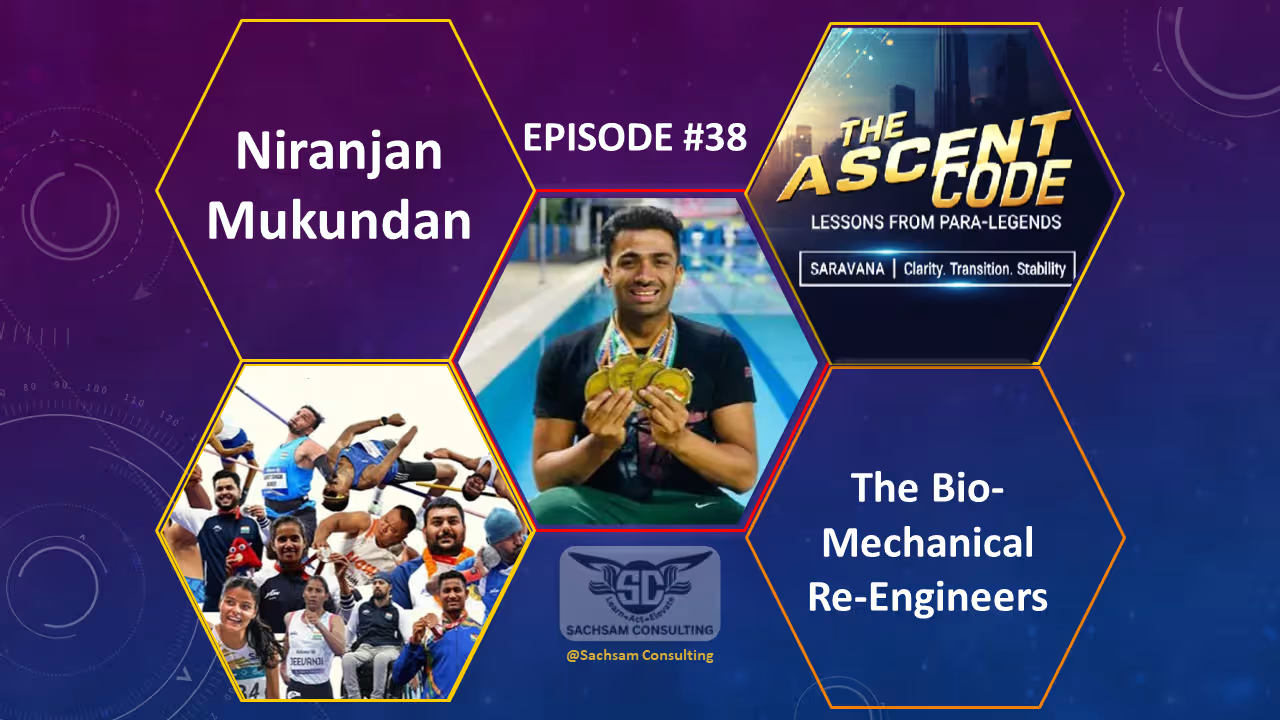
ASCENT CODE: Episode 38
The Water That Healed and Competed
Niranjan Mukundan, The Bio‑Mechanical Re‑Engineers. Born with Spina Bifida. Fifteen‑plus surgeries. Started swimming as hydrotherapy in Bangalore. Won 10 medals at a single Junior World Championship edition. Accumulated 50‑plus international medals. First Indian para‑swimmer to complete a 5km open water swim in the Arabian Sea.
EXECUTIVE SUMMARY
Niranjan Mukundan was born with Spina Bifida in Bangalore. More than fifteen surgeries is not a statistic that belongs in a sport profile. It belongs in a medical record. The pool was prescribed as hydrotherapy — not as sport, not as competition, but as a management tool for the physical effects of Spina Bifida. Water’s buoyancy reduces the mechanical load on a spine that the condition has compromised, and the resistance training that swimming provides builds the supporting musculature that manages the condition’s long-term effects.
Ten medals at a single edition of the Junior World Championships in 2015. More than fifty international medals across his career. The first Indian para‑swimmer to complete a 5km open water swim in the Arabian Sea. The pool that was prescribed for healing became the arena for something far larger than anyone who wrote the hydrotherapy prescription had anticipated.
⚙️ THE CLOSED‑LOOP TRAINING METRIC: When the rehabilitation medium and the competitive medium are the same, the recovery and the development compound simultaneously. The therapy was the training. Every session that managed Spina Bifida’s physical effects was also building the cardiovascular base and competitive endurance that fifty-plus international medals required.
THE ASCENT CODE: THE RE‑ENGINEER CODE OF THERAPEUTIC TRAINING: When the rehabilitation medium and the competitive medium are the same, the recovery and the development track run simultaneously and compound each other. Find the domain where healing and competing are the same activity. Then enter it fully.
THE CRISIS: SPINA BIFIDA, FIFTEEN SURGERIES, AND THE POOL
Niranjan Mukundan was born with Spina Bifida in Bangalore. Spina Bifida is a neural tube defect affecting the spinal cord’s formation, producing a range of mobility and physical management challenges that require ongoing medical intervention throughout life. More than fifteen surgeries is not a statistic that belongs in a sport profile. It belongs in a medical record. The particular antiseptic smell of surgical preparation rooms revisited across a childhood, the specific weight of a post‑operative recovery that requires stillness when the body wants to move: these are the sensory coordinates of a childhood that learned, before any coach arrived, that the body is a system to be managed rather than a given.
The pool was prescribed as hydrotherapy. Not as sport. Not as competition. As a management tool for the physical effects of Spina Bifida: water’s buoyancy reduces the mechanical load on a spine that the condition has compromised, and the resistance training that swimming provides builds the supporting musculature that manages the condition’s long‑term effects. The prescription was clinical and correct. What it could not anticipate was that the prescribed medium contained a world‑class competitive athlete waiting to emerge.
Ten medals at a single Junior World Championship edition in 2015. More than fifty international medals across a career. The first Indian para‑swimmer to complete a 5km open water swim in the Arabian Sea. The pool that was prescribed for healing became the arena for something far larger than anyone who wrote the hydrotherapy prescription had anticipated.
THE ORIGIN: THE THERAPY THAT BECAME THE COMPETITION
The shadow phase in Niranjan’s story is the period before the competitive scale of his capability was apparent: hydrotherapy sessions producing physical management benefits without yet revealing the world‑class competitive swimmer the medium was developing. The transition from therapeutic to competitive swimmer was a gradual revelation: each coached development and competitive entry produced evidence of a capability the clinical prescription had not been designed to discover.
The Bangalore swimming environment provided access to coaching that could translate therapeutic swimming volume into competitive technique. The turning point was the 2015 Junior World Championships. Ten medals at a single edition of that competition is a result that removes all ambiguity: this was not a swimmer who happened to also have Spina Bifida competing in a modified category. This was one of the best junior para‑swimmers in the world, who happened to have started in the pool because a doctor had prescribed it.
THE GRIND: FIFTY‑PLUS MEDALS AND AN OPEN OCEAN
Accumulating more than fifty international medals requires competing consistently across multiple events and championships while maintaining technical standards through Spina Bifida’s ongoing medical demands.
- Building competitive para‑swimming technique across multiple events, developing the range of specialisation that ten medals at a single championship requires.
- Competing consistently at international level across more than fifty medals, maintaining world‑class standards while managing the ongoing physical demands of Spina Bifida.
- Completing a 5km open water swim in the Arabian Sea, the first Indian para‑swimmer to achieve it, extending the competitive boundary beyond pool events into open water endurance.
Verified Achievements
• 2015 Junior World Championships: 10 medals in a single edition
• 50‑plus international medals across competitive career
• First Indian para‑swimmer to complete a 5km open water swim in the Arabian Sea
Ten in one edition. Fifty‑plus across a career. An open ocean. The prescription said hydrotherapy.
THE ASCENT CODE: THE RE‑ENGINEER CODE OF THERAPEUTIC TRAINING
Here is the assumption most professional development frameworks treat as a binary: recovery and development are separate tracks. You recover first, then you develop. The rehabilitation phase precedes the high‑performance phase. They occupy different timeframes and different resource budgets. Niranjan Mukundan’s career dismantles that binary completely.
When the rehabilitation medium and the competitive medium are the same, the two tracks run simultaneously and compound each other. Every session that managed Spina Bifida’s physical effects through water resistance was also building the cardiovascular base, the stroke mechanics, and the competitive endurance that fifty‑plus international medals required. The therapy was the training. There was no switch between rehabilitation mode and development mode. It was always both at once.
Patterns like this are not limited to sport. I often see them in professionals whose prescribed recovery activities overlap with professional development domains. The closed loop compounds both tracks. What if the recovery medium and the career medium could be the same? What professional domains reward the capabilities that your management of your condition has built? Niranjan’s fifty‑plus medals are the output of a life where that question had a perfect answer.
THE HOW-TO FRAMEWORK: THE RE‑ENGINEER CODE IN 4 STEPS
- Find the Domain Where Therapy and Competition Are the Same
The pool was both his rehabilitation and his arena. Identify the domains where managing your constraint and performing at your best require the same activities. That domain is where output volume is naturally sustainable. - Let the Clinical Prescription Lead to the Competitive Discovery
Niranjan entered the pool on medical advice. The competitive revelation followed from the therapeutic immersion. Enter your prescribed domain fully. The competitive capability is discovered in the depth of the therapeutic engagement. - Build Range Before Depth
Ten medals at a single Junior Worlds required range across multiple events. Niranjan built competitive capability across the event range that the medium offered before deepening specialisation. When you enter a new domain through a therapeutic pathway, explore its full competitive range before narrowing to a single specialisation. - Extend the Boundary Beyond the Pool
The 5km Arabian Sea swim was not in the original prescription. It was a self‑directed extension of the competitive boundary the pool had established. After reaching world‑class within the standard competitive framework, identify what lies beyond it and compete there too.
THE REFRAME: THE PRESCRIPTION WAS THE PERFORMANCE PLAN
Return to the earliest Bangalore pool sessions. A child prescribed hydrotherapy for Spina Bifida. The clinical instructions: water resistance, buoyancy support, musculature development. The prescription was correct in every detail for managing the condition. It was also, without anyone knowing it, the performance plan for a world‑class competitive swimming career.
The doctor who prescribed hydrotherapy wrote the first training programme. Every subsequent session built on that prescription, compounding therapeutic benefit and competitive development simultaneously. When Niranjan stood at the Arabian Sea for the 5km open water swim, every part of the preparation had also been managing Spina Bifida’s demands. The condition required the development that the career expressed.
As of 2026, Niranjan Mukundan is an active motivational speaker. The thing prescribed to manage limitation became the source of world‑class excellence. The prescription was not a constraint on the career. It was the career.
SELF AUDIT
- What has been prescribed or recommended for you as a recovery, management, or coping activity in your life? Is there a professional domain where that prescribed medium also builds competitive capability?
- Are you treating your recovery process and your career development as separate tracks? What would it look like to identify a domain where they compound rather than compete?
- What is your Arabian Sea: the competitive extension beyond the standard boundaries of your domain that your therapeutic development has made possible?
👇 Drop your answer in the comments. The #AscentYouTribe learns together.
THE SCIENCE OF THERAPEUTIC EXERCISE AND COMPETITIVE DEVELOPMENT
Exercise physiology and sports medicine research on therapeutic swimming in populations with spinal conditions documents that the training volumes and intensities required for effective symptom management overlap substantially with the training profiles of competitive swimmers at national and international level. The mechanism is structural: water resistance training for Spina Bifida management requires the same cardiovascular and muscular development that competitive swimming demands, meaning high therapeutic dosage produces high competitive training volume as a direct byproduct.
Niranjan’s competitive development reflects this overlap precisely. Medically prescribed hydrotherapy built a physiological foundation equivalent to years of deliberate competitive preparation. When coached technique arrived, it was applied to a base that therapeutic necessity had already constructed. Fifty-plus medals are the output of a training volume medical management made both necessary and sustainable.
Next on The Ascent: Episode 39: Yogesh Kathuniya, The System‑Hacking Outsiders.
SARAVANA KUMAR
Clarity | Transition | Inner Stability
The question from Niranjan’s story that I bring into my coaching practice is the closed‑loop question. Where in your professional development are the recovery activity and the performance activity the same thing? Recovery is what you do so you can go back to performing. Find the domain where these compound rather than alternate. That is where sustained output without burnout becomes possible.
#SaravanaSays
Your Growth Journey Starts Here
All the ways to connect, learn, and grow with the Tribe — in one place. Choose your favourite platform and stay plugged into daily momentum.
KEYWORDS: Ascent Code, Niranjan Mukundan, Re‑Engineer Code, Therapeutic Training, Bio‑Mechanical Re‑Engineers, Junior World Championship, 50 international medals, para‑swimming, hydrotherapy competitive swimming, Bangalore para‑swimmer, Arabian Sea open water para‑swim, first Indian open water para‑swimmer, therapeutic development sport, 15 surgeries athlete, closed loop recovery performance.
HASHTAGS: #AscentCode #AscentYouTribe #SaravanaSays #SaravanaKumar #ReEngineerCode #TherapeuticTraining #Clarity #Transition #InnerStability #NiranjanMukundan #ParalympicsIndia #ParaSwimming #50InternationalMedals #OpenWaterSwim #TherapyToGold


Comments
2[…] Read → […]
[…] Episode 38: Niranjan Mukundan, The Bio‑Mechanical Re‑Engineers […]