

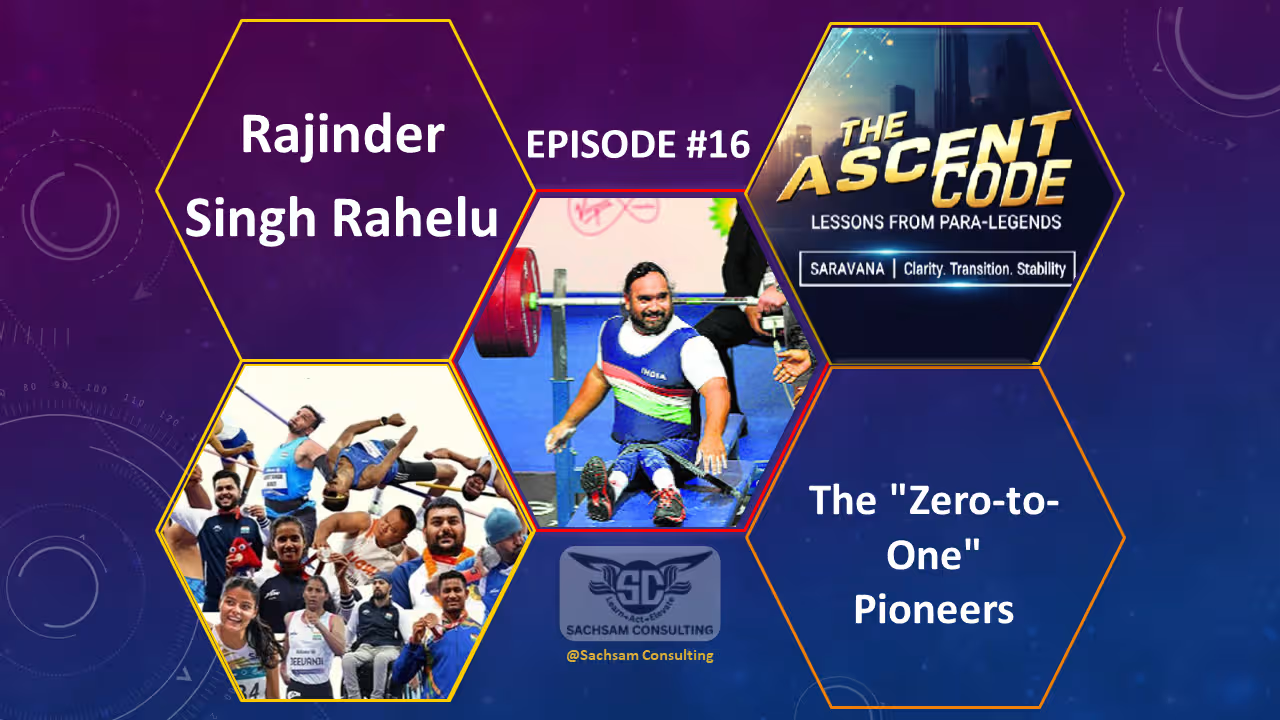
ASCENT CODE: Episode 16
The Powerlifting Blueprint
Rajinder Singh Rahelu, The Zero‑to‑One Pioneers. Paralysed by polio in rural Jalandhar, carried to school by his brothers, no wheelchair, no system. He won India’s first‑ever Paralympic powerlifting medal at Athens 2004.
EXECUTIVE SUMMARY
Rajinder Singh Rahelu contracted polio at eight months old. Both legs paralysed. In rural Jalandhar in the 1970s, there was no wheelchair. No rehabilitation programme. No para‑sports pathway. His brothers carried him to school. That detail is not metaphorical. It is literal.
In 1996, a powerlifting friend encouraged him to start lifting. He discovered a natural mechanical advantage in the bench press. At Athens 2004, he won Bronze: India’s first‑ever Paralympic medal in powerlifting. He opened a category that had not existed in Indian Paralympic history.
⚙️ THE PARALYSIS‑TO‑POWER METRIC: Polio concentrated developmental investment into his upper body. With no lower body competing for neural and muscular resources, his bench press mechanics developed at levels able‑bodied lifters never achieve. The constraint produced the physical profile the sport rewarded.
THE ASCENT CODE: THE PIONEER CODE OF STRENGTH FROM SCARCITY: Physical power is a form of self‑assertion against the constraints of poverty and disability. When the system offers nothing, the body itself becomes the only available tool. Build it. The record follows.
THE CRISIS: CARRIED TO SCHOOL BY YOUR BROTHERS
Rajinder Singh Rahelu contracted polio at eight months old. Both legs paralysed. In rural Jalandhar in the 1970s, a disabled child in a poor household was not a candidate for institutional support. There was no wheelchair. No rehabilitation programme. No para‑sports pathway. The family could not afford the first of those, and the other two did not exist in any meaningful form.
His brothers carried him to school. That detail sits differently from every other image in this series. It is not metaphorical. It is literal. The weight of a child’s body, the grip of an older brother’s hands, the particular smell of Punjabi winter mornings, the dust of the path to school: these are the sensory coordinates of an early life that required a family to physically carry one of its members toward the possibility of education. That act of being carried was also an act of refusing the alternative, which was not going at all.
At Athens 2004, Rajinder Singh Rahelu won Bronze: India’s first‑ever Paralympic medal in powerlifting. Built from Jalandhar, with no wheelchair, no gym, and a body that two legs had stopped serving at eight months old.
THE ORIGIN: THE FRIEND, THE BENCH PRESS, AND THE DECISION
The shadow phase spans decades of structural invisibility. A disabled man from a poor rural family in India had no institutional pathway into elite sport. Para‑powerlifting did not exist as a recognised competitive category in his environment. He existed in the gap between what the system offered, which was nothing, and what he was capable of, which would eventually be a Paralympic medal.
The turning point was a friend, not a system. In 1996, a powerlifting friend encouraged him to start lifting for strength. Rajinder discovered something immediate: a natural mechanical advantage in the bench press. Upper body strength, unimpaired by the polio that had taken his legs, generating power that surprised those who watched it. He made a decision: pursue it competitively. Not as rehabilitation. As assertion.
THE GRIND: BUILDING STRENGTH FROM NOTHING
Training in rural Punjab without specialised gym access or transport infrastructure meant improvising every element of a programme that elite powerlifters take for granted. No periodisation coach. No nutritional support. No biomechanics analysis. The physical preparation was built on grit, consistency, and the natural upper body capacity that polio had, in a specific mechanical sense, concentrated by removing the lower body from the developmental equation entirely.
- Developing bench press mechanics and raw lifting strength through years of competition at national para‑powerlifting level, building competitive experience without the infrastructure that international competitors possessed.
- Qualifying for international competition and representing India at the highest level of para‑powerlifting, where competitors from better‑resourced nations had access to coaching, equipment, and preparation systems he did not.
- Reaching Athens 2004 as the benchmark Indian lifter in his category, carrying the weight not just of the bar but of a complete absence of national precedent in the sport.
Verified Achievements
• Athens 2004 Paralympics: Bronze Medal, Powerlifting (India’s first‑ever Paralympic medal in the sport)
First. Not the best in a long line. The first. He opened a category that had not existed in Indian Paralympic history.
THE ASCENT CODE: THE PIONEER CODE
Here is what most people overlook in stories of extreme adversity: the strength that emerges from poverty is not simply motivational. It is often structural. Rajinder’s polio concentrated developmental investment into the upper body. With no lower body competing for neural and muscular adaptation, the resources his body allocated to training went entirely into bench press mechanics. The constraint produced the physical profile the sport rewarded.
The Pioneer Code is not about suffering producing character. The structural reading is more precise: specific constraints produce specific physical architectures that controlled development environments cannot replicate. His competitors had more resources. He had total concentration of developmental investment in the one capability that mattered.
I see this pattern often in professionals who describe their early deprivation as something to overcome. I ask: what specific capability did that deprivation concentrate your development toward? Rajinder was not allowed the luxury of distributing effort across comfortable options. All his force went into one direction. That is the Pioneer Code. Find the direction. Put everything into it.
THE HOW-TO FRAMEWORK: THE PIONEER CODE IN 4 STEPS
- Identify What Scarcity Concentrated
Before dismissing your resource‑scarce periods, ask what they forced your development to concentrate toward. Scarcity is not always dilution. Often it is concentration. Rajinder’s constraint produced the physical profile the sport rewarded. Name what yours produced specifically. - Accept a Personal Invitation as a Starting System
A friend’s encouragement in 1996 initiated his competitive career, not a talent programme or government scheme. Institutional pathways are preferable when they exist. When they do not, a personal invitation from someone who sees your capability is sufficient. Do not wait for the system to formalise what someone already sees. - Compete to Assert, Not Just to Win
Rajinder pursued powerlifting as assertion against the constraints that had defined his life. Identify the personal assertion behind your professional ambition. Assertion‑driven performance outlasts result‑driven performance when results are delayed. It kept him competing long enough to reach Athens. - Be the First Entry in a New Record
He did not inherit a tradition. He created one. When you pioneer in a domain, you are not competing against precedent. You are setting it. The Pioneer Code is complete when your output becomes the reference point for those who follow. Rajinder is now coaching the next generation. The record he opened is still growing.
THE REFRAME: BEING CARRIED WAS NOT WEAKNESS
Return to that Jalandhar morning. The smell of Punjabi winter dust on the path to school. An older brother’s hands gripping a younger brother’s body, carrying him forward because the alternative was not going at all.
That image is usually read as hardship. It is also a story of direction. Being carried toward education rather than away from it embedded a specific understanding in Rajinder: that forward motion requires other people, and accepting that is not weakness. He did not reach Athens alone. He was carried there by a family that had been practising that act since his childhood.
Most professionals resist acknowledging who carried them forward. Independence is the preferred narrative. Rajinder’s Pioneer Code includes a different truth: strength from scarcity is built with other people’s hands in it at the beginning. The medal was his. The path was shared. As of 2026, Rajinder Singh Rahelu holds the Arjuna Award and serves as Senior Coach in Punjab, building the next generation on the foundation only he could have laid.
SELF AUDIT
- • What did your most resource‑scarce period concentrate your development toward? Not what it took away, but what it focused. Name the specific capability that emerged because the comfortable options were not available.
- • Who has personally invited or encouraged you toward a capability or arena before any institutional system acknowledged it? Have you acted on that invitation at full intensity, or filed it as interesting and moved on?
- • Who carried you forward at an early stage of your development? Have you named them and acknowledged that the path was shared, or are you still presenting the story as entirely self‑made?
👇 Drop your answer in the comments. The #AscentYouTribe learns together.
THE SCIENCE OF CROSS‑SECTIONAL HYPERTROPHY IN LIMB‑DEFICIENT ATHLETES
Exercise physiology research on athletes with lower limb impairments consistently documents greater upper body cross‑sectional muscle development compared to able‑bodied peers who train equivalent volumes. The mechanism is resource allocation: when lower limb activity is removed from the training equation, the neuromuscular system directs a higher proportion of anabolic and neural adaptation resources toward the functioning upper limbs.
Rajinder’s bench press capacity was not coincidental. His polio had directed the body’s full developmental investment into upper body mechanics for decades. When he began structured lifting in 1996, he was not starting from zero. He was starting from a baseline able‑bodied lifters had never had reason to build. The bar he lifted at Athens was heavy. The body that lifted it had been building for that lift since it was eight months old.
Next on The Ascent: Episode 17: Harvinder Singh, The Mind‑Quiet Precisionists.
SARAVANA KUMAR
Clarity | Transition | Inner Stability
The image of Rajinder’s brothers carrying him to school is the one I keep returning to this week. In thirty years of coaching, I have watched professionals construct an entirely self‑made narrative around careers that were, in truth, carried forward at the beginning by someone else’s belief, effort, or sacrifice. That is not a diminishment. It is the actual architecture of most meaningful careers. The question I ask clients: who carried you? Name them. Build something worthy of that weight.
#SaravanaSays
Your Growth Journey Starts Here
All the ways to connect, learn, and grow with the Tribe — in one place. Choose your favourite platform and stay plugged into daily momentum.
KEYWORDS: Ascent Code Rajinder Singh Rahelu, Pioneer Code, Zero‑to‑One Pioneers, Athens 2004 Paralympics, India first Paralympic powerlifting medal, para‑powerlifting Punjab, polio athlete Jalandhar, strength from scarcity, cross‑sectional hypertrophy, pioneering athlete India, Arjuna Award powerlifting.
HASHTAGS: #AscentCode #AscentYouTribe #SaravanaSays #SaravanaKumar #PioneerCode #Clarity #Transition #InnerStability #HighPerformance #MindsetEngineering #ResilienceEngineered #SuccessSystems #LegacyBuilding #LeadershipPrinciples #StrengthFromScarcity #SelfOptimization #RajinderSinghRahelu #ParalympicsIndia #ParaPowerlifting #Athens2004 #IndianAthletes #PioneerSpirit #ArjunaAward

Comments
1[…] Episode 16: Rajinder Singh Rahelu, The Zero‑to‑One Pioneers […]