

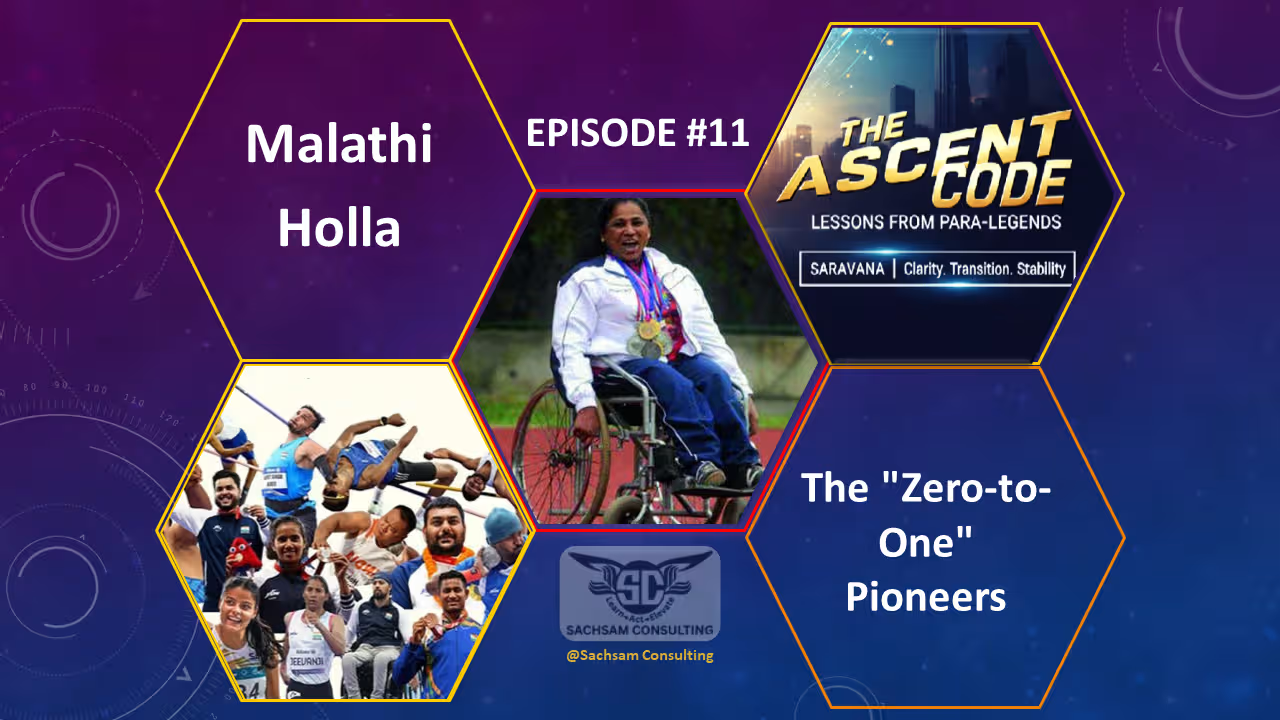
ASCENT CODE: Episode 11
400 Medals, 35 Years, Zero Infrastructure
EXECUTIVE SUMMARY
Malathi Holla was paralysed from the waist down by polio at age one. She underwent more than 30 surgeries in childhood, spent her early years in hospital wards, and grew up in a 1980s India where para-sports infrastructure was effectively zero. No specialist equipment. No training systems. No institutional support.
She competed with heavy non-sport-specific wheelchairs against purpose-built international equipment. She represented India at four Paralympic Games across three decades. She won over 400 medals in a 35-year career. She was the first Indian para-athlete to receive both the Padma Shri and the Arjuna Award.
⚙️ THE 15KG WHEELCHAIR LOGIC: Training with a chair three times heavier than the international standard produced core stability and upper body mechanics that made the world-standard equipment feel like zero gravity when she finally accessed it. The disadvantage was the training load. The metric was the medal.
THE ASCENT CODE: THE PIONEER CODE OF FOUNDATIONAL FORTITUDE: Build yourself in the absence of the system. Build to world-class. Then watch the system catch up to acknowledge what you already created.
THE CRISIS: THIRTY SURGERIES BEFORE SHE EVER SAW A STARTING LINE
Malathi Holla was one year old when polio paralysed her from the waist down. She did not lose mobility in a moment she could remember. She grew into the constraint, one surgery at a time. More than 30 operations across her childhood, each one carrying the sharp antiseptic smell of another hospital ward, the cold press of surgical lights, the particular silence of recovery rooms in government hospitals across Karnataka.
For a child in 1960s India, repeated hospitalisation was repeated social withdrawal. School interrupted. Friendships suspended. Life was organised around recovery schedules, not the other way around. That inversion shaped the architecture of her resilience in ways that would not show until she started competing.
At the 1989 World Masters Games in Denmark, Malathi Holla won two Gold medals. She was already competing at international level with equipment that no specialist would have prescribed, heavy non-sport-specific wheelchairs, against athletes in purpose-built chairs. She won anyway. The 30 surgeries did not produce defeat. They produced someone who knew, at a cellular level, what real adversity costs, and therefore could not be intimidated by competitive pressure.
THE ORIGIN: BUILDING YOURSELF WHEN NO SYSTEM EXISTS
The shadow phase for Malathi was not post-trauma recovery. It was the entirety of her early life. There was no before-and-after moment of loss. The constraint was the baseline. What she had to construct, therefore, was not a return to a previous identity. It was a first identity, built from the beginning, on terms the available world had not designed for her.
Para-sports in India in the 1980s had no infrastructure in any meaningful sense. No national coaching programme, no specialist equipment procurement, no federation actively developing athletes. Malathi competed on whatever wheelchairs she could access, trained on surfaces that were not designed for wheelchair racing, and found competitive environments largely through her own initiative. The turning point was Denmark 1989, two Golds on the world stage, which confirmed what she had been building privately was world-class in absolute terms.
THE GRIND: FOUR PARALYMPICS, 400 MEDALS, 35 YEARS
400 medals is not a number. It is a way of life sustained across 35 years: a competitive frequency that most professional athletes in any sport never approach.
- Competing across multiple disciplines including wheelchair racing, shot put, javelin, and discus; building cross-disciplinary physical capabilities in the same tradition as Joginder Singh Bedi.
- Representing India at four Paralympic Games across three decades, each time with equipment that was inferior to her competitors and without the institutional support that enabled their preparation.
- Becoming the benchmark for an entire generation of Indian para-athletes who came after her, none of whom had to start from as close to zero as she did.
Verified Achievements
• Over 400 medals across a 35-year competitive career
• Four Paralympic Games appearances
• 1989 World Masters Games, Denmark: Two Gold medals
• First Indian para-athlete to receive both the Padma Shri and Arjuna Award
First. Four. Four hundred. Built from a starting point that no coaching manual would consider viable.
THE ASCENT CODE: THE PIONEER CODE
Here is the question Malathi Holla’s career forces every professional to answer honestly: what would you have built if no system existed to support you?
Most high achievers, if they are truthful, built their careers with significant institutional assistance. Good education, specialist training, mentors, organisations that invested in their development. The infrastructure was there. They navigated it well. That is real and worthy. But it is not the Pioneer Code.
I have coached leaders who tell me they cannot develop in their current organisation because the support structures are not right. The feedback culture is poor. The mentorship is absent. The resources are limited. I hear them. And then I think about Malathi Holla, competing in 1980s India with a heavy non-specialist wheelchair against purpose-built international equipment, winning Gold. The absence of the system is not the obstacle. Your relationship with the absence is the obstacle.
The Pioneer Code is not about suffering. It is about refusing to make the system’s absence the explanation for your output. Build what you can build with what you have. Build it to world-class. Then watch the system catch up to acknowledge what you already created.
Patterns like this are not limited to sport. I often see them in professionals navigating difficult career transitions — where the absence of a system forces the same kind of self-built architecture.
THE HOW-TO FRAMEWORK: THE PIONEER CODE IN 4 STEPS
- Stop Auditing the Infrastructure
Malathi competed with what existed. Most professionals map the gaps in organisational support before they start building. Stop. The audit of what is missing is a delay mechanism dressed as due diligence. Start with what you have. The audit can happen later, if it ever becomes useful. - Set Your Standard Against the World, Not Your Context
Her benchmark was absolute: world-class or not. When you operate in resource-constrained environments, the temptation is to calibrate ambition to the constraints. Resist it. Your constraints determine your method. They do not determine your ceiling. - Sustain Output Across Decades, Not Cycles
35 years, not a peak with a long tail. This requires a structural reason for the work that exists independently of external reinforcement. Short-cycle motivation, the excitement of a new project, does not survive 35 years. Find the deeper reason before you need it. - Convert Your Platform into Infrastructure for Others
Malathi now runs the Mathru Foundation, creating the conditions she never had for the next generation. When you reach capability or influence, the Pioneer Code requires you to turn back and build. The system you create for others is the evidence that your foundation was real.
THE REFRAME: THE 30 SURGERIES WERE THE TRAINING
Return to those Karnataka hospital wards. The antiseptic smell. The cold surgical lights. A child who organised her life around recovery schedules before she could organise it around anything else.
Thirty surgeries did not create a damaged person who later overcame the damage. They created a person with a fundamentally different relationship to physical pain, to institutional systems, and to the gap between what is promised and what is delivered. Every recovery ward taught her that the body adapts. Every surgical setback taught her that timelines are not fixed. Every discharge taught her that functional output is possible under conditions most people would classify as not yet ready.
That curriculum is not replicable by choice. But its output is directly observable in 400 medals and four Paralympic Games. The medical history was not despite the career. It was the pre-season for it.
As of 2026, Malathi Holla runs the Mathru Foundation, delivering to disabled children the surgical access and shelter that the system did not deliver to her. The Pioneer Code is complete. She built the path, and now lays it for others.
SELF AUDIT
- • What system are you waiting to be built before you start building seriously? Name it specifically. Then ask: what could you build right now, with what exists today, if that system never arrives?
- • Is your professional standard set against the world benchmark, or against what is reasonable given your constraints? Which one is Malathi Holla’s standard? Which one is yours?
- • What platform have you built that you have not yet converted into infrastructure for others? What would the Mathru Foundation equivalent look like in your domain?
👇 Drop your answer in the comments. The #AscentYouTribe learns together.
THE SCIENCE OF POST-TRAUMATIC GROWTH
Psychology research on post-traumatic growth documents a consistent finding: individuals who experience severe adversity early in life and develop structured responses to it, rather than avoidance patterns, frequently develop superior psychological resilience compared to those with easier developmental histories. The mechanism is direct exposure to high-stakes uncertainty, repeated across enough cycles to build neural pathways that register future adversity as manageable rather than catastrophic.
Malathi’s 30 surgeries created this exposure at scale. Each surgery built the neural response that registers adversity as a phase, not a terminus. Sports psychology research shows athletes with significant pre-sport adversity demonstrate measurably higher competitive resilience under pressure. Her medical history was not a disadvantage she overcame. It was a developmental curriculum her competitors had not completed.
Next on The Ascent: Episode 12: Sheetal Devi, The Mind-Quiet Precisionists.
SARAVANA KUMAR
Clarity | Transition | Inner Stability
Four hundred medals. I have spent time with that number this week. In thirty years of corporate coaching, I have rarely encountered a professional who has made four hundred meaningful competitive attempts in any domain. Most of us stop counting when the attempts stop feeling safe. Malathi never stopped. The system gave her nothing. She gave the system a benchmark it still has not surpassed. If you are waiting for better conditions before you begin, this episode is the answer to that wait.
#SaravanaSays
Your Growth Journey Starts Here
All the ways to connect, learn, and grow with the Tribe — in one place. Choose your favourite platform and stay plugged into daily momentum.
KEYWORDS: Ascent Code Malathi Holla, Pioneer Code, Zero-to-One Pioneers, 400 medals para-athlete, four Paralympics India, Padma Shri Arjuna Award para-athlete, post-traumatic growth, Mathru Foundation, wheelchair racing India, foundational fortitude, Karnataka para-athlete, 1989 World Masters Games, Indian para-sport matriarch, disability sport pioneer, legacy building sport.
HASHTAGS: #AscentCode #AscentYouTribe #SaravanaSays #SaravanaKumar #PioneerCode #Clarity #Transition #InnerStability #HighPerformance #MindsetEngineering #ResilienceEngineered #SuccessSystems #LegacyBuilding #LeadershipPrinciples #FoundationalFortitude #SelfOptimization #MalathiHolla #ParalympicsIndia #ParaAthletics #IndianAthletes #WomenInSport #PioneerSpirit #MathruFoundation




Comments
2[…] Read → […]
[…] Episode 11: Malathi Holla, The Zero‑to‑One Pioneers […]