

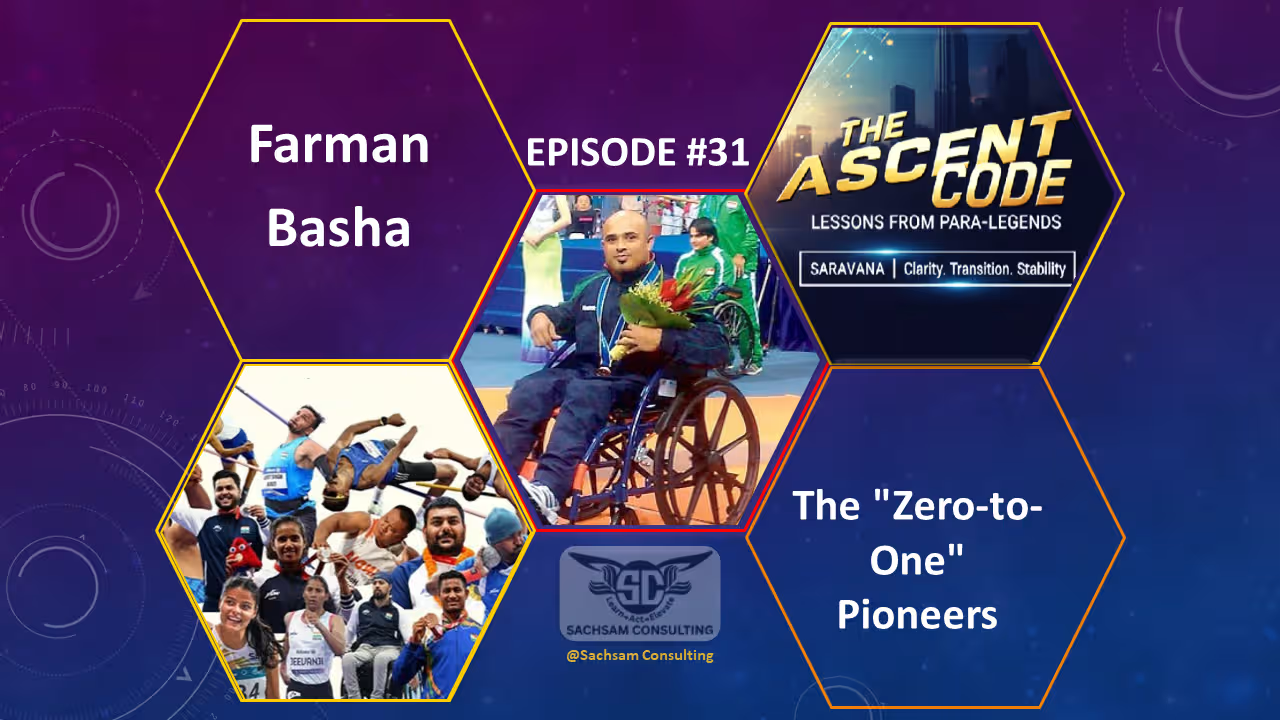
ASCENT CODE: Episode 31
The Godfather of Strength
Farman Basha, The Zero‑to‑One Pioneers. A Bangalore powerlifter who contracted polio in childhood, funded his own international competitions from personal savings for years, competed at four Paralympic Games, and became the founding figure of modern Indian para‑powerlifting.
EXECUTIVE SUMMARY
Farman Basha contracted polio in childhood. Growing up in Bangalore, he was inspired by neighbourhood friends to take up powerlifting, competed at the international level for years by spending his own meagre savings on travel because no corporate or government sponsorship was available, won his first international medal in 2006 which finally brought institutional support, and went on to compete at four Paralympic Games across multiple decades. He is the acknowledged Godfather of modern Indian para‑powerlifting.
Four Paralympic cycles is not a statistic. It is the output of a particular kind of discipline: the ability to maintain elite competitive standards across two decades, through funding crises, without the institutional support that most international athletes rely on as standard, and with the sustained motivation that only a deep personal relationship with the sport produces. No sponsor. No system. Four Games.
⚙️ THE FOUR‑CYCLE METRIC: Four Paralympic appearances spanning two decades. The average elite athletic career peaks within two cycles. Farman sustained performance across four. The metric is not medal count. It is duration at world‑class level.
THE ASCENT CODE: THE PIONEER CODE OF LONG‑FORM RESILIENCE: Long‑form resilience, maintaining elite competitive standards across multiple Games cycles without institutional support, is a different and rarer quality than peak performance. Build not for one cycle. Build for four.
THE CRISIS: POLIO, BANGALORE, AND THE BAR
Farman Basha contracted polio in childhood. Growing up in Bangalore, disability in the context of a working‑class urban community means a specific social negotiation: not the rural invisibility of some earlier episodes, but the particular weight of being seen as limited in a city that measures itself by physical productivity. The antiseptic echo of hospital corridors during the polio recovery years, the specific pressure of being the child in the neighbourhood who moved differently: these are the sensory coordinates of an early life that required an alternative arena for physical self‑assertion.
Neighbourhood friends who lifted gave him that arena. The bench press and the squat rack do not require legs the way running does. Upper body strength, which polio had redirected development toward by removing lower body competition for adaptive resources, was something Farman could build. He built it. And discovered that what he could build was internationally competitive.
Four Paralympic Games. Multiple Asian Para Games medals. The Godfather title given not by a committee but by a community that had watched him carry Indian para‑powerlifting on his back for twenty years before the institutional system caught up with what he had been building.
THE ORIGIN: PERSONAL SAVINGS, INTERNATIONAL COMPETITION
The shadow phase was the long pre‑recognition period: building international‑level performance without institutional infrastructure. No corporate sponsor. No government scheme. He paid for his own international travel, competing at events that would have been inaccessible without self‑funding, building the record that would eventually force institutional notice.
The turning point was the 2006 international medal, which finally brought him to the attention of the sports ministry. That recognition arrived years after the competitive standard had been achieved. The standard preceded the system’s awareness of it by a significant margin. Farman’s career before 2006 is the Pioneer Code’s shadow phase in its clearest form: building world‑class capability in the complete absence of institutional investment, sustained entirely by personal resources and personal motivation.
THE GRIND: FOUR GAMES, TWO DECADES
Competing at four Paralympic Games requires sustaining peak competitive performance across a minimum of twelve to sixteen years, through the natural physical decline of ageing, through the motivational valleys that follow major competition cycles, and through the institutional changes that affect funding, coaching access, and competitive support across that timeline.
- Funding international competition from personal savings in the pre‑recognition years, building the international results record that forced institutional notice without institutional support.
- Winning multiple Asian Para Games medals across his competitive career, establishing himself as the benchmark Indian para‑powerlifter across multiple decades.
- Competing across four Paralympic Games cycles, sustaining the physical conditioning and competitive preparation standards that international powerlifting requires across a twenty‑year career span.
Verified Achievements
• Four Paralympic Games appearances
• Multiple Asian Para Games medals
• Acknowledged as the Godfather of modern Indian para‑powerlifting
Four Games. Two decades. Self‑funded at the start. The system eventually caught up with what Farman had built before it was watching.
THE ASCENT CODE: THE PIONEER CODE OF LONG‑FORM RESILIENCE
Here is the distinction most performance frameworks do not make: peak performance and long‑form resilience are different skills. Peak performance is the ability to produce the best possible output at a single high‑stakes moment. Long‑form resilience is the ability to continue producing competitive output across multiple cycles, through the valleys between peaks, without the external motivation that peak events provide.
Most elite athletic careers are built around the peak. The training cycle builds to the major event. The event produces the result. The recognition follows. Farman’s career was built around something different: the sustained maintenance of competitive standards across twenty years, including the years when no recognition arrived and the personal savings were what made international competition possible.
I see this pattern often in professionals who excel in high‑visibility moments and struggle to maintain standards between them. The Pioneer Code across four Games cycles asks a question single‑peak careers do not: what is your motivational architecture for the years when no one is watching? Farman’s answer was the sport itself, not the medal, not the recognition. That answer sustains twenty years. The others sustain one cycle.
Patterns like this are not limited to sport. I often see them in professionals who build careers slowly, without early recognition, and sustain them across decades when faster‑burning peers have faded. The sustained presence is the credential.
THE HOW-TO FRAMEWORK: THE PIONEER CODE IN 4 STEPS
- Build the Motivational Architecture for the Long Game
Farman’s two‑decade career was not sustained by external recognition, which arrived late and partially. It was sustained by an intrinsic relationship with the sport itself. Identify the intrinsic motivation beneath your professional drive before you need it. The external motivators — recognition, compensation, status — fluctuate across long careers. The intrinsic ones can sustain twenty years. - Self‑Fund the Pre‑Recognition Phase
He spent personal savings on international travel before institutional support existed. Identify what you are willing to invest personally before the system notices. That investment is the evidence of genuine commitment and what produces the record that eventually forces recognition. - Sustain Standards Between Peaks
Four Games cycles means maintaining competitive standards across periods when no peak event is imminent. Identify the minimum standard you will sustain between major performance events and build the practice architecture that maintains it. Valleys define long‑form careers more than peaks. - Become the Foundation Others Build On
The Godfather title is not self‑appointed. It is given by a community that recognised Farman as the person whose sustained presence made their development possible. The Pioneer Code is complete when you become the foundation layer that the next generation builds on. That requires being present consistently enough, for long enough, that your output becomes the reference point others measure themselves against.
THE REFRAME: THE STANDARD PRECEDED THE SYSTEM
Return to those early 2000s Bangalore training sessions. The bar, the weights, the particular smell of iron and chalk in a gym that was not designed for an international para‑powerlifter. Personal savings budgeted for competition travel. No sponsor. No ministry backing. No system watching.
The standard was being built anyway. The international‑level performance was being developed in the complete absence of the infrastructure that international‑level performance is assumed to require. When the 2006 medal finally forced the system’s attention, what the system was acknowledging was not a new development. It was an existing standard that had been operating independently of the system’s awareness for years.
Most organisations believe they develop talent. Often they identify talent that was developing before they found it, and then accelerate what was already in motion. Farman’s career is the record of what was in motion before anyone was looking. As of 2026, he works as a coach and mentor in Bangalore, transferring the long‑form discipline of a four‑Games career to the next generation of Indian para‑powerlifters.
SELF AUDIT
- • What is the intrinsic motivation beneath your professional drive that would sustain your standards for twenty years, independent of whether external recognition arrived? Have you identified it at that depth?
- • What are you currently building that the institutional system has not yet noticed? Are you sustaining that development independently, or waiting for institutional support before committing to the work?
- • What minimum professional standard will you maintain between your major performance events? Is that standard defined explicitly, or does it drift depending on external motivation?
👇 Drop your answer in the comments. The #AscentYouTribe learns together.
THE SCIENCE OF INTRINSIC MOTIVATION AND LONG‑FORM PERFORMANCE
Motivational psychology research distinguishes between extrinsic motivation, driven by external rewards and recognition, and intrinsic motivation, driven by genuine engagement with the activity itself. Research on long‑form athletic careers consistently shows that athletes whose primary motivation is intrinsic demonstrate significantly longer competitive careers, better performance maintenance between peak events, and more effective recovery from setbacks than those whose primary motivation is extrinsic.
Farman’s two‑decade career, sustained through years without institutional support, reflects the intrinsic motivation profile precisely. The sport itself, not the recognition or the sponsorship, was the primary driver. Research further confirms that intrinsically motivated athletes continue training effectively through periods of reduced external reward, because the activity remains its own reward. The Godfather title came from outside. Four Games cycles came from inside.
Next on The Ascent: Episode 32: Rubina Francis, The Mind‑Quiet Precisionists.
SARAVANA KUMAR
Clarity | Transition | Inner Stability
The question I sit with after Farman’s story: how many professionals do I work with who are in the pre‑recognition phase of something they have been building independently, and have stopped because the system has not yet noticed? Farman’s answer to that situation was to keep going, on his own savings, until the medal made it impossible for the system to continue not noticing. In my coaching practice, I call this the 2006 test: what would you need to produce, independently, to make the recognition arrive? Then produce it, whether or not the recognition arrives on schedule.
#SaravanaSays
Your Growth Journey Starts Here
All the ways to connect, learn, and grow with the Tribe — in one place. Choose your favourite platform and stay plugged into daily momentum.
KEYWORDS: Ascent Code, Farman Basha, Pioneer Code, Long‑Form Resilience, Zero‑to‑One Pioneers, four‑time Paralympian powerlifting, self‑funded competition, Bangalore para‑powerlifter, long‑form resilience sport, Asian Para Games medals, polio powerlifting India, intrinsic motivation sport, pre‑recognition career building, para‑powerlifting pioneer India, twenty‑year athletic career.
HASHTAGS: #AscentCode #AscentYouTribe #SaravanaSays #SaravanaKumar #PioneerCodeOfLongFormResilience #Clarity #Transition #InnerStability #FarmanBasha #ParalympicsIndia #ParaPowerlifting #GodfatherOfStrength #FourTimeParalympian #LongFormResilience



Comments
3Introduction Post & Hub Page
[…] Read → […]
[…] Episode 31: Farman Basha, The Zero‑to‑One Pioneers […]