

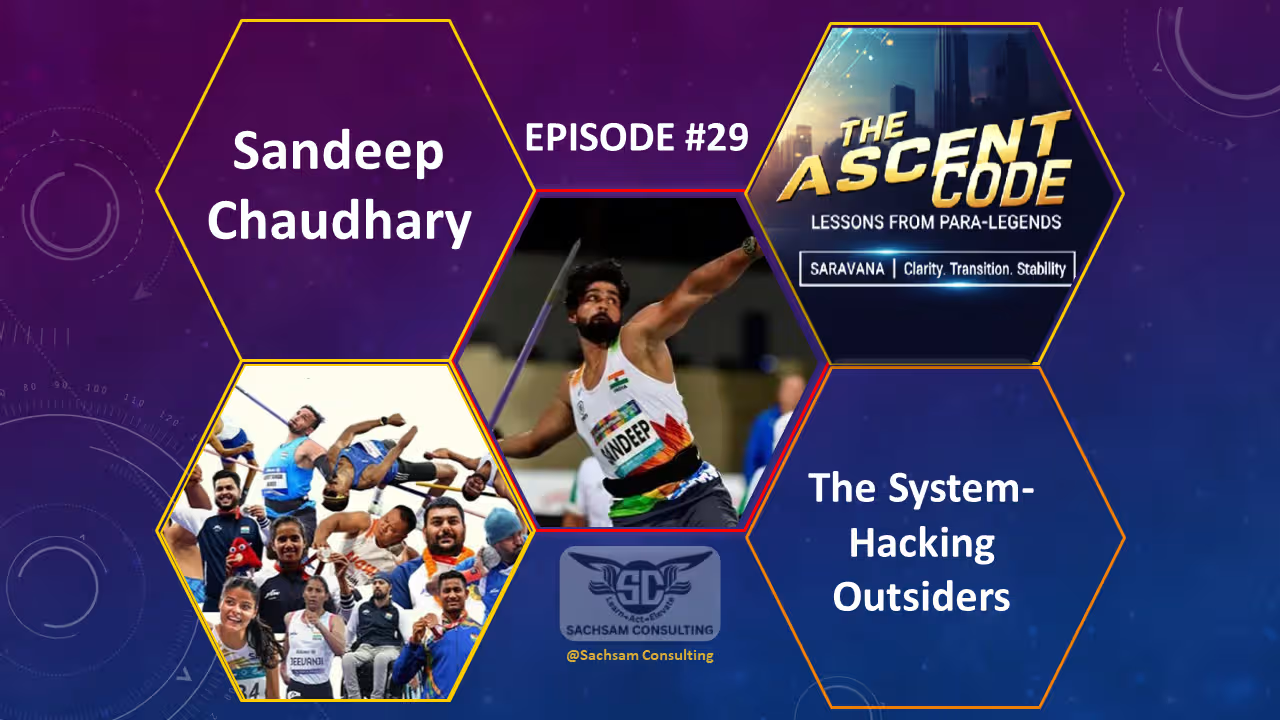
ASCENT CODE: Episode 29
The Rajasthan Record-Breaker
Sandeep Chaudhary, The System‑Hacking Outsiders. A Rajasthan javelin thrower who competed without a specialist coach for years, broke the World Record at the 2018 Asian Para Games, became World Champion, and sustains world‑record level performance through relentless technical evolution.
EXECUTIVE SUMMARY
Sandeep Chaudhary sustained a hip injury in youth that produced a permanent impairment, was passionate about throwing events from school days, competed in the F44 javelin category for years without a specialist coach, broke the World Record at the 2018 Asian Para Games while winning Gold, went on to become World Champion, broke the world record multiple times, and represented India at Tokyo 2020. He remains a top‑tier global F44 competitor and actively mentors young para‑javelin throwers in rural Rajasthan.
The Maverick Code in Sandeep’s story is built on a specific insight: reaching world record level is a different challenge from sustaining it. Most athletes, once they break a world record, are defending a standard. The record becomes the ceiling. Sandeep’s multiple world record breaks indicate something different: a refusal to treat any previous performance as the definition of possible. Each record was not a ceiling to defend. It was a baseline to exceed.
⚙️ THE RECORD‑EVOLUTION METRIC: Each successive record break required identifying what limited the previous throw and developing the technical modification that removed that limitation. The world record is the starting point for the next iteration of development, not the finish line.
THE ASCENT CODE: THE MAVERICK CODE OF SUSTAINED EXCELLENCE: Sustained excellence requires continuous evolution. The world record is not the finish line. It is the starting point for the next iteration of technical development. Settle for previous success and the field catches up. Keep evolving and the record keeps moving.
THE CRISIS: THE HIP INJURY AND THE THROWING ARM
Sandeep Chaudhary sustained a hip injury in youth that produced a permanent impairment. In Rajasthan, where the open landscape and the culture of physical endurance shape how boys engage with sport, a permanent hip impairment does not automatically close the pathway to athletics. It redirects it. The particular heat of Rajasthan summer training grounds, the grip of dry earth under feet at a throwing line: these are the sensory coordinates of an early relationship with the javelin that the injury could redirect but not remove.
He had been drawn to throwing events from school. The hip impairment that limited his mobility in running events made throwing a more natural competitive domain: the explosive release of force from a controlled position, where the hip constraint could be accommodated through technique rather than overcome through physical capacity that was no longer available.
At the 2018 Asian Para Games, Sandeep Chaudhary won Gold and set a World Record in the F44 javelin. He had been competing for years without a specialist coach. The self‑developed technique, refined through competition, had produced a world record. The Rajasthan training ground had been enough.
THE ORIGIN: WITHOUT A COACH, WITH A RECORD
The shadow phase was the long competitive period without specialist coaching. F44 para‑javelin coaching in India was not readily available. He developed technique through competitive feedback alone, using each competition as a technical laboratory.
The turning point was the 2018 Asian Para Games World Record. That result brought institutional recognition and confirmed the self‑developed technique was not just competitive but world‑leading. The question shifted: from “am I competitive?” to “what is the next version of this technique?”
THE GRIND: MULTIPLE WORLD RECORDS, SUSTAINED EVOLUTION
Breaking a world record once is a peak event. Breaking it multiple times is a process. Each successive record break requires identifying what limited the previous throw, developing the technical modification that removes that limitation, and confirming the modification under competitive pressure. That process is more demanding than the initial record because it requires the athlete to voluntarily leave behind a proven performance level for an unproven evolution of it.
- Competing at national and international F44 javelin level without specialist coaching, using competition data to drive technical development and build the competitive experience that world‑record performance requires.
- Breaking the World Record at the 2018 Asian Para Games, establishing himself as the global benchmark in his category and triggering the institutional recognition that followed.
- Competing at Tokyo 2020, continuing to evolve the technique and break the world record multiple times across the competitive career.
Verified Achievements
• 2018 Asian Para Games: Gold Medal with World Record, F44 javelin
• World Champion, F44 para‑javelin
• Multiple World Record breaks in the F44 javelin
World Record. World Champion. Multiple record breaks. Each one built in the absence of the specialist support that his international competitors took as standard.
THE ASCENT CODE: THE MAVERICK CODE OF SUSTAINED EXCELLENCE
Here is the assumption most athletes make after a world record: that the work is complete. Defend the technique that produced it. That framing is wrong, and every world record broken by someone else demonstrates why.
The world record is a snapshot of the best current technique in the category on the day it was set. It describes what is currently possible. It does not define what is possible. Sandeep’s multiple record breaks indicate that he understands this distinction at a practical level. Each record break is the result of identifying the limitation in the previous best performance and developing the technical modification that exceeds it.
I see this pattern often in professionals who plateau after a significant achievement. The recognition arrived. The urgency faded. I ask: is this the record to defend or the baseline for the next version? Sandeep’s answer, across multiple record breaks, is that no performance is the finish line. Every world record is the new starting point. That mindset sustains excellence over time.
Patterns like this are not limited to sport. I often see them in professionals who reach a career peak and stop evolving. The ones who sustain excellence are those who treat every achievement as a baseline, not a ceiling.
THE HOW-TO FRAMEWORK: THE MAVERICK CODE IN 4 STEPS
- Use Competition as Your Primary Technical Laboratory
Each competition revealed the limitation of the current throw. When specialist coaching is unavailable, competition is the most rigorous feedback system available. Enter it early and often. The data about your current technical ceiling is more accurate than any amount of isolated training. - Treat Each Record as a Baseline, Not a Ceiling
After the 2018 World Record, he evolved the technique rather than defended it. When you reach a significant milestone, the question is not “how do I protect this?” It is “what is the limiting factor in my current performance, and what would removing it produce?” - Identify the Specific Technical Limitation in Each Performance
Multiple records require identifying, for each throw, the specific limiting factor. Not a general impression of what could be better. The precise constraint on the next level. After each significant professional performance, name the specific limiting factor. That naming is the work the result itself does not do. - Voluntarily Leave the Proven Level for the Unproven One
Each evolution required abandoning the technique that had produced a world record for an untested modification. The comfort of the current record always argues against the risk of modification. The record‑breaker overrules that argument every time.
THE REFRAME: THE WORLD RECORD IS THE STARTING POINT
Return to that 2018 Asian Para Games throwing line. The particular heat. The grip of the javelin. The moment after the throw when the distance measurement arrived and the number exceeded the world record.
Most athletes would carry that moment as the definition of their career. Sandeep carried it as the starting point for the next technical question. What was the limiting factor in that throw? What modification would produce a longer flight? Where was the next metre hiding in the mechanics? The world record, in his competitive psychology, was not an achievement to rest on. It was a data point that defined the current technical ceiling and asked what the next ceiling was.
That reframe is available to any professional who has reached a significant achievement and is deciding what it means. Is the achievement the summit, or the base camp for the next ascent? Sandeep’s answer, repeated across multiple world record breaks, is always base camp. As of 2026, he is active, promoting para‑athletics in rural Rajasthan and mentoring young throwers on the technical discipline that multiple world records required.
SELF AUDIT
- • What is the most significant professional achievement in your current role? Are you treating it as the ceiling or as the baseline for the next iteration of your performance? What would the next record look like?
- • What is the specific technical limitation in your current best professional performance? Not a general impression of what could be better. The precise limiting factor that, if removed, would produce the next level of output.
- • Where are you defending a proven performance level rather than voluntarily evolving toward an unproven one? What would it look like to treat your current record as the starting point?
👇 Drop your answer in the comments. The #AscentYouTribe learns together.
THE SCIENCE OF DELIBERATE PRACTICE AND PERFORMANCE CEILINGS
Cognitive science research on deliberate practice distinguishes between naive practice, repeating what already works, and deliberate practice, identifying the specific limiting factor in current performance and targeting it directly. Athletes who engage in naive practice plateau at the level their current technique produces. Athletes who engage in deliberate practice continue developing because they are always working at the edge of current capability rather than within it.
Sandeep’s multiple world record breaks are a direct expression of deliberate practice applied at the highest competitive level. Each successive record required identifying what limited the previous best throw and developing the targeted modification that removed that limit. Sports science research confirms that athletes who maintain deliberate practice discipline after reaching world‑class level improve at a measurably faster rate than those who shift to performance maintenance. The record‑breaking mindset is not motivational. It is methodological.
Next on The Ascent: Episode 30: Preeti Pal, The Gen‑Z Speed‑Runners.
SARAVANA KUMAR
Clarity | Transition | Inner Stability
The question I return to from Sandeep’s story is the one about the moment after the world record. What happens to a professional in the days and weeks after their biggest achievement? Most go into consolidation mode. Sandeep went into analysis mode: what was the limiting factor? I ask this question in coaching engagements after significant client achievements. The ability to ask it honestly, and to act on the answer, is what separates one‑record careers from multiple‑record careers.
#SaravanaSays
Your Growth Journey Starts Here
All the ways to connect, learn, and grow with the Tribe — in one place. Choose your favourite platform and stay plugged into daily momentum.
KEYWORDS: Ascent Code Sandeep Chaudhary, Maverick Code of Sustained Excellence, System‑Hacking Outsiders, Asian Para Games Gold World Record 2018, F44 para‑javelin World Champion, multiple world records javelin, deliberate practice, sustained excellence.
HASHTAGS: #AscentCode #AscentYouTribe #SaravanaSays #SaravanaKumar #MaverickCodeOfSustainedExcellence #Clarity #Transition #InnerStability #SandeepChaudhary #ParalympicsIndia #ParaJavelin #WorldRecord #WorldChampion #SustainedExcellence




Comments
1[…] Read → […]