

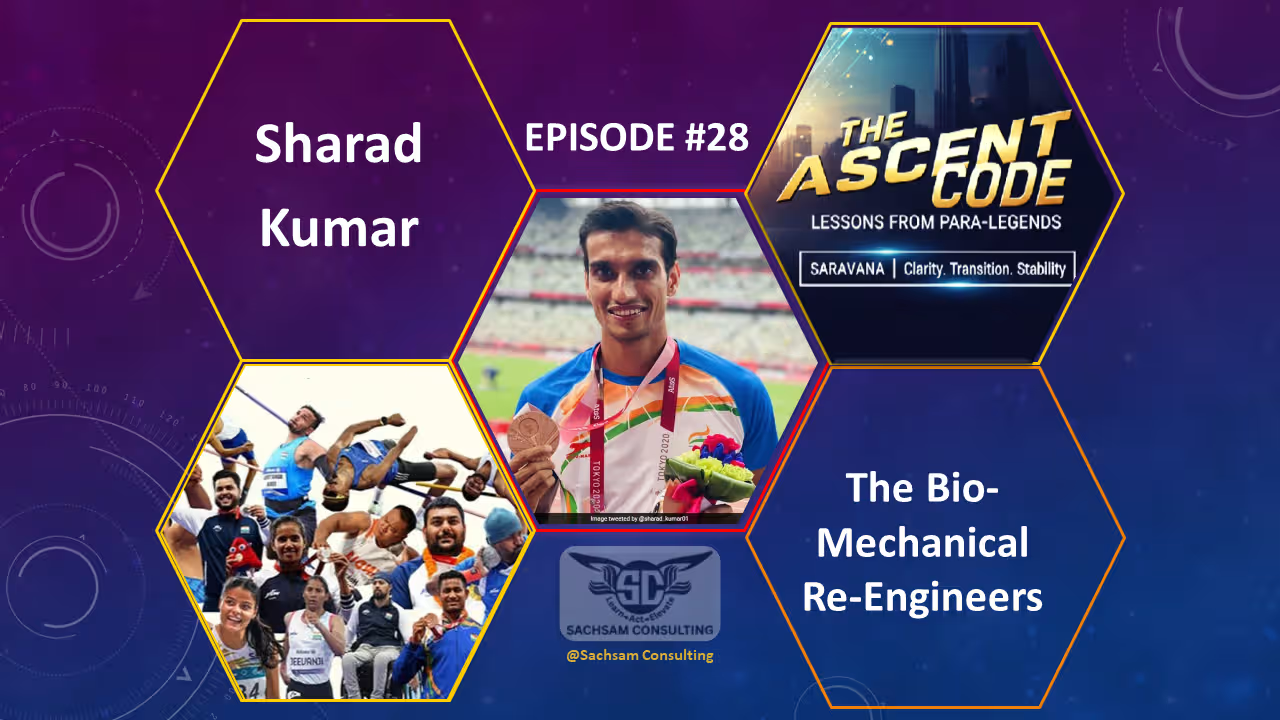
ASCENT CODE: Episode 28
The Analytical High Jumper
Sharad Kumar, The Bio‑Mechanical Re‑Engineers. Paralysed by spurious polio drops at age two, he balanced postgraduate study in International Relations with overseas training in Ukraine, won the 2014 Asian Para Games Gold, and delivered back‑to‑back Paralympic Silver medals at Tokyo 2020 and Paris 2024.
EXECUTIVE SUMMARY
Sharad Kumar was two years old when spurious polio drops administered during a government immunisation drive paralysed his left leg. In a Bihar household where academic achievement was the primary framework, paralysis was processed as a changed set of parameters within which possibility still existed. He focused on education and athletics simultaneously.
He won Gold at the 2014 Asian Para Games. At Tokyo 2020, he won Silver despite a last-minute injury. At Paris 2024, he won Silver again. Back‑to‑back Paralympic medals across two full competitive cycles, delivered when most athletes in physically demanding events have begun declining from their peak.
⚙️ THE COGNITIVE MODEL METRIC: When physical feel degrades under pressure or injury, the explicit cognitive model of correct execution remains available. Sharad built his model in training. It was available when injury compromised his physical preparation.
THE ASCENT CODE: THE RE‑ENGINEER CODE OF ANALYTICAL SPORT: Viewing sport through an analytical lens builds performance consistency that physical training alone cannot sustain across multiple competitive cycles. The athlete who understands the biomechanical model does not rely on feel. Feel is not available under maximum pressure. The model is.
THE CRISIS: SPURIOUS DROPS AND A PARALYSED LEG
Sharad Kumar was two years old when spurious polio drops administered during a government immunisation drive paralysed his left leg. In a Bihar household where academic achievement was the primary framework for a child’s future, paralysis in infancy was processed not as the end of possibility but as a changed set of parameters within which possibility still existed. The specific antiseptic quality of early childhood medical appointments, the institutional weight of a condition acquired through the very system designed to prevent it: these coordinates shaped a person who developed a particular relationship with institutional frameworks and their failure modes.
He focused on education and athletics simultaneously. The academic culture of his Bihar family gave him the analytical tools that would make him a more technically sophisticated high jumper than peers who had trained longer. The athletics gave him the competitive ambition the academic track alone could not sustain.
At Tokyo 2020, Sharad Kumar won Silver in the T63 high jump despite sustaining a last‑minute injury before competition. At Paris 2024, he won Silver again. Back‑to‑back Paralympic medals across two full competitive cycles, the second delivered four years after the first, when most athletes in physically demanding events have begun declining from their peak.
THE ORIGIN: UKRAINE, POSTGRADUATE STUDY, AND THE ANALYTICAL MODEL
The shadow phase is the period before the 2014 Asian Para Games: genuine potential but no world‑class result to force institutional investment. Training in Ukraine while completing postgraduate studies in International Relations was expensive and professionally unproven.
The turning point was the 2014 Asian Para Games Gold, which confirmed the analytical approach was producing international results and brought the funding for continued specialist coaching. He was building not just physical preparation but an explicit mental model of the jump: approach mechanics, plant geometry, flight arc, bar clearance position. When physical feel degrades under pressure or injury, the explicit cognitive model remains available. Physical memory does not.
THE GRIND: ANALYTICAL CONSISTENCY ACROSS TWO GAMES CYCLES
Sustaining a Paralympic Silver standard across two Games cycles separated by four years in a physically demanding jumping event requires more than physical conditioning. It requires a technical architecture that can be reliably reconstructed after injury, time away, or competitive pressure disrupts the physical feel of the movement.
- Training under specialist overseas coaching while managing the academic and financial demands of postgraduate study, developing the biomechanical framework alongside the physical technique.
- Winning Gold at the 2014 Asian Para Games, establishing T63 credibility and securing the institutional support for continued high‑level preparation.
- Competing at Tokyo 2020 with a last‑minute injury and winning Silver, demonstrating that the cognitive model of the jump could compensate for compromised physical preparation.
Verified Achievements
• 2014 Asian Para Games: Gold Medal, T63 high jump
• Tokyo 2020 Paralympics: Silver Medal (with pre‑competition injury)
• Paris 2024 Paralympics: Silver Medal
Gold. Silver. Silver. The model held across every context, including the one where physical preparation had been disrupted.
THE ASCENT CODE: THE RE‑ENGINEER CODE OF ANALYTICAL SPORT
Here is the assumption embedded in most athletic training philosophy: that elite performance is primarily physical, and the mental component is secondary support for the physical. Train the body. The mind manages the execution. Sharad Kumar’s career challenges that hierarchy for high‑pressure competitive performance.
Under maximum competitive pressure, feel degrades. The neurological arousal of a Paralympic final introduces noise into the physical feedback systems that trained movement relies on. Athletes who perform by feel in training often find that the feel is not reliably available when the stakes are highest. Athletes who have an explicit cognitive model of correct execution have a different resource available: they can run the model when the feel is gone.
I see this pattern often in professionals who perform worse in high‑stakes situations than in rehearsal. The explanation is almost always the same: they have developed feel rather than building a cognitive model. I ask them to describe excellent performance at the level of explicit steps, not sensations. The inability to do that precisely is the vulnerability. Your professional background has given you the same analytical tools Sharad’s academic training gave him. The question is whether you have applied them to your own performance architecture.
Patterns like this are not limited to sport. I often see them in professionals navigating high‑pressure career moments — where the explicit model of execution is the difference between performing and seizing up.
THE HOW-TO FRAMEWORK: THE RE‑ENGINEER CODE IN 4 STEPS
- Build the Cognitive Model Before You Need It
Sharad built his explicit biomechanical model before he needed it to compensate for injury. Build your cognitive model of excellent professional performance when conditions are good. Map the explicit steps, the decision points, the recovery protocols. The model built in good conditions is the resource available in bad ones. - Apply Academic Rigour to Your Own Technical Domain
He brought postgraduate research frameworks to jumping biomechanics. Apply the same analytical standard to your professional performance. Understand why the best performers do what they do at a mechanistic level. That understanding produces stability that observation alone cannot build. - Test the Model Under Adverse Conditions
His Tokyo Silver with a pre‑competition injury was a validation of the model under genuinely adverse conditions. Design tests for your performance model under constrained circumstances: limited preparation, unfamiliar environments, partial information. Constraints reveal which parts of your model are robust. - Update the Model Between Cycles
Four years separate Tokyo and Paris. He evolved his model across that period. Professional performance models require deliberate updating between major cycles. What in your model needs refinement for your next competitive context?
THE REFRAME: THE SPURIOUS DROPS BUILT THE ANALYST
Return to that Bihar household. An academic family processing the news that their child’s leg was paralysed by a vaccination that was supposed to prevent exactly that. A specific institutional failure, producing a specific physical consequence, in the life of a child being raised in a culture that believed analytical rigour was the response to any problem the world presented.
The paralysis did not prevent athletic excellence. The context in which it arrived, an academic Bihar household, produced the precise intellectual framework that made him more durable than purely physical peers. The spurious drops created the condition. The academic culture built the response. Two consecutive Paralympic Silvers were the result.
As of 2026, Sharad Kumar serves as a coach and sports administrator, bringing the same analytical framework to the next generation of T63 athletes.
SELF AUDIT
- Can you describe your best professional performance at the level of explicit cognitive steps, not just sensations? If not, which part of your performance model needs to be made explicit before you need it under pressure?
- When did you last apply research‑level analytical rigour to your own professional technique, not just to the content of your work? What would treating your own performance as a biomechanical problem look like?
- What in your professional performance model has not been deliberately updated since your last major competitive cycle? What would the Paris 2024 version of your Tokyo 2020 performance look like?
👇 Drop your answer in the comments. The #AscentYouTribe learns together.
THE SCIENCE OF EXPLICIT VERSUS IMPLICIT MOTOR LEARNING
Motor learning research distinguishes between explicit learning, building a conscious cognitive model of the movement, and implicit learning, developing feel through repetition without verbal or conceptual knowledge. Under low arousal, implicit learners often perform as well as explicit learners because the physical memory is accessible. Under high arousal conditions, research consistently shows explicit learners perform better: the conscious model remains available when the neurological noise of high stakes suppresses the physical memory systems that implicit learning relies on.
Sharad built explicit motor knowledge alongside physical training. When his Tokyo pre‑competition injury disrupted physical preparation, the explicit model was the fallback. The Silver was the output of that model executing under conditions where feel alone would have been insufficient. His Paris Silver confirmed the model held across the full four‑year cycle.
Next on The Ascent: Episode 29: Sandeep Chaudhary, The System‑Hacking Outsiders.
SARAVANA KUMAR
Clarity | Transition | Inner Stability
The Tokyo story is the one I use most. Sharad Kumar competed in a Paralympic high jump final with a pre‑competition injury. He won Silver. That result was not the output of optimal physical preparation. It was the output of a cognitive model that could execute the movement correctly when the physical feel was compromised. I ask you: do you have that model for your highest‑stakes professional performance, or are you relying on feel? If it is feel, the model‑building begins now.
#SaravanaSays
Your Growth Journey Starts Here
All the ways to connect, learn, and grow with the Tribe — in one place. Choose your favourite platform and stay plugged into daily momentum.
KEYWORDS: Ascent Code Sharad Kumar, Re‑Engineer Code of Analytical Sport, Bio‑Mechanical Re‑Engineers, Tokyo 2020 Silver high jump, Paris 2024 Silver high jump, T63 para‑high jump, spurious polio drops Bihar, explicit motor learning, analytical athlete India.
HASHTAGS: #AscentCode #AscentYouTribe #SaravanaSays #SaravanaKumar #ReEngineerCodeOfAnalyticalSport #Clarity #Transition #InnerStability #SharadKumar #ParalympicsIndia #ParaHighJump #Tokyo2020 #Paris2024 #AnalyticalAthlete




Comments
1[…] Read → […]