

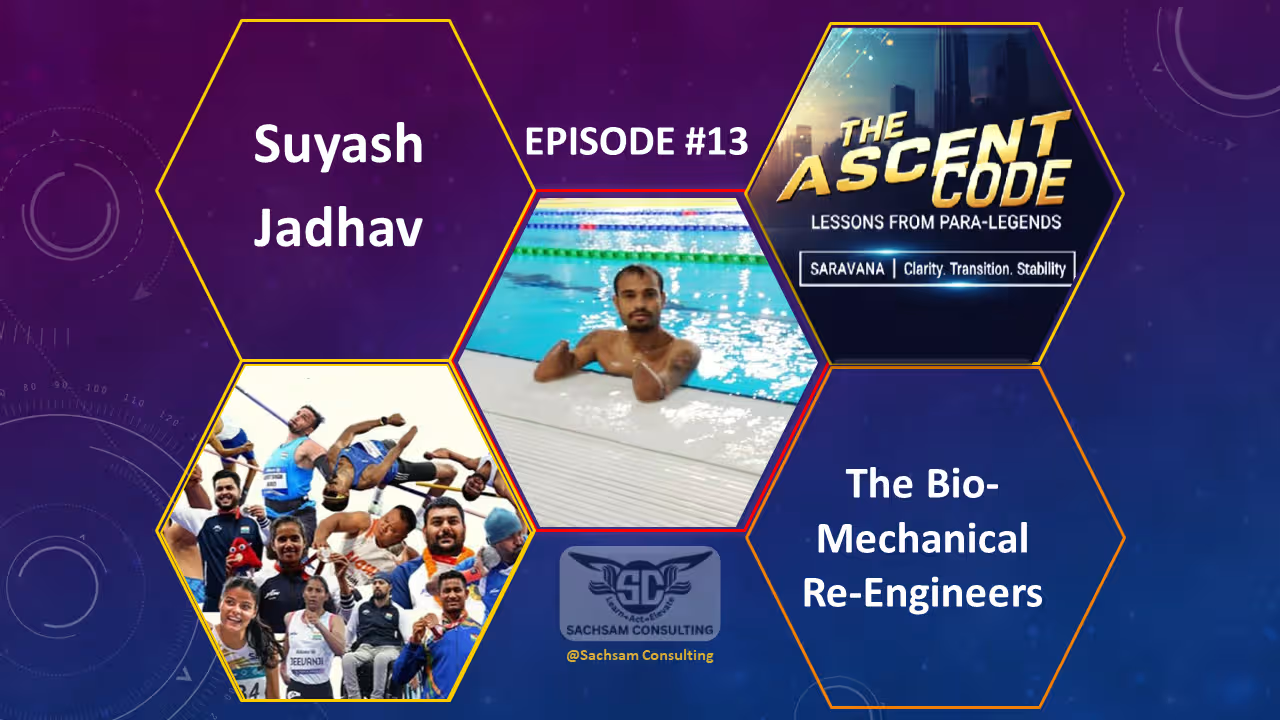
ASCENT CODE: Episode 13
The Dual‑Amputee Speedster
Suyash Jadhav, The Bio‑Mechanical Re‑Engineers. How a boy who lost both arms in a 2004 electrocution rebuilt his entire swimming stroke from torso and kick to win Asian Para Games Gold and become India’s most prominent para‑swimmer.
EXECUTIVE SUMMARY
Suyash Jadhav lost both arms at mid‑forearm level in a 2004 electrocution accident. His father was a national‑level swimmer. That fact mattered more than any infrastructure or coaching system. The sport was already in the household as a living language. He built a stroke without hands, using extraordinary torso rotation and leg kick power.
He was the only Indian swimmer to qualify for the 2016 Rio Paralympics. He won Gold at the 2018 Asian Para Games. He is the most prominent face of modern Indian para‑swimming.
⚙️ THE TORQUE‑TO‑PROPULSION METRIC: The palm and forearm account for roughly 70 % of propulsive force in competitive swimming. Suyash had neither. His torso rotation and kick intensity were trained to deliver 100 % of propulsion from the remaining 30 % of resources. The constraint forced a complete mechanical reinvention.
THE ASCENT CODE: THE RE‑ENGINEER CODE OF COMPENSATORY HYPERTROPHY: When the primary mechanism is removed, the remaining 30 % of propulsive resource does not disappear. It becomes the entire budget. Train it beyond what standard biomechanics expects, and it produces world‑class output.
THE CRISIS: THE ELECTROCUTION THAT CHANGED EVERYTHING
It was 2004. Suyash Jadhav was a child when accidental electrocution took both his arms at mid‑forearm level. The antiseptic sterility of the hospital ward, the cold clinical weight of surgical assessment, and the silence of a room where doctors are deciding what remains and what does not.
His father was a national‑level swimmer. That fact mattered more than any infrastructure or coaching system. The sport was already in the household as a living language. Suyash had grown up near water, near the rhythm of training, near the particular focus that competitive swimming produces in those who practise it seriously. The accident removed his arms. It did not remove the inherited relationship with the water.
At the 2016 Rio Paralympics, Suyash Jadhav was the only Indian swimmer present. At the 2018 Asian Para Games, he won Gold. He built that result without hands, using a torso‑driven stroke that India had no coaching framework to teach, because no one had needed to teach it before.
THE ORIGIN: A SWIMMER’S SELF‑BUILT ARCHITECTURE
The shadow phase was real and prolonged. Suyash had to relearn every physical interaction with the world. The question was not whether he would return to the water; his father’s presence made that almost irrelevant. The question was what swimming would look like without the primary propulsion surface the sport is built around.
The turning point was Pune. Moving to high‑performance professional coaches gave him the structured environment to answer that question systematically. He learned to maximise what remained: powerful torso rotation, elevated kick intensity, and hydrodynamic body position compensating for the absent hand catch. No coaching manual had the chapter he needed. He and his coaches built it together.
His father’s background was the emotional anchor. Inherited passion is not sentiment. It is a pre‑loaded competitive framework: training discipline, physical tolerance in water, the understanding that elite performance requires a relationship with sport that outlasts any single result.
THE GRIND: BUILDING A STROKE NO COACH HAD DESIGNED
India had very few coaches who understood how to train a swimmer without hands for elite competition. Suyash and his coaches had to develop the training methodology alongside the competitive technique. Every session produced information. Every competition refined the system further.
- Developing extraordinary torso rotation mechanics, generating propulsion from the core and shoulder girdle rather than the forearm and palm catch.
- Building leg kick power beyond standard competitive levels, using kick as a primary propulsion contributor rather than a balance and rhythm tool.
- Qualifying for the 2016 Rio Paralympics as the only Indian swimmer in the Games, validating the technique at the highest level of international para‑swimming competition.
Verified Achievements
• 2018 Asian Para Games: Gold Medal
• 2016 Rio Paralympics: Qualified and competed, sole Indian swimmer in the Games
Gold. Sole representative. Two facts. No established technique. No specialised coaching in India. Built from nothing.
THE ASCENT CODE: THE RE‑ENGINEER CODE
Here is a technical fact most people do not consider: the palm and forearm account for roughly 70 % of propulsive force in competitive swimming. Suyash lost both. The conventional wisdom would say: the sport is now inaccessible at elite level. Not competitive. Not viable.
That analysis is correct if you assume the standard technique is the only path to elite performance. Suyash’s career proves the assumption is wrong. When the primary mechanism is removed, the remaining 30 % of propulsive resource does not disappear. It becomes the entire budget. And when the entire budget is invested in torso rotation and kick power, those mechanisms develop to levels that standard swimmers, who rely on arm pull for 70 % of their propulsion, never need to build. The constraint removed the dominant tool and forced the development of alternatives to world‑class standard.
I see this pattern often in professionals after a major capability is removed. They mourn the primary mechanism. The Re‑Engineer Code asks: given what remains, what can be developed to primary‑level output? Suyash’s torso and kick are not consolation prizes. They are world‑class propulsion systems no able‑bodied swimmer needed to build. Your remaining capabilities are not lesser versions of what you lost. They are underdeveloped assets waiting to be trained to world standard.
THE HOW-TO FRAMEWORK: THE RE‑ENGINEER CODE IN 4 STEPS
- Map the Secondary Mechanisms
When the primary tool is gone, inventory everything else precisely. Not “what remains generally” but “what specific capability can generate equivalent output?” Suyash mapped torso rotation and kick as propulsion sources. Name your secondary mechanisms at that specificity. Vague inventory produces vague development. - Train the Secondary to Primary Standard
The error is treating secondary mechanisms as stopgaps. Suyash did not develop adequate torso rotation. He developed world‑class torso rotation — the kind no standard swimmer needs because they have arms. Secondary capabilities, invested in at full intensity, reach competitive standard. Stopgap thinking produces stopgap results. - Use the Family or Peer Framework as an Anchor
His father’s background was not emotional comfort. It was a pre‑loaded framework for elite discipline. When you rebuild after disruption, identify who in your network carries the professional DNA of where you are going. Use their experience as a map of the terrain. Your path through it is your own. - Enter Specialist Environments Before You Feel Ready
Moving to Pune required Suyash to expose an incomplete technique to expert scrutiny. Enter the specialist environment early. Expert feedback on an unfinished technique accelerates development faster than more isolated practice on the same technique. Discomfort in the specialist context is data, not failure.
THE REFRAME: THE ARMS WERE THE LIMITATION ALL ALONG
Return to that hospital ward in 2004. The antiseptic smell. The cold clinical assessment. A swimmer’s son calculating what the electrocution had taken.
Here is the reframe most people miss. Able‑bodied swimmers rely so heavily on arm pull that they never develop the torso and kick power their bodies could produce. The arms limit the other propulsion systems because they make them unnecessary. Suyash’s constraint removed the dominant tool and forced the subordinate ones to extraordinary levels. In a mechanical sense, the arms were never needed for elite performance. They were simply what everyone used because they had them.
The Re‑Engineer Code does not ask you to accept less. It asks you to discover more. As of 2026, Suyash works for the Government in a sports capacity and actively advocates for raising para‑swimming coaching standards nationwide. He built the technique. Now he is building the system.
SELF AUDIT
- • After your most significant professional disruption, what secondary capabilities were present but underdeveloped? Have you since trained those to primary standard, or are you still treating them as temporary substitutes?
- • Who in your immediate network carries the professional DNA of the domain you are building toward? Are you using their experience as a framework, or avoiding comparison by keeping your distance?
- • What specialist environment have you been avoiding entering because your technique does not yet feel ready? What would you learn in one month there that another year of isolated preparation cannot give you?
👇 Drop your answer in the comments. The #AscentYouTribe learns together.
THE SCIENCE OF COMPENSATORY HYPERTROPHY IN LIMB‑DEFICIENT ATHLETES
Exercise physiology research on limb‑deficient athletes documents a consistent phenomenon: when a primary propulsive limb is absent, the neuromuscular system recruits and develops alternative muscle groups to levels significantly above those of able‑bodied peers in the same sport. Core musculature, shoulder girdle mechanics, and lower limb kick power in double‑arm‑amputee swimmers exceed the measurements recorded in able‑bodied elite swimmers in those same muscle groups.
Suyash’s torso rotation and kick intensity are direct expressions of this. His body allocated the full training adaptation budget to the remaining systems. The result is a propulsion profile able‑bodied coaches do not expect and competitors cannot match in those parameters. The Re‑Engineer Code works because the neuromuscular system has no preference for which muscles do the work. It only responds to the demand placed on it.
Next on The Ascent: Episode 14: Jayanti Behera, The System‑Hacking Outsiders.
SARAVANA KUMAR
Clarity | Transition | Inner Stability
The detail that stays with me is the father. A national‑level swimmer who watched his son lose both arms and chose to be an anchor rather than a mourner. In my coaching work, I ask clients to identify who in their network carries the professional DNA of where they are going. Suyash had his father’s relationship with water. Most of us have something equivalent we have not fully named. Name it this week. Then use it.
#SaravanaSays
Your Growth Journey Starts Here
All the ways to connect, learn, and grow with the Tribe — in one place. Choose your favourite platform and stay plugged into daily momentum.
KEYWORDS: Ascent Code Suyash Jadhav, Re‑Engineer Code, Bio‑Mechanical Re‑Engineers, Asian Para Games Gold 2018, double‑arm‑amputee swimmer, compensatory hypertrophy, para‑swimming India, torso rotation technique, inherited passion sport, Pune swimming coach, adaptive swimming technique.
HASHTAGS: #AscentCode #AscentYouTribe #SaravanaSays #SaravanaKumar #ReEngineerCode #Clarity #Transition #InnerStability #HighPerformance #MindsetEngineering #ResilienceEngineered #SuccessSystems #CareerPivot #LeadershipPrinciples #CompensatoryHypertrophy #SelfOptimization #SuyashJadhav #ParalympicsIndia #ParaSwimming #AsianParaGames #IndianAthletes #AdaptiveAthletes #ReEngineerYourself


Comments
3Wonderful
[…] Read → […]
[…] Episode 13: Suyash Jadhav, The Bio‑Mechanical Re‑Engineers […]