

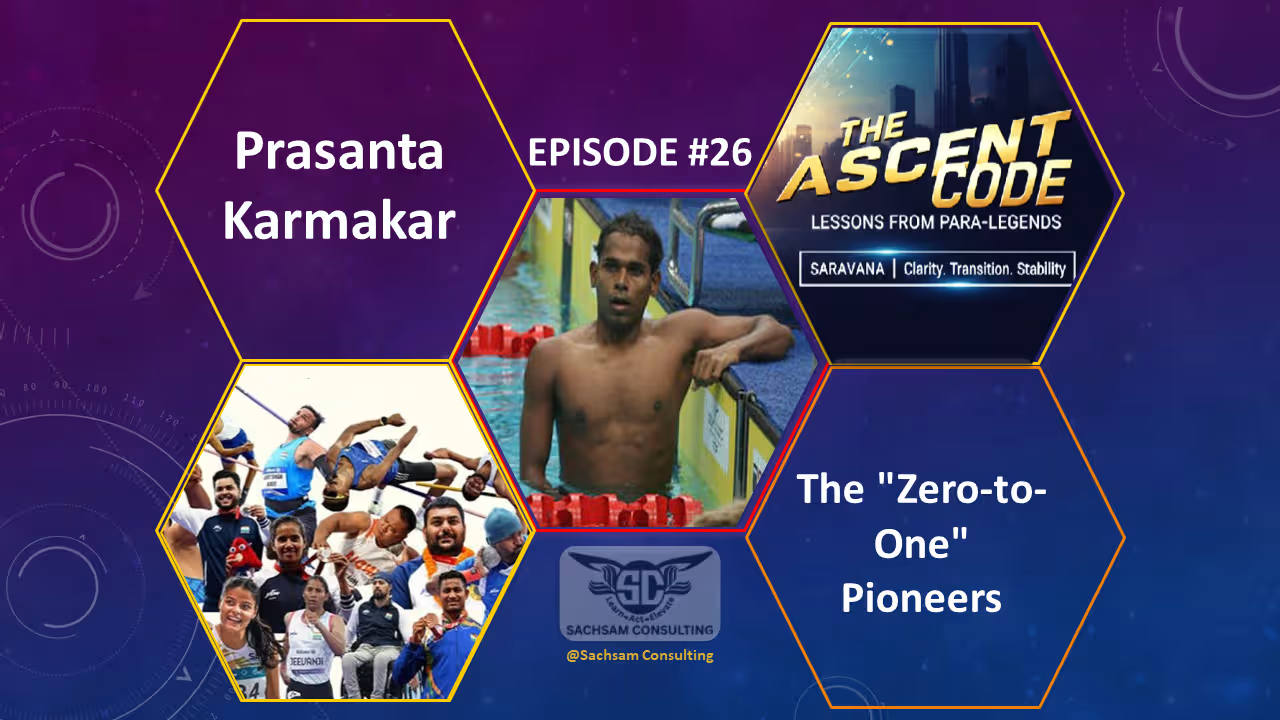
ASCENT CODE: Episode 26
The Defiant Voice of Swimming
Prasanta Karmakar, The Zero‑to‑One Pioneers. He lost his right hand at seven, fought legally to compete with able‑bodied swimmers when officials said he did not belong, and won India’s first Commonwealth Games para‑swimming medal in Delhi 2010. The Arjuna Award followed.
EXECUTIVE SUMMARY
Prasanta Karmakar was seven years old when a road accident took his right hand. In West Bengal in the 1980s, disability in childhood meant a fundamental reordering of what was expected. He turned to swimming. He trained. He reached a competitive standard. And then officials told him he should not be in the pool with able‑bodied swimmers.
He fought that discrimination legally. He stayed in the pool. At the 2010 Commonwealth Games in Delhi, he won Bronze in para‑swimming — India’s first CWG para‑swimming medal. Over a dozen international medals followed. He represented India at the 2012 London Paralympics. He holds the Arjuna Award.
⚙️ THE DEFIANT EXCELLENCE METRIC: The official who told him he did not belong produced something no coach can manufacture: a specific person and system his performance could prove wrong. Every medal was a data point in the institutional argument. The CWG Bronze was its most visible submission.
THE ASCENT CODE: THE PIONEER CODE OF DEFIANT EXCELLENCE: Using societal skepticism as competitive fuel produces historic firsts and pioneering achievements. The discriminatory system that tries to exclude you is also, if you refuse to leave, the system that eventually has to acknowledge you. Stay in the pool.
THE CRISIS: THE ACCIDENT, THE EXCLUSION, AND THE FIGHT
Prasanta Karmakar was seven years old when a road accident took his right hand. In West Bengal in the 1980s, disability in childhood meant a fundamental reordering of what was expected and what was possible. The antiseptic cold of a hospital ward where a child is told what has been permanently lost: these are the coordinates of a life divided into before and after at an age when that division was not yet comprehensible.
He turned to swimming. The water offered a physical environment where the absence of one hand, while technically significant, did not make competitive swimming categorically impossible. He trained. He reached a competitive standard. And then officials told him he should not be in the pool with able‑bodied swimmers. Not that his standard was insufficient. That his presence was inappropriate. That the problem was not his performance. It was his body.
Prasanta Karmakar fought that discrimination legally. He stayed in the pool. At the 2010 Commonwealth Games in Delhi, he won Bronze in para‑swimming, India’s first CWG para‑swimming medal, on home soil. The system that had tried to exclude him had to award him a medal.
THE ORIGIN: THE LEGAL FIGHT AND THE COMPETITIVE PROOF
The shadow phase in Prasanta’s story is the period of active exclusion: officials blocking his access to competition, a system that had not designed space for a disabled swimmer alongside able‑bodied athletes, and the absence of any formal para‑swimming framework that could have provided an alternative route. He was caught between two structures, neither of which had allocated a place for him.
He chose a third route: legal challenge. The fight for the right to compete was simultaneous with his athletic development. While building elite‑level swimming with one hand, he was building the institutional case for his right to compete at all. Both required the same quality: refusal to accept that the system’s current configuration was the final word on his participation. The 2010 Delhi CWG Bronze produced the evidence that discrimination could not easily sustain itself against.
THE GRIND: A DECADE OF DEFIANT EXCELLENCE
Building a competitive swimming career as a one‑handed athlete in India without established para‑swimming infrastructure required solving technical and institutional problems simultaneously. The technical problem was developing a stroke and turn technique that compensated for the absent right hand. The institutional problem was remaining eligible to compete while the system attempted to redefine his eligibility.
- Developing one‑handed competitive swimming technique at international standard, building the upper body asymmetric propulsion and rotation mechanics that one‑handed racing demands.
- Competing internationally across a decade, building the results record that established Indian para‑swimming’s credibility on the world stage.
- Winning Bronze at the 2010 Commonwealth Games in Delhi, India’s first‑ever para‑swimming medal at the Commonwealth Games, on home soil.
Verified Achievements
• 2010 Commonwealth Games (Delhi): Bronze Medal, para‑swimming (India’s first)
• 2012 London Paralympics: Represented India
• Over a dozen international medals across a decade of competition
• Arjuna Award for foundational contributions to Indian para‑swimming
First. A dozen. Arjuna. Built against a system that tried to exclude him from the pool in the first place.
THE ASCENT CODE: THE PIONEER CODE
Here is what most development narratives miss about defiant excellence: the discrimination does not just produce obstacles. When refused and contested rather than accepted, it produces fuel. The official who told Prasanta Karmakar he did not belong in the pool with able‑bodied swimmers handed him a competitive motivation that no training programme designs and no coaching system manufactures. It converted every lap into a proof of concept.
The Pioneer Code is not passive endurance. It is active contestation. You stay in the pool to make the exclusion’s falseness visible through accumulated performance evidence. Every medal was a data point in the institutional argument. The Bronze at Delhi 2010 was its most visible submission.
I see this pattern often in professionals who have been told they do not belong in a particular room. I ask: what would one undeniable result in that room say? Prasanta’s answer was a CWG Bronze on home soil. Stay in the room. Win. The system that tried to exclude you will eventually have to present you with the medal.
THE HOW-TO FRAMEWORK: THE PIONEER CODE IN 4 STEPS
- Convert the Exclusion Into Competitive Fuel
The official who told Prasanta he did not belong produced something no coach can manufacture: a specific person and system his performance could prove wrong. Identify the institutional assumption used to exclude you. Name it precisely. Treat every performance in that domain as a direct response to it. - Fight on the Technical and Institutional Fronts Simultaneously
He built his swimming technique and his legal case in parallel. Neither track waited for the other. When facing systemic exclusion, technical development and institutional challenge must proceed together. One without the other produces either ability without access, or access without ability. - Build the Evidence Record
The legal fight alone does not end discrimination. The performance record that makes discrimination’s claims visibly false is what makes it unsustainable. Compete. Win. Each result is a data point in the argument. Enough data points and the argument becomes impossible to deny. - Stay in the Pool
When the system excludes you, continued presence is the most productive response. Leave and the exclusion wins by default. Stay and compete and the exclusion must eventually confront what it tried to prevent. Prasanta stayed. The pool gave him a CWG Bronze and an Arjuna Award.
THE REFRAME: THE EXCLUSION WAS THE INVITATION
Return to that West Bengal pool. A one‑handed swimmer being told by officials that he should not be in the water with able‑bodied athletes. The antiseptic edge of a facility designed for a body he did not have.
The exclusion was not a closing door. It was a marker of unclaimed territory. His presence was both a violation of the existing order and an act of definition: establishing that this pool, this stage, and this medal were available to someone who looked like him. The discriminatory system was describing the pioneer territory. He claimed it.
The Pioneer Code completes when the system that tried to exclude you becomes the system that honours you. The Arjuna Award is the system acknowledging that it was wrong about who belonged in the pool. As of 2026, Prasanta Karmakar is a professional coach and mentor, building the next generation of Indian para‑swimmers on the access he had to fight to establish.
SELF AUDIT
- • What professional room have you been told, explicitly or implicitly, that you do not belong in? Are you building the performance record that makes that statement false, or have you left the room?
- • Where are you fighting on only one front, either building capability without institutional access, or fighting institutionally without building the performance evidence that makes the institutional argument credible?
- • What one result in the domain that tried to exclude you would be the equivalent of a CWG Bronze on home soil? Name it. Then build toward it.
👇 Drop your answer in the comments. The #AscentYouTribe learns together.
THE SCIENCE OF MOTIVATIONAL FUEL FROM ADVERSARIAL CONTEXTS
Sports psychology research on motivation in adversarial contexts documents that athletes who face systemic discrimination or explicit exclusion attempts, and who respond by intensifying competitive effort rather than withdrawing, develop a specific motivational profile characterised by greater persistence under setback, higher performance under conditions of scrutiny, and longer competitive careers than peer athletes without equivalent adversarial history.
Prasanta’s decade‑long career and his consistent international performance level reflect this profile precisely. The exclusion attempts did not suppress his competitive output. Research suggests they amplified it. The mechanism is identity‑threat response: when a person’s right to be in a domain is challenged, those who contest rather than accept the challenge activate a motivational system that treats every performance as an identity‑preservation act. That system is extraordinarily durable. Prasanta’s dozen international medals are the output of a motivational engine that his discriminators inadvertently built.
Next on The Ascent: Episode 27: Singhraj Adhana, The Mind‑Quiet Precisionists.
SARAVANA KUMAR
Clarity | Transition | Inner Stability
The image I return to from Prasanta’s story is the official telling a one‑handed boy that he does not belong in the pool. What that official produced was not obedience. It was one of the most decorated careers in Indian para‑swimming history. I tell professionals who have been told they do not belong in a room: the person who told you that gave you something no training programme can manufacture. Use it. Stay in the room.
#SaravanaSays
Your Growth Journey Starts Here
All the ways to connect, learn, and grow with the Tribe — in one place. Choose your favourite platform and stay plugged into daily momentum.
KEYWORDS: Ascent Code Prasanta Karmakar, Pioneer Code, Zero‑to‑One Pioneers, CWG Bronze 2010 para‑swimming, India first Commonwealth Games para‑swimming medal, one‑handed swimmer India, West Bengal para‑swimmer, Arjuna Award swimming, legal fight para‑sport discrimination, defiant excellence sport, 2012 London Paralympics swimming, para‑swimming pioneer India, identity threat motivation.
HASHTAGS: #AscentCode #AscentYouTribe #SaravanaSays #SaravanaKumar #PioneerCode #Clarity #Transition #InnerStability #HighPerformance #MindsetEngineering #ResilienceEngineered #SuccessSystems #DefiantExcellence #LeadershipPrinciples #StayInThePool #SelfOptimization #PrasantaKarmakar #ParalympicsIndia #ParaSwimming #CWG2010 #IndianAthletes #WomenInSport #PioneerSpirit


Comments
2[…] Read → […]
[…] Episode 26: Prasanta Karmakar, The Zero‑to‑One Pioneers […]