

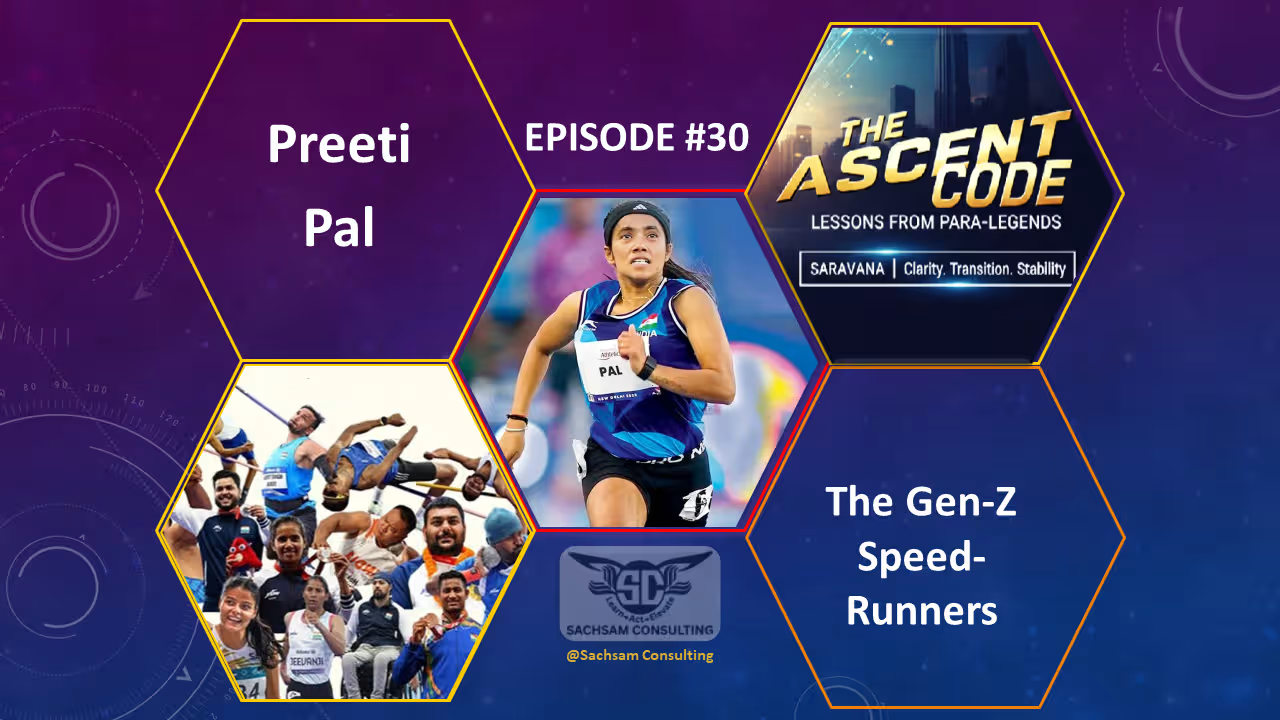
ASCENT CODE: Episode 30
The Sprint Queen
Preeti Pal, The Gen‑Z Speed‑Runners. Born with cerebral palsy, legs in plaster for six days after birth, callipers until age 13. She discovered Paralympic sport via YouTube at 17, moved to Delhi to train, and won two Bronze medals at Paris 2024: India’s first-ever Paralympic track medals.
EXECUTIVE SUMMARY
Preeti Pal was born with cerebral palsy. Her legs were in plaster for six days after birth. She wore callipers, the metal leg supports that assist walking in children with motor impairments, until she was 13. Medical facilities in Meerut were limited, and her family faced financial strain from specialised gear. The expectation in her environment was not that she would become an international athlete. That was reasonable given every available data point except one: the YouTube video at 17.
She discovered Paralympic athletics by watching videos on YouTube at 17, met athlete Fatima Khatoon, moved to Delhi to train, and at Paris 2024 won two Bronze medals: India’s first-ever track medals at a Paralympic Games. She was also chosen as India’s flag‑bearer. She is now in the LA 2028 training cycle.
⚙️ THE SELF‑IDENTIFICATION METRIC: The pathway identification step that previously required institutional access — a coach who knew about para‑athletics, a family member with competitive sport experience — is now available on a phone screen. YouTube removed the information asymmetry that kept capable athletes like Preeti in Meerut without a competitive pathway.
THE ASCENT CODE: THE SPEED‑RUN CODE OF SELF‑IDENTIFICATION: Self‑identification of an available arena, followed by immediate maximum commitment and relocation toward the best available training environment, can compress a decade of conventional development into a fraction of that timeline. The first competition is within yourself. Beat the doubt first. Then beat the field.
THE CRISIS: CALLIPERS, MEERUT, AND THE QUESTION OF POSSIBLE
Preeti Pal was born with cerebral palsy. Her legs were in plaster for six days after birth. She wore callipers, the metal leg supports that assist walking in children with motor impairments, until she was 13. The particular weight of metal callipers on growing legs, the specific sound they make on the floors of a school in Meerut, the daily physical negotiation of a body that moved differently from the standard: these are the sensory coordinates of a childhood that built an intimate understanding of physical constraint before any sporting arena had been identified.
Medical facilities for cerebral palsy management in Meerut were limited. Financial strain from specialised gear added to the family’s resource constraints. The expectation in her environment was not that she would become an international athlete. That was reasonable given every available data point except one: the YouTube video at 17.
At Paris 2024, Preeti Pal won two Bronze medals: India’s first Paralympic track medals. She was chosen as India’s flag‑bearer at the closing ceremony. The callipers in a Meerut school had been part of the preparation for that Paris podium.
THE ORIGIN: YOUTUBE, FATIMA KHATOON, AND THE MOVE TO DELHI
The shadow phase was the long period before the arena was identified. A capable girl with cerebral palsy in Meerut, without a para‑athletics pathway, existed in the gap between what she was capable of and what her environment had connected her to.
At 17, watching Paralympic athletics on YouTube, she encountered what was possible. She met athlete Fatima Khatoon, whose experience provided a personal framework for what the pathway looked like in practice. That combination was enough to produce the decision: move to Delhi, train seriously, compete. Moving to Delhi was a commitment of identity before any result validated it. That decision is the Speed‑Run Code of Self‑Identification’s essential act.
THE GRIND: DELHI, TRAINING, PARIS
The arc from YouTube discovery to Paris podium required building sprint mechanics adapted to the specific profile of cerebral palsy: asymmetric muscle tone, coordination challenges, the technique adjustments T35 sprinting demands. Delhi gave her access to structured coaching that Meerut could not.
- Developing sprint technique adapted to her cerebral palsy profile, building the speed, coordination, and race execution that T35 international competition requires.
- Competing at national level and building the international competition experience that a Paralympic qualification campaign demands.
- Competing at Paris 2024 and winning two Bronze medals in sprint events, becoming the first Indian athlete to win a track medal at a Paralympic Games.
Verified Achievements
• Paris 2024 Paralympics: Two Bronze Medals, T35 sprint events (India’s first Paralympic track medals)
• Paris 2024 Paralympic Games: Flag‑bearer, India closing ceremony
• 2024 World Championships, Kobe: Bronze Medal
Two firsts. India’s first track medals. Flag‑bearer. All from a discovery made on YouTube at 17. All from a starting point that had no institutional pipeline behind it.
THE ASCENT CODE: THE SPEED‑RUN CODE OF SELF‑IDENTIFICATION
Here is what conventional talent development systems miss about the Gen‑Z generation’s relationship with information: the pathway identification step that previously required institutional access — a coach who knew about para‑athletics, a family member with competitive sport experience, a school with a development programme — is now available on a phone screen. YouTube removed the information asymmetry that kept capable athletes like Preeti in Meerut without a competitive pathway.
Information alone does not produce a Paris Bronze. The Speed‑Run Code of Self‑Identification requires two additional elements: a peer mentor who personalises the information into a practical framework, and immediate maximum commitment. Fatima Khatoon provided the first. The move to Delhi provided the second. Without both, the YouTube discovery remains inspiration rather than trajectory.
I see this pattern often in professionals who have identified the right arena but have not committed fully. They have the information. They have not made the move to Delhi. The distance between knowing the arena and being in it is almost always a decision, not a qualification.
Patterns like this are not limited to sport. I often see them in professionals who discover a new career path online but hesitate to relocate their effort. The information is there. The move is what separates discovery from achievement.
THE HOW-TO FRAMEWORK: THE SPEED‑RUN CODE IN 4 STEPS
- Use Available Information to Identify the Arena
Preeti found her competitive pathway through YouTube. The information to identify your optimal arena is available independently. Active personal research combined with peer connection can produce the same pathway identification the institutional system provides. Do the research. Do not wait for the system to deliver it. - Find the Fatima Khatoon
YouTube gave information. Fatima Khatoon gave a personal framework for what the information meant in practice. Find the person who has navigated the specific path your research identified. The peer mentor who has been where you are heading is more valuable than general information about the destination. - Make the Move to Delhi
Identify the equivalent of the Delhi training environment: the place or context that provides world‑class development access your current location does not. Move toward it. The validation comes after the move, not before it. - Win the Internal Competition First
The first competition is within yourself. Beat the doubt that says the arena is not for someone with your background, your condition, your starting point. The external result follows the internal victory. Preeti beat the internal competitor before she stepped on a Paris track.
THE REFRAME: THE CALLIPERS WERE PART OF THE PREPARATION
Return to that Meerut school. The weight of the callipers. The particular sound of metal on corridor floors. A girl navigating a day that required more physical negotiation than it asked of anyone around her.
Every year in callipers built a specific relationship with her body: the awareness of how it moved, the precise understanding of where the resistance was and where the capacity was, the developed sensitivity to physical feedback that years of standard mobility produce in a different and shallower way. That body knowledge, built through necessity in Meerut, was exactly what sprint technique adaptation for cerebral palsy requires. The callipers were not the obstacle to the Paris Bronze. They were part of the preparation for it.
Preeti’s Sprint Queen identity did not begin in Delhi. It began in Meerut, in callipers, building the body awareness the Paris track would eventually require. As of 2026, she trains for the LA 2028 cycle and remains India’s flag‑bearer in the truest sense: the first to stand where no Indian track athlete had stood.
SELF AUDIT
- What YouTube equivalent information is available to you right now that could identify a professional arena you have not yet entered? Have you done the research, or are you waiting for the institutional system to deliver the pathway?
- Who is your Fatima Khatoon: the person who has navigated the specific path your research has identified and can translate the information into a personal practical framework? Have you found them and engaged them?
- Where is the distance between knowing the right arena and being in it a decision rather than a qualification? What is keeping you in Meerut when Delhi is the next step?
👇 Drop your answer in the comments. The #AscentYouTribe learns together.
THE SCIENCE OF PROPRIOCEPTION AND CEREBRAL PALSY ATHLETIC PERFORMANCE
Sports science research on athletes with cerebral palsy documents that early years of managing motor impairment through devices like callipers produce elevated proprioceptive sensitivity: the body’s awareness of its own position and movement in space. This heightened proprioceptive feedback develops because the body must actively manage and adjust movement patterns that typical motor development handles automatically. Over years, this produces a more conscious and sophisticated relationship with bodily movement than standard development generates.
Preeti’s years in callipers built precisely this architecture. When she began sprint training in Delhi, she was not starting from a standard 17‑year‑old proprioceptive baseline. She had been consciously navigating and adjusting her movement for thirteen years. Research on cerebral palsy athletes confirms that this developed proprioceptive sensitivity produces superior responsiveness to technical coaching and faster technique acquisition when formal training begins.
Next on The Ascent: Episode 31: Farman Basha, The Zero‑to‑One Pioneers.
SARAVANA KUMAR
Clarity | Transition | Inner Stability
The YouTube moment at 17 is the one I return to from Preeti’s story. A girl in Meerut, on a phone screen, watching someone who looked like she could be her competing at the highest level of international sport. That moment of representation, seeing someone with a similar physical profile succeeding at the level you want to reach, is one of the most powerful career‑initiation forces there is. I tell professionals who have made it into rooms that were previously closed to people like them: your presence in that room is someone else’s YouTube moment. Show up visibly. The next Preeti Pal is watching.
#SaravanaSays
Your Growth Journey Starts Here
All the ways to connect, learn, and grow with the Tribe — in one place. Choose your favourite platform and stay plugged into daily momentum.
KEYWORDS: Ascent Code, Preeti Pal, Speed‑Run Code, Self‑Identification, Gen‑Z Speed‑Runners, Paris 2024 Paralympic Bronze, India first Paralympic track medal, cerebral palsy sprinter, YouTube Paralympic discovery, T35 para‑sprint, Paris 2024 flag‑bearer, proprioception cerebral palsy.
HASHTAGS: #AscentCode #AscentYouTribe #SaravanaSays #SaravanaKumar #SpeedRunCodeOfSelfIdentification #Clarity #Transition #InnerStability #PreetiPal #ParalympicsIndia #ParaAthletics #Paris2024 #IndianAthletes #WomenInSport #FlagBearer