

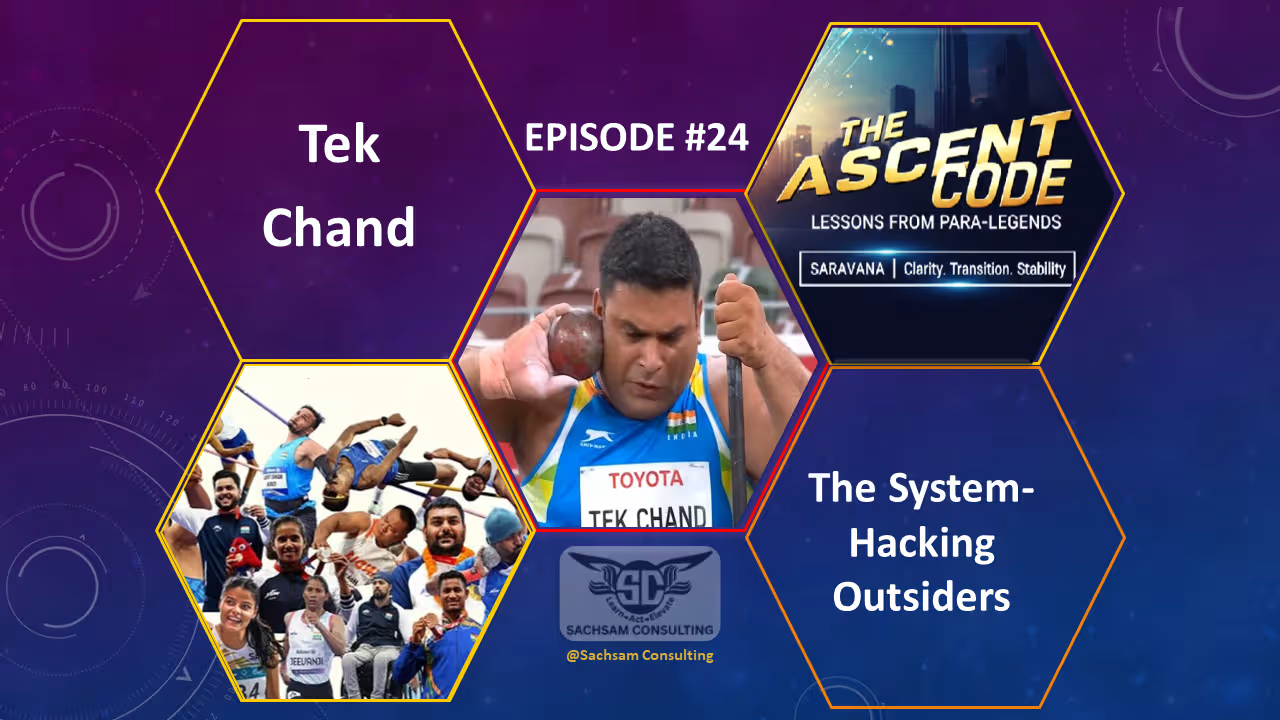
ASCENT CODE: Episode 24
The Silent Workhorse
Tek Chand, The System‑Hacking Outsiders. A Haryana athlete who lost mobility in one leg, trained without specialised throwing frames, earned Asian Para Games Bronze, and led the Indian contingent as flag‑bearer at Tokyo 2020.
EXECUTIVE SUMMARY
Tek Chand suffered a permanent leg impairment from an accident. He turned to throwing events — javelin and shot put — to stay connected to his sporting roots. Specialised throwing frames were not available in his early career. He trained without them.
At the 2018 Asian Para Games, he won Bronze. At Tokyo 2020, he was selected to lead the Indian contingent as flag‑bearer. The flag‑bearer role was not awarded for a single breakthrough. It was awarded for the cumulative weight of a decade of consistent national‑level performance.
⚙️ THE CONSISTENCY METRIC: The flag‑bearer role recognises the athlete who has been present, consistent, and reliable across years, not the athlete who produced a single exceptional result. In professional life, that recognition is harder to earn than a medal. It is also more durable.
THE ASCENT CODE: THE MAVERICK CODE OF CONSISTENCY: Long‑term commitment to a discipline, even without early glory or institutional infrastructure, eventually produces moments of national honour. The work itself is the credential. The flag follows.
THE CRISIS: THE ACCIDENT THAT RESHAPED THE PATH
Tek Chand was a young athlete in Haryana when an accident left him with a permanent mobility impairment in one leg. The particular dust of a Haryana training ground, the sharp sound of metal weights dropping on concrete, the silence that follows a doctor’s assessment when the words “permanent” are spoken: these are the sensory coordinates of a before‑and‑after that redefined what his body could do.
He turned to throwing events — javelin and shot put — to remain connected to his sporting roots. The mobility impairment limited approach run speed and rotational stability. In a sport where those variables determine medal outcomes, the constraint was significant. He could not remove it. He could only engineer technique around it.
At the 2018 Asian Para Games, Tek Chand won Bronze. At Tokyo 2020, he carried the Indian flag as the contingent’s flag‑bearer. The accident had reshaped the path. It had not ended it.
THE ORIGIN: TRAINING WITHOUT THE FRAME
The shadow phase was not a dramatic gap between injury and recovery. It was the long, unglamorous period of competing without the equipment international rivals took for granted. Specialised throwing frames, the chairs that stabilise seated throwers and optimise rotational mechanics, were not available in his early career. He trained with what existed, not what the sport’s equipment catalogue recommended.
That constraint shaped his technique in a specific direction. Without a specialised frame to stabilise the throw, he developed compensatory core mechanics that standard training would not have produced. The absence of equipment forced a deeper relationship with the fundamentals of the throw: the rotational axis, the release point, the transfer of force from core to implement. When better equipment eventually arrived, the technique it supported was built on a foundation of understanding that equipment could not replace.
THE GRIND: THE FLAG‑BEARER’S DECADE
The career arc is defined by duration and consistency. National championships across multiple seasons, Asian Para Games competitions, qualification for the Tokyo 2020 Paralympic Games, and the accumulation of performance data across years of competition. No single year produced a result that changed everything. The accumulation of years produced a result that the flag‑bearer role recognised.
- Competing consistently at national para‑athletics level across javelin and shot put, building a reputation as a reliable medal contender in domestic competition and a steady international performer.
- Qualifying for and competing in the Tokyo 2020 Paralympic Games, representing India at the highest level of para‑athletics in throwing events.
- Winning Bronze at the 2018 Asian Para Games, converting years of consistent national‑level performance into an international medal.
Verified Achievements
• 2018 Asian Para Games: Bronze Medal
• Tokyo 2020 Paralympics: Flag‑bearer, Indian contingent
• Represented India at Tokyo 2020 Paralympic Games, Javelin throw
The Bronze is the medal. The flag‑bearer role is the measure of the career that produced it.
THE ASCENT CODE: THE MAVERICK CODE
Here is the assumption most performance narratives carry: that breakthroughs are single events, that a medal or a record is the moment the career became real. Tek Chand’s story is evidence against that assumption. The Bronze at the 2018 Asian Para Games was not a sudden emergence. It was the output of a decade of consistent competition in a system that offered him no shortcuts and no specialised equipment for most of that decade.
The flag‑bearer role at Tokyo 2020 is the more instructive data point. That role is not awarded for a single result. It is awarded for the cumulative weight of a career: the reliability, the consistency, the years of showing up to competitions without the infrastructure that would have made the path easier. The flag recognises duration, not peak.
I see this pattern often in professionals who wait for the breakthrough moment that will validate their career. The job change that finally gets recognition. The project that finally gets noticed. The promotion that finally signals arrival. Tek Chand’s career asks a different question: what would happen if you stopped waiting for the breakthrough and treated every year of consistent work as the credential itself? The flag followed the work. It rarely precedes it.
THE HOW-TO FRAMEWORK: THE MAVERICK CODE IN 4 STEPS
- Compete Without the Equipment You Do Not Have
Tek trained without specialised throwing frames. That constraint forced deeper mechanical understanding. When you lack the standard tool, you develop a deeper relationship with the fundamentals the tool normally manages for you. That understanding becomes an asset when the equipment eventually arrives. Do not wait for the tool. Work without it. The tool follows. - Let the Accumulation Speak, Not the Breakthrough
His career was not built on a single medal. It was built on years of national‑level competition that eventually produced the Asian Games result. Stop waiting for the breakthrough to validate the work. The work itself is the validation. The breakthrough, when it comes, is the output of the accumulation, not the cause of it. - Accept the Flag as the Measure of the Career
The flag‑bearer role recognises the athlete who has been present, consistent, and reliable across years, not the athlete who produced a single exceptional result. In professional life, the equivalent is the reputation for reliability, the trust that accumulates across projects, the institutional recognition that comes from being the person who delivers consistently. That recognition is harder to earn than a medal. It is also more durable. - Train Multiple Events to Build Fundamental Mastery
Tek competed in both javelin and shot put. The cross‑training built a deeper understanding of rotational mechanics than specialising in one event would have produced. Your professional equivalent is breadth across related domains. The insights from one area inform the other. The generalist who understands fundamentals deeply outperforms the specialist who knows one surface.
THE REFRAME: THE FLAG WAS NEVER THE GOAL
Return to those early training sessions. The Haryana dust. The sound of weights on concrete. An athlete throwing without the specialised frame, engineering technique from fundamentals because the equipment was not available to do it for him.
The flag at Tokyo was not the goal he was training for when he started. It was the recognition that arrived after the work had already proven itself. The Asian Para Games Bronze was the medal. The flag was the measure of the career that produced it. He did not train to carry the flag. He trained to compete. The flag followed.
Most professionals chase the recognition directly. They want the title, the promotion, the public acknowledgment. Tek Chand’s career suggests the opposite sequence: do the work at the level that would earn the recognition even if no one is watching. The recognition may never arrive. But if it does, it will arrive as a flag, not a target. As of 2026, Tek Chand continues to compete and mentor athletes in his region, still training, still throwing. The flag was one moment. The work is the career.
SELF AUDIT
- What tool or resource are you waiting for before you begin serious work in a domain? What would it look like to work without it, developing fundamental understanding that the tool would normally manage for you?
- Are you chasing the breakthrough or building the accumulation? If the recognition never arrived, would the work you are doing still be worth doing on its own terms?
- What is the flag‑bearer equivalent in your professional domain? The role that recognises consistency, reliability, and cumulative contribution rather than a single exceptional result. Are you building toward that recognition, or only toward the breakthrough?
👇 Drop your answer in the comments. The #AscentYouTribe learns together.
THE SCIENCE OF DELAYED RECOGNITION AND MOTOR CONSISTENCY
Sports psychology research on recognition and performance motivation distinguishes between outcome goals and process goals. Outcome goals, winning a medal or achieving a ranking, produce inconsistent motivation because the outcome is not directly controllable. Process goals, executing a specific technical sequence at a specific standard, are controllable and produce consistent performance across competition cycles.
Tek Chand’s career reflects a process‑goal orientation. The flag‑bearer recognition was an outcome that followed a decade of process‑goal execution: consistent training, technical refinement, competition regardless of infrastructure. Research on motor skill retention confirms that athletes who train without specialised equipment develop more robust movement patterns because they cannot rely on the equipment to compensate for technical error. His decade of training without specialised throwing frames produced motor consistency that equipment‑dependent peers may not have developed. The flag recognised that consistency, not just the result.
Next on The Ascent: Episode 25: Suhas Yathiraj, The Gen‑Z Speed‑Runners.
SARAVANA KUMAR
Clarity | Transition | Inner Stability
The flag‑bearer role at Tokyo is the detail from Tek Chand’s career that I keep returning to. I have watched professionals chase the recognition directly: the title, the promotion, the public acknowledgment. Tek Chand’s story suggests a different sequence. He did not train to carry the flag. He trained to compete. The flag followed. If you are chasing recognition, the question worth asking is whether you are doing the work that would earn it even if no one was watching. The flag is not the target. The flag is what arrives when you stop aiming at it and aim at the work instead.
#SaravanaSays
Your Growth Journey Starts Here
All the ways to connect, learn, and grow with the Tribe — in one place. Choose your favourite platform and stay plugged into daily momentum.
KEYWORDS: Ascent Code Tek Chand, Maverick Code, System‑Hacking Outsiders, Asian Para Games Bronze 2018, Tokyo 2020 flag‑bearer India, para‑athletics javelin, Haryana para‑athlete, consistency in sport, delayed recognition, process goals, motor consistency, flag‑bearer Paralympics, career accumulation.
HASHTAGS: #AscentCode #AscentYouTribe #SaravanaSays #SaravanaKumar #MaverickCode #Clarity #Transition #InnerStability #HighPerformance #MindsetEngineering #ResilienceEngineered #SuccessSystems #ConsistencyCode #LeadershipPrinciples #FlagBearer #SelfOptimization #TekChand #ParalympicsIndia #ParaAthletics #Tokyo2020 #IndianAthletes #MaverickSpirit #SilentWorkhorse


Comments
2[…] Episode 24: Tek Chand, The System‑Hacking Outsiders […]
[…] Read → […]