

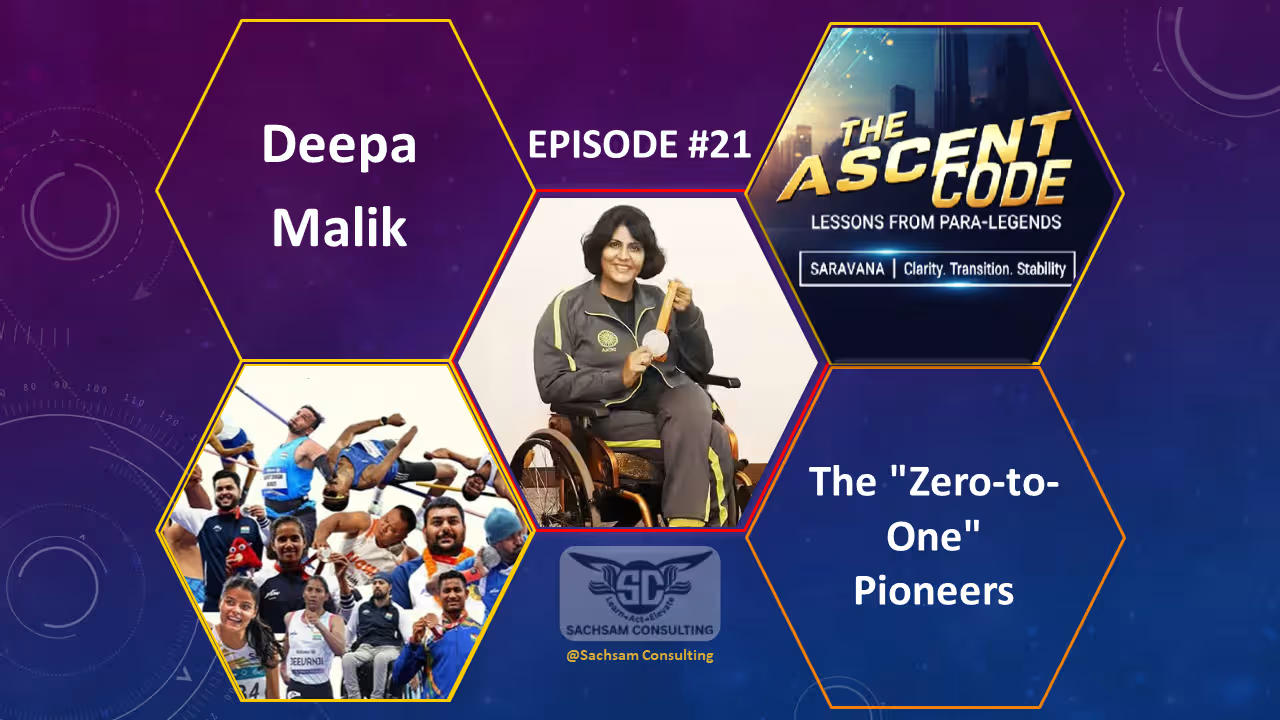
ASCENT CODE: Episode 21
The Barrier Breaker
Deepa Malik was diagnosed with a spinal tumour at 30. Three surgeries and 183 stitches left her paralysed from the chest down. At 36, she started competing in sports and later became the first Indian woman to win a medal at the Paralympics, achieving it at Rio 2016.
EXECUTIVE SUMMARY
Deepa Malik was 30 years old when she was diagnosed with a spinal tumour. She was a mother with an active life. To save her life, she underwent three major surgeries. The operations left 183 stitches along her spine and paralysed her from the chest down.
Doctors told her that this would be her new reality. They believed she would never walk again, sit without support, or compete in sports.
But Deepa refused to let that define her future.
At the age of 36, she started competing in sports. Ten years later, at the Rio 2016 Paralympics, she won a silver medal in para shot put, becoming the first Indian woman to win a Paralympic medal. She was 45 years old when she created history.
The Lesson: Never let someone else’s limits become your own. Doctors can describe your condition, but they cannot decide your determination. Your future is shaped more by your actions than by anyone else’s prediction.
THE ASCENT CODE: THE PIONEER CODE OF IDENTITY REINVENTION: Your circumstances do not define your identity. No matter what life takes away, you can always choose who you become through courage, persistence, and consistent action.
THE CRISIS: 183 STITCHES AND A REVISED CEILING
Deepa Malik was 30 years old when she was diagnosed with a spinal tumour. She was a mother living an active life. To save her life, she underwent three major surgeries, leaving 183 stitches along her spine. The surgeries also left her paralysed from the chest down.
After her treatment, doctors gave her a heartbreaking prognosis. They told her she would never walk again, sit without support, or compete in sports. According to them, this was the limit of what her life could be.
But Deepa refused to accept those limits.
At the age of 36, she entered competitive sports. Years of determination, training, and resilience led her to the Rio 2016 Paralympics, where she won a silver medal in para shot put. At 45, she became the first Indian woman to win a Paralympic medal.
The same woman who had once been told what she could never do proved that determination can go beyond any prediction. Her physical condition remained the same, but her response to it changed everything.
THE ORIGIN: THE MOTOR RALLY AND THE DECISION
The shadow phase was public and prolonged. A woman in a wheelchair in India in the early 2000s, told by medicine and society her physical capacity was permanently capped, in a world with no sporting infrastructure for women in wheelchairs. Ageism compounded the absence of any developmental pathway.
The turning point was a motor rally. She joined the Beyond the Barrier rally to test whether the capability for extreme performance remained intact beneath the paralysis. It was not a sporting event. It was an evidence‑gathering exercise. The rally answered the question. At 36, she entered competitive sport at elite level.
That decision was not athletic ambition. It was identity logic: accepting the ceiling meant ceding the authorship of her life to the medical prognosis. She chose not to cede it.
THE GRIND: ELITE SPORT AT 36, SILVER AT 45
Entering competitive para‑shot put at 36 with no prior throwing background, no women’s wheelchair sport infrastructure, and a spine reconstructed across three surgeries meant building every element from first principles. No coaching system covered her profile. No pathway existed for a woman of her age entering the event for the first time.
- Building shot put technique adapted to wheelchair‑based throwing mechanics, developing the upper body rotation and explosive arm strength that the event demands without any lower body contribution.
- Competing at national and international level through her thirties, accumulating the competitive experience that international para‑athletics demands before the highest stage.
- Qualifying for and competing in the Rio 2016 Paralympic Games at 45, winning Silver in a performance that shocked a system that had told her the event was beyond her reach.
Verified Achievements
• Rio 2016 Paralympics: Silver Medal, shot put (first Indian woman to win any Paralympic medal)
Nine years from decision to Silver. Built in the absence of infrastructure, youth, prior background, and the institutional encouragement the standard pathway assumes.
THE ASCENT CODE: THE PIONEER CODE
Here is the assumption the medical system, the social environment, and most development frameworks share: capability is determined by physical state. The prognosis defines the possible. What the body cannot do sets the limit of the life. Deepa Malik’s career is a direct refutation of that assumption at the level of verifiable result.
She was paralysed from the chest down. She was 36 when she entered elite sport. She had no prior athletic background in throwing. Every standard predictor said no. The Silver medal at Rio said something different. Not motivationally different. Evidentially different. The data point is real, the result is verified, and the gap between what the prognosis predicted and what the performance produced is quantifiable.
I see this pattern often in leaders who accepted institutional definitions of their ceiling as objective fact: the company decided, the assessment confirmed, a failed project sealed it. I ask the same question Deepa’s career asks: was that ceiling structural or assumed? Most of the time it was assumed. The Pioneer Code insists ceilings be tested before they are accepted. Nine years after the medical system delivered the prognosis, a Silver medal at Rio did the testing.
THE HOW-TO FRAMEWORK: THE PIONEER CODE IN 4 STEPS
- Distinguish the Condition from the Ceiling
The spinal tumour was the condition. “You will not compete” was an inference, not a diagnosis. Identify what is the actual condition in your professional life and what is the inferred ceiling others have built around it. The condition may be real. The ceiling around it frequently is not. - Test the Ceiling Before You Accept It
Deepa ran a test: the motor rally. One data point from your own performance is worth more than any external assessment. Before accepting any institutional definition of your limit, design a test. Enter a context that challenges the ceiling directly. - Enter at the Highest Available Level
She entered competitive sport at elite level immediately, not from a developmental entry point. Gradual entry allows the ceiling definition to reassert itself. Immediate high‑level entry produces the data faster. When you decide to test a ceiling, enter the highest arena you can access now. - Build the Infrastructure That Does Not Exist
There was no women’s wheelchair sport pathway in India when she entered. She helped build one. When you pioneer, infrastructure does not precede you. You create it through presence and performance. Your pioneering output becomes the system others inherit.
THE REFRAME: THE PROGNOSIS WAS NOT THE VERDICT
Return to that recovery ward. The antiseptic air. The cold weight of post‑surgical mornings. A 30‑year‑old woman being told, with clinical authority, what the rest of her life would look like.
The prognosis was accurate about the physical condition. Paralysis from the chest down is not a matter of interpretation. What it was not accurate about was the identity. A woman who decides at 36 to enter elite sport, trains through her late thirties and forties without infrastructure or encouragement, and wins a Silver medal at 45 is not the person the prognosis described. The condition was correctly diagnosed. The person was not.
The Pioneer Code here is in its most complete form: identity is a choice renewed through action, not assigned by physical state. As of 2026, Deepa Malik is a former President of the Paralympic Committee of India, a motivational speaker, and a consultant for the Ministry of Youth Affairs and Sports. She broke the ceiling. Then helped build the room above it for everyone who followed.
SELF AUDIT
- • What ceiling in your professional life have you accepted on institutional or external authority without personally testing it? What would one direct test of that ceiling look like?
- • In what area of your life have you confused the condition with the ceiling? What is the real, irreducible constraint, and what is the inferred limit that has been built around it by others?
- • Where are you waiting for the infrastructure to exist before you begin? What would it look like to enter the arena at the highest available level now, before the pathway is built?
👇 Drop your answer in the comments. The #AscentYouTribe learns together.
THE SCIENCE OF LATE‑ONSET ATHLETIC DEVELOPMENT
Sports science research on late‑onset training challenges the assumption that elite performance requires early specialisation. Studies on master‑level and late‑career starters document measurable adaptations in upper body strength, neuromuscular coordination, and explosive power across the training lifespan, independent of when training began. Neural strength adaptation remains robust across the adult lifespan.
Deepa’s entry into competitive throwing at 36 exploited these mechanisms. Her shot put drew on upper body explosive strength and rotational coordination, both domains where training adaptation remains significant well into the forties. The wheelchair constraint concentrated neuromuscular investment into upper body throwing mechanics. Her Silver was not despite the late start. The late start produced an investment profile that the wheelchair format specifically rewarded.
Next on The Ascent: Episode 22: Sidhartha Babu, The Mind‑Quiet Precisionists.
SARAVANA KUMAR
Clarity | Transition | Inner Stability
The number that stays with me from Deepa’s story is 36. Not 30, when the tumour arrived. Not 45, when the Silver medal was won. The number that matters is 36, which is the age at which she made the decision to act on a different definition of herself than the one medicine and society had provided. In my coaching work, I watch for the moment when a client is ready to test their ceiling rather than accept it. That moment rarely announces itself. It looks like a motor rally. It looks like one small unreasonable decision. It looks like 36.
#SaravanaSays
Your Growth Journey Starts Here
All the ways to connect, learn, and grow with the Tribe — in one place. Choose your favourite platform and stay plugged into daily momentum.
KEYWORDS: Ascent Code Deepa Malik, Pioneer Code, Zero‑to‑One Pioneers, Rio 2016 Paralympic Silver shot put, first Indian woman Paralympic medal, spinal tumour athlete, 183 stitches, paralysis sport comeback, late‑onset athletic development, Beyond the Barrier motor rally, identity reinvention sport.
HASHTAGS: #AscentCode #AscentYouTribe #SaravanaSays #SaravanaKumar #PioneerCode #Clarity #Transition #InnerStability #HighPerformance #MindsetEngineering #ResilienceEngineered #SuccessSystems #IdentityReinvention #LeadershipPrinciples #BarrierBreaker #SelfOptimization #DeepaMalik #ParalympicsIndia #ParaShotPut #Rio2016 #WomenInSport #IndianAthletes #PioneerSpirit

Comments
2[…] Preview → […]
[…] Episode 21: Deepa Malik, The Zero‑to‑One Pioneers […]