
Summary of “Heart Lamp” by Banu Mushtaq
Overview
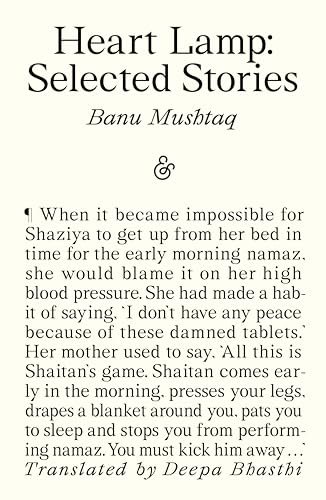
Heart Lamp is a collection of eleven short stories by Banu Mushtaq, a Kannada writer, journalist, lawyer, and activist whose work emerges from the Bandaya (dissent/rebellion) literary movement. Translated into English by Deepa Bhasthi, these stories offer an unflinching look into the lives of Muslim women in small-town Karnataka, India. The collection critiques patriarchy, religious hypocrisy, economic exploitation, and the double standards embedded in both society and religious institutions.
Key Themes Across the Collection
Patriarchy and Male Hypocrisy
Nearly every story exposes how men weaponize religion, tradition, and law to control women while exempting themselves from the same rules. In Black Cobras, the mutawalli (mosque trustee) lectures a desperate woman about Allah’s will while secretly drinking, gambling, and planning to abandon his wife. When Yakub kicks his wife Aashraf and she faints, her infant daughter Munni dies—yet no man is held accountable. The story ends with women cursing the mutawalli, but justice remains elusive.
A Decision of the Heart shows a husband planning to marry off his own mother to punish his wife. The mother, Mehaboob Bi, accepts this fate to restore peace, while the wife Akhila manipulates the situation to avoid blame. Neither woman wins; both are trapped by male ego.
Economic Exploitation and Class
Red Lungi contrasts a wealthy family’s elaborate circumcision celebrations with poor families who receive only a red cloth and meager wheat. When a destitute woman tries to get her already-circumcised son done again just to receive food, she is publicly humiliated. Latif Ahmad’s own son nearly dies from infection after a hospital procedure, while a poor boy heals naturally with ash—yet the rich boy receives all the care.
Religious Institutions as Enforcers of Patriarchy
The mosque and its leaders appear repeatedly as institutions that uphold male privilege rather than justice. In Black Cobras, the mutawalli refuses to help Aashraf despite her husband’s clear violation of Islamic law requiring equal treatment of multiple wives. In The Shroud, a woman who fails to deliver a promised burial shroud from Mecca is consumed by guilt—but the story implies the real sin is how religion is used to control women’s behavior.
The Weight of Unfulfilled Promises
The Shroud is a devastating story about a wealthy woman, Shaziya, who promises to bring a holy burial shroud from Mecca for a poor widow, Yaseen Bua. She forgets. Years later, when Yaseen Bua dies, her son comes to claim the shroud. Shaziya cannot produce it. The story follows her spiral into guilt and self-loathing, realizing that her wealth and status mean nothing against a broken promise to a dead woman whose last wish she ignored.
Love, Loneliness, and Arranged Marriage
Soft Whispers revisits a narrator’s childhood memory of Ajji (grandmother), a wise, independent woman who smokes bidis, challenges religious hypocrites, and loves fiercely. The narrator recalls a boy named Abid who kissed her as a child; decades later, Abid has become the supervisor of a dargah (shrine), and the narrator must navigate this adult encounter with the ghost of that childhood memory.
A Taste of Heaven follows a family caring for an elderly aunt, Bi Dadi, whose only remaining pleasure is drinking Pepsi, which her grandnephew renames “aab-e-kausar” (heavenly nectar). She lives contentedly in a delusion that she is already in heaven with her long-dead husband—a bittersweet critique of how older women are cared for (or not) by families.
Language and Code-Switching
The translator’s note explains that Banu writes in a Kannada infused with Dakhni, Urdu, and Arabic—reflecting how Muslims in this region actually speak. The translator deliberately avoids italicizing non-English words to prevent exoticizing them. Terms like savathi (co-wife), khabaristan (cemetery), janaza (funeral bier), and seragu (the loose end of a saree worn over the head) remain in their original forms, immersing the reader in the characters’ world.
Notable Stories
“Stone Slabs for Shaista Mahal” opens the collection. Zeenat admires Iftikhar’s apparent devotion to his wife Shaista—the guava trees he planted for her, the swings, the flowers. But when Shaista dies in childbirth, Iftikhar remarries within forty days. The new wife is a teenager. The symbolic “Shaista Mahal” Iftikhar promised is never built. Love, the story suggests, is performative and easily replaced.
“Fire Rain” follows a mutawalli who refuses his sister’s legal share of inheritance, citing tradition. When a Muslim man’s body is mistakenly buried in a Hindu cemetery, he leads a campaign to exhume it—spending enormous energy on symbolic religious purity while ignoring his own family’s moral debts. His sick child suffers while he plays politics.
“High-Heeled Shoe” uses a pair of imported shoes as a symbol of aspiration and oppression. Nayaz Khan, a low-level employee, becomes obsessed with getting his wife Arifa a pair of high heels like his wealthy sister-in-law wears. He forces her to wear shoes that don’t fit, and she nearly miscarries. The shoes shatter. The story critiques how men project their insecurities onto women’s bodies.
“Heart Lamp” (the title story) follows Mehrun, a woman abandoned by her husband for another woman. When she returns to her brothers for help, they tell her to “manage” and send her back. She attempts suicide by setting herself on fire, but her daughter Salma stops her. The “heart lamp” that should guide her has been extinguished by everyone who should have protected her.
“The Arabic Teacher and Gobi Manchuri” is the collection’s rare comic story. A Quran teacher from Uttar Pradesh becomes obsessed with gobi manchuri (a cauliflower snack). His marriage negotiations fail because he asks every potential bride if she can cook it. He finally marries, then beats his wife because she cannot make it to his taste. The narrator, a lawyer, eventually sends him the recipe—but the damage is done.
Critical Reception and Significance
Banu Mushtaq is considered one of the few women writers from the Bandaya movement who has continued writing consistently over decades. Her work is remarkable for centering Muslim women’s lives without reducing them to their religious identity—instead showing them as complex individuals navigating patriarchy, class, and tradition.
The translator, Deepa Bhasthi, notes in her introduction that she and Banu share a “sisterhood” as women, despite their different religious and caste backgrounds. This solidarity, she argues, is the foundation of the translation.
Conclusion
Heart Lamp is a collection about women surviving in spaces not designed for their survival. The stories are unflinching, often brutal, but also tender and sometimes darkly comic. Banu Mushtaq writes with the precision of a lawyer (her other profession) and the empathy of someone who has witnessed these struggles firsthand. The translation by Deepa Bhasthi brings these voices into English while preserving the multilingual texture of their original language.
These are stories about broken promises, stolen inheritances, performative piety, and the quiet rebellion of women who refuse to disappear. The “heart lamp” of the title—the inner light that should guide each person—is constantly threatened by those who claim to protect it. But it never goes out entirely.