
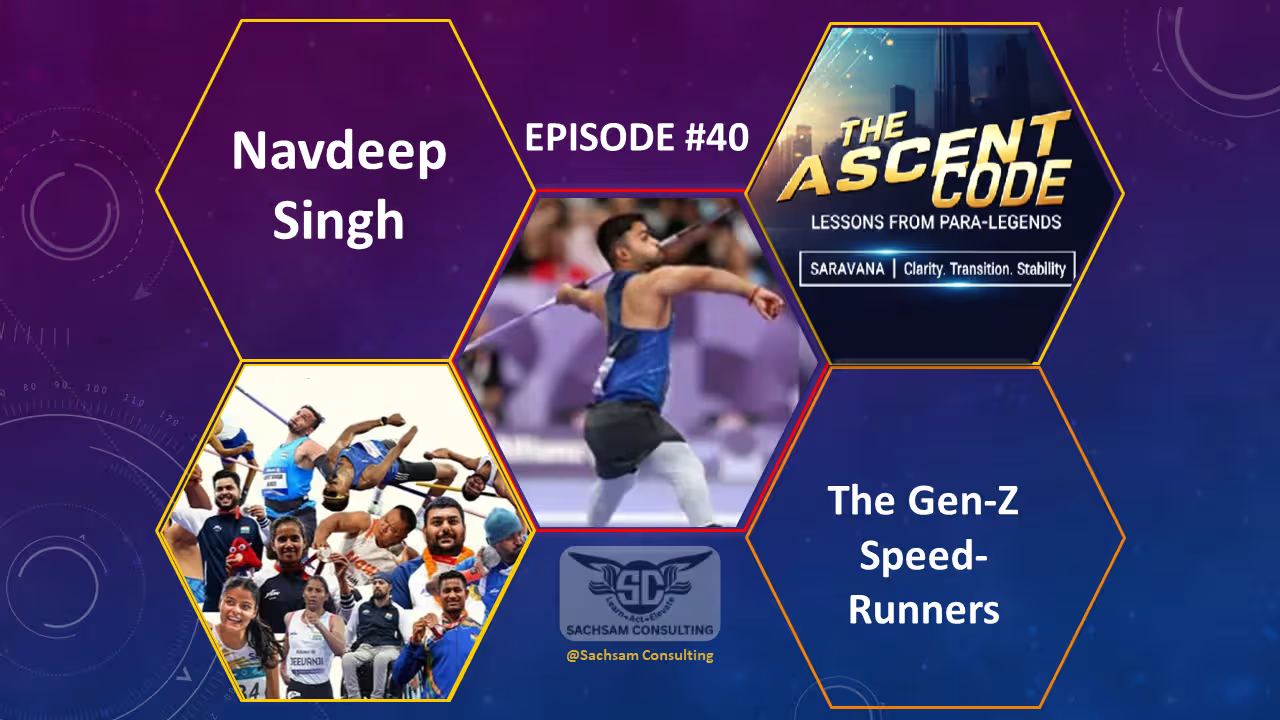
ASCENT CODE: Episode 40
The Final Throw
Navdeep Singh, The Gen‑Z Speed‑Runners. Born with dwarfism at 4’4″. Village ridicule. Fourth place at Tokyo 2020 fuelled three years of monk‑like discipline. His final throw at Paris 2024 was upgraded to Gold: the first‑ever F41 Paralympic champion. Now an Income Tax Inspector leading national short‑stature field camps.
EXECUTIVE SUMMARY
Navdeep Singh was born with dwarfism at 4’4″ in a Haryana village where physical stature carries social weight. The ridicule was systematic: a nickname built around what the body was not, the specific weight of a community’s decision about what kind of person could amount to something. Fourth place at Tokyo 2020 produced a precise and specific gap: here is exactly how far current performance is from the Gold standard. That measurement is the most useful data a serious competitor can have.
Three years of monk‑like training discipline followed. At Paris 2024, on the final throw of the competition, Navdeep Singh’s result was upgraded to Gold after a competitor’s disqualification. The first‑ever F41 Paralympic javelin champion. He also won Bronze at the 2024 World Championships in Kobe. As of 2026, he works as an Income Tax Inspector and leads national short‑stature field camps.
⚙️ THE FOURTH‑PLACE FUEL METRIC: Fourth place at the Paralympics says you are fourth in the world in the most competitive para‑athletic event. Most would celebrate that. Navdeep read it as a training plan. That reading is the Speed‑Run Code’s specific contribution: re‑framing the result not as an achievement to be acknowledged but as a measurement to be acted on.
THE ASCENT CODE: THE SPEED‑RUN CODE OF FOURTH‑PLACE FUEL: Fourth place is not failure. It is the most precise possible measurement of the gap between current performance and the Gold standard. Convert it into a training architecture and it becomes the highest‑quality motivational fuel in sport.
THE CRISIS: 4’4″, VILLAGE RIDICULE, AND FOURTH PLACE
Navdeep Singh was born with dwarfism. Growing up at 4’4″ in a village context where physical stature carries social weight, the ridicule was not incidental. It was systematic: the particular sound of a nickname built around what the body was not, the specific weight of a community’s decision about what kind of person can or cannot amount to something. These are the sensory coordinates of an early life that built, in response, an internal determination to disprove the community’s assessment on any available stage.
The Paralympic stage arrived. Tokyo 2020. He competed. He threw. He finished fourth. One place off the podium. One result off a medal. In a different athlete, fourth place might have been sufficient evidence of competitive legitimacy: I am nearly the best in the world in my category. In Navdeep, fourth at the Paralympics produced something different. It produced a precise and specific gap: here is exactly how far current performance is from the Gold standard. That measurement is the most useful data a serious competitor can have.
At Paris 2024, on the final throw of the competition, Navdeep Singh’s result was upgraded to Gold after a competitor’s disqualification. The first‑ever F41 Paralympic javelin champion. The village had no vocabulary for what happened in Paris. The ridicule had built the engine that produced the Gold.
THE ORIGIN: THREE YEARS, ONE STANDARD, MONK‑LIKE DISCIPLINE
The shadow phase is the fourth‑place result: not failure, but precise knowledge of a gap. The three years between Tokyo and Paris were defined entirely by converting that gap into a training architecture.
Monk‑like discipline here has structural meaning: every training decision across three years was referenced against the Gold standard. The Tokyo gap was not a general sense of needing to improve. It was a specific measurement: the technical elements separating his fourth‑place throw from the first. Those elements became the entire focus. Three years on a precisely identified gap produces the Gold on the final throw.
THE GRIND: THREE YEARS, ONE FOCUS, ONE FINAL THROW
Every session in the three‑year arc was oriented toward the precise gap the fourth‑place result had identified. The monk‑like discipline was targeted preparation directed at the exact technical variables Tokyo had measured, not generalised high‑volume training.
- Converting the Tokyo fourth‑place result into a precise technical gap analysis, identifying the specific physical and mechanical elements separating the fourth‑place throw from a Gold‑standard throw.
- Three years of monk‑like training discipline, every session referenced against the Gold standard measurement, building toward the Paris competition with a specific and non‑negotiable performance target.
- Competing at Paris 2024, throwing on the final attempt, and receiving the upgraded Gold after a competitor’s disqualification: the first‑ever F41 Paralympic javelin champion.
Verified Achievements
• Paris 2024 Paralympics: Gold Medal, F41 javelin (first‑ever F41 champion)
• 2024 World Championships (Kobe): Bronze Medal, F41 javelin
First ever. The village that called him small watched him become the first F41 champion in history. The fourth‑place fuel ran exactly as far as it needed to.
THE ASCENT CODE: THE SPEED‑RUN CODE OF FOURTH‑PLACE FUEL
Here is what most motivational frameworks mishandle about near‑miss results: they treat the near‑miss as a motivational resource of lower quality than victory. You almost won. Use that as fuel. But the framing remains aspirational rather than technical. Almost won is not a training instruction. It is a feeling. Feelings are unreliable training architects over three‑year timelines.
The fourth‑place result at Tokyo was not almost won. It was a precise technical measurement: the distance in metres between his best throw and Gold. The specific mechanical elements that produced the gap. Those are not a feeling. They are a training plan. Navdeep’s three years were directed by the technical information fourth place contained, not by the emotion it generated.
I see this pattern often in professionals who treat near‑miss results as motivational fuel. I ask them to be precise: what exactly was the gap between your performance and the Gold standard? Not how did it feel. What was the specific technical delta? That delta is the training plan. The emotion fades after six months. The gap does not. Navdeep worked from the gap. The Gold was the output.
Patterns like this are not limited to sport. I often see them in professionals who experience near‑misses in their careers. The technical gap, extracted precisely, is more valuable than the emotion of the near‑miss.
THE HOW-TO FRAMEWORK: THE SPEED‑RUN CODE IN 4 STEPS
- Extract the Technical Gap From the Near‑Miss
After every near‑miss performance, before the emotion subsides, extract the precise technical gap. Not what it felt like to miss. What specifically separated your performance from the Gold standard. Name it in technical, measurable terms. That extraction is the training plan that will still be valid in year three of the preparation cycle. - Convert the Gap Into a Daily Training Reference
Monk‑like discipline means every session is referenced against the gap. Not against your previous personal best. Against the Gold standard gap identified after the near‑miss. Design your professional practice sessions so that each one is explicitly directed at closing a specific element of that gap rather than generally improving your performance. - Let the Village Ridicule Build the Engine, Not the Ceiling
The village ridicule built a determination to disprove. That is a high‑quality motivational engine when it is directed toward a specific competitive standard rather than a vague aspiration to succeed. Identify the specific result that would make the dismissal visibly wrong. Build toward it technically. - Trust the Final Throw
The Paris Gold came on the final throw. That moment required trusting three years of preparation to produce the output on the last available attempt. Build the preparation so that the final throw is the inevitable expression of three years of focused technical work, not a gamble.
THE REFRAME: FOURTH PLACE WAS THE MOST USEFUL RESULT
Return to that Tokyo 2020 competition. The fourth‑place result delivered. One position off the podium. The specific measurement of a gap that, if closed, produces a medal.
Fourth place at the Paralympics says you are fourth in the world in the most competitive para‑athletic event. Most would celebrate that. Navdeep read it as a training plan. That reading is the Speed‑Run Code’s specific contribution: re‑framing the result not as an achievement to be acknowledged but as a measurement to be acted on.
The Gold was not the result of trying harder. It was working smarter on a precisely identified gap. Fourth place gave him the map. Three years followed it. Paris 2024 was the destination. As of 2026, Navdeep Singh works as an Income Tax Inspector and leads national short‑stature field camps for the next generation of F41 competitors.
SELF AUDIT
- What is the most recent near‑miss result in your professional career? Have you extracted the precise technical gap from it, or have you processed it only as an emotional experience?
- Is your current development programme directed at closing a precisely identified gap, or is it directed at generally improving your performance? What would it look like to work from the gap rather than from the general aspiration?
- Do you trust your preparation enough that the final throw is the expression of three years of focused work, rather than a gamble? If not, what specific element of preparation would need to be in place for that trust to exist?
👇 Drop your answer in the comments. The #AscentYouTribe learns together.
THE SCIENCE OF NEAR‑MISS MOTIVATION AND TECHNICAL GAP ANALYSIS
Sports psychology research documents a bifurcated response to near‑miss results. Athletes who process them emotionally show short‑term motivational spikes followed by performance anxiety. Athletes who process them analytically, converting the technical gap into a training target, show sustained motivational drive across multi‑year cycles and superior performance under pressure.
Navdeep’s three‑year preparation between Tokyo and Paris reflects the analytical processing profile. The fourth‑place result was not a source of emotional fuel but a source of technical information. Research on elite javelin performance confirms that technique‑specific protocols directed at identified gap elements produce greater gains over three‑year cycles than equivalent non‑specific volume. The monk‑like discipline was precision directed by the Tokyo gap data.
Next on The Ascent: Episode 41: Bhimrao Kesarkar, The Zero‑to‑One Pioneers.
SARAVANA KUMAR
Clarity | Transition | Inner Stability
The question from Navdeep’s story that I bring into every coaching debrief after a near‑miss: what was the precise technical gap? Not how close was it, not how did it feel, not what would you do differently in a general sense. The precise technical delta between your performance and the Gold standard in that room. When clients can answer that question precisely, the three‑year preparation plan practically writes itself. When they cannot, the near‑miss remains an emotional memory rather than a training plan. Extract the gap. Build from the map.
#SaravanaSays
Your Growth Journey Starts Here
All the ways to connect, learn, and grow with the Tribe — in one place. Choose your favourite platform and stay plugged into daily momentum.
KEYWORDS: Ascent Code, Navdeep Singh, Speed‑Run Code, Fourth‑Place Fuel, Gen‑Z Speed‑Runners, Paris 2024 Gold, F41 javelin first ever, Kobe 2024 Bronze javelin, monk‑like training, dwarfism athlete, F41 para‑javelin champion, village ridicule success story, near‑miss motivation gap, LA 2028 javelin India, final throw Gold upgrade.
HASHTAGS: #AscentCode #AscentYouTribe #SaravanaSays #SaravanaKumar #SpeedRunCode #FourthPlaceFuel #Clarity #Transition #InnerStability #NavdeepSingh #ParalympicsIndia #ParaJavelin #Paris2024 #FirstEverChampion #MonkMode #IncomeTaxInspector #sachsamconsulting