

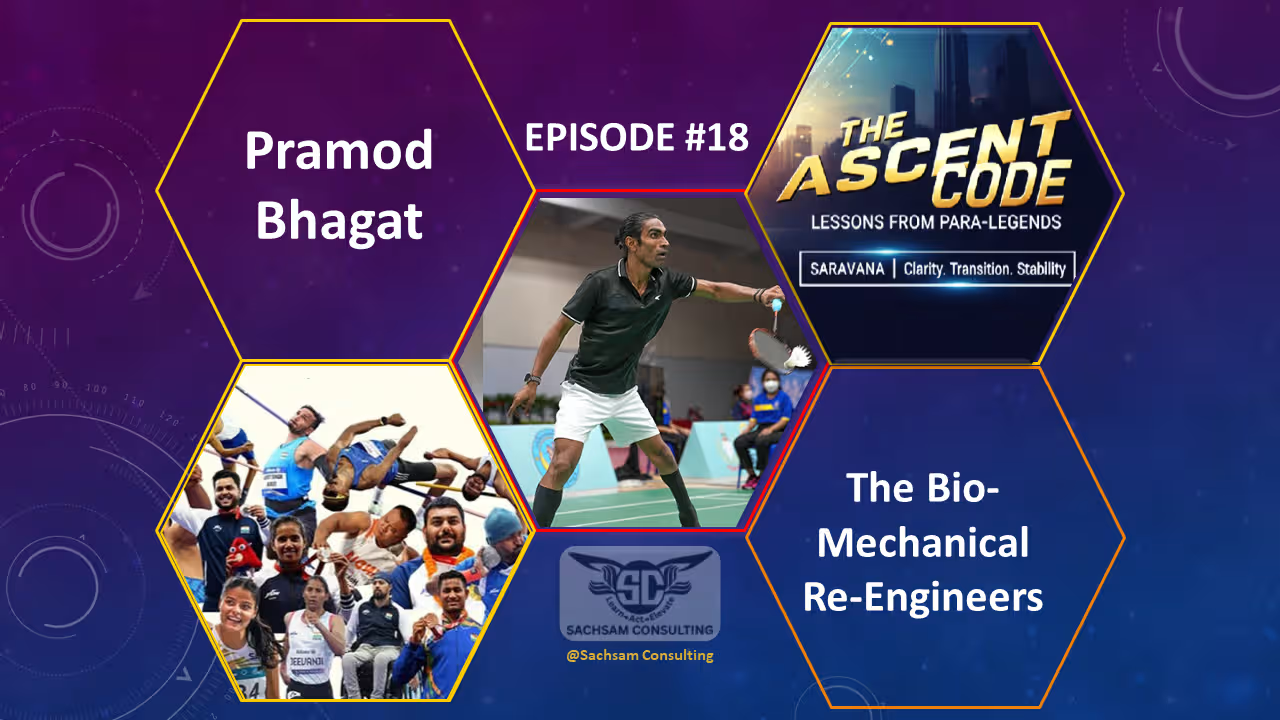
ASCENT CODE: Episode 18
The Court Tactician
Pramod Bhagat, The Bio‑Mechanical Re‑Engineers. A boy from Odisha who watched neighbours play badminton, picked up a heavy wooden racquet, and won the first‑ever Paralympic Gold in the sport. Five World Championship Golds. One tactical masterclass.
EXECUTIVE SUMMARY
Pramod Bhagat was five years old when polio affected his left leg. In Odisha in the late 1980s, he picked up a heavy wooden racquet and joined neighbourhood games against able‑bodied players. No para‑category. No adapted equipment. No coaching.
His physical limitation forced a specific tactical adaptation. He could not dominate through speed and reach. So he built mastery of court geometry and opponent psychology. At Tokyo 2020, badminton appeared at the Paralympics for the first time. He won Gold — the first Paralympic badminton champion in history. He also holds more than five World Championship Gold medals.
⚙️ THE TACTICAL COMPENSATION METRIC: Years of playing against able‑bodied, faster opponents forced him to develop anticipatory skills, spatial prediction, and placement mastery that his slower opponents in the SL3 category could not decode.
THE ASCENT CODE: THE RE‑ENGINEER CODE OF TACTICAL COMPENSATION: When physical reach is limited, tactical intelligence becomes the primary competitive weapon. Master the geometry of the space. Map your opponent’s patterns. Win the match in your mind before your body executes it.
THE CRISIS: THE LEG, THE WOODEN RACQUET, AND THE NEIGHBOUR’S COURT
Pramod Bhagat was five years old when polio affected his left leg. In Odisha in the late 1980s, a disabled child in a modest household had limited access to anything that could be called a developmental pathway. The particular dust of an Odishan summer afternoon, the slap of a shuttlecock on a wooden racquet, the sound of neighbours calling across the court: these are the sensory coordinates of a childhood that was building a world‑class player without knowing it.
He watched the neighbourhood games, then picked up a heavy wooden racquet and joined in. Against able‑bodied players. No para‑category. No adapted equipment. No coaching. He played well enough that the belief formed: this was an arena where he could dominate.
At the Tokyo 2020 Paralympic Games, badminton appeared at the Paralympics for the first time in history. Pramod Bhagat won Gold. The first Paralympic badminton champion in the world. The heavy wooden racquet from an Odishan neighbourhood court had eventually led here.
THE ORIGIN: WHEN THE COURT BECAME A LABORATORY
The shadow phase in Pramod’s story is not institutional invisibility in the way earlier episodes have shown. It is a different gap: years of competing in the wrong category. Because no local para‑tournaments existed, he competed against able‑bodied players for years. That constraint, frustrating in one sense, built something specific. Playing against faster, more mobile opponents with a physically limited leg required him to find an edge that was not physical.
He found it in the geometry of the court. Placement matters more than speed, if you have mapped where your opponent will move. He began to see each rally as a spatial problem: identifying gaps, forcing movement to disadvantage positions, manufacturing pressure through placement rather than power. When he transitioned to the SL3 category, his tactical architecture was already world‑class.
The turning point was winning a local tournament against able‑bodied players. His tactical game beat faster, more mobile opponents. That confirmation converted neighbourhood play into serious competitive intent.
THE GRIND: BUILDING A TACTICAL MASTERCLASS
The arc from neighbourhood play to Paralympic champion was built through accumulated competition: national, international, World Championship cycles; each level adding data to the tactical framework.
- Competing extensively on the international para‑badminton circuit, building opponent‑specific game plans and refining the court geometry principles across different competitive contexts.
- Winning multiple World Championship titles, establishing himself as the global SL3 benchmark and the player every competitor in the category prepared specifically to face.
- Qualifying for and competing in Tokyo 2020 as the sport’s debut at the Paralympics, winning Gold in the first‑ever para‑badminton Olympic competition.
Verified Achievements
• Tokyo 2020 Paralympics: Gold Medal, SL3 para‑badminton (sport’s first Paralympic champion)
• Five-plus World Championship Gold medals across the competitive career
First Paralympic champion in the sport. Five World Championship Golds. The tactical framework built in a neighbourhood court produced results at every level.
THE ASCENT CODE: THE RE‑ENGINEER CODE
Here is what most people assume about physical limitation in sport: that reduced reach, mobility, or speed translates directly into reduced competitive output. That you compensate for physical limitation by working harder within it. Pramod Bhagat’s career is evidence that this assumption misses the more productive response entirely.
His left leg limited his court coverage. The conventional response to that constraint would be to maximise what remained: train the right leg harder, improve reaction time, build explosive lateral movement. He did some of that. But the primary response was tactical: redesign the game so that court coverage becomes less important than court geometry. Force the opponent into positions where their speed advantage is neutralised. Win through placement, not pace.
I see this pattern often in professionals after restructuring or role change. The first instinct is to compensate: work harder in the remaining domain, restore what was lost. The Re‑Engineer Code asks a different question: given the new constraint, which tactical approach produces better outcomes than the original game? Pramod did not rebuild his physical game. He built a tactical one that beat it. Your constraint may be asking you to do the same.
THE HOW-TO FRAMEWORK: THE RE‑ENGINEER CODE IN 4 STEPS
- Map the Geometry, Not the Physical Contest
Pramod stopped asking “how do I keep up?” and started asking “where does the match get won?” Map the geometry of your domain: the positions that produce outcomes independent of raw capability. Build toward those positions instead of trying to match capability you do not have. - Study Your Opponent Before They Study You
He developed opponent‑specific game plans before stepping on court: movement tendencies, preferred patterns, pressure responses. Your professional equivalent is preparation intelligence. The prepared mind is not startled by what the unprepared mind has not mapped. - Convert Constraint into Tactical Specialisation
Years against able‑bodied players forced placement mastery that became his primary weapon. Your constraint is forcing you to develop a capability your unconstrained competitors have no reason to build. Identify it. Develop it. Compete where it creates asymmetric advantage. - Win in Your Mind Before Your Body Executes
Pramod entered matches with the outcome already framed in his tactical preparation. Apply this to professional performances: analysis and strategic framing happen before the room. Execution is the output of prior mental work. If you are improvising on the court, you have not done the pre‑match work.
The Reframe: The Wooden Racquet Built the World Champion
Return to that Odishan afternoon. The dust. The slap of shuttlecock on wood. A five‑year‑old with a polio‑affected leg watching neighbours play, then picking up the heavy wooden racquet and joining in.
That wooden racquet was not a lesser tool. It was a harder one. The inability to generate power easily forced placement development. The heavy frame forced wrist mechanics that lightweight equipment would have made unnecessary. The years against able‑bodied opponents forced the tactical intelligence that became his primary competitive weapon.
As of 2026, Pramod Bhagat is focused on a competitive comeback and runs a badminton academy in Odisha, building the next generation of players on the tactical foundation only he could have laid.
SELF AUDIT
- • In your professional domain, what is the geometry of the contest? Where are the positions that produce outcomes independent of raw capability? Are you competing for those positions, or competing on capability alone?
- • What does your current constraint force you to develop that your unconstrained competitors have no reason to build? Have you identified that capability and invested in it deliberately?
- • How much of your professional preparation happens before the room, and how much do you improvise in it? What would it look like to win the match in your mind before your body executes?
👇 Drop your answer in the comments. The #AscentYouTribe learns together.
THE SCIENCE OF TACTICAL COMPENSATION IN SPORT
Sports science research on athletes with lower limb impairments in court sports documents a consistent finding: elite performers in these categories develop measurably superior anticipatory skills and spatial decision‑making compared to able‑bodied peers at equivalent competitive levels. The mechanism is adaptive investment: when physical coverage is constrained, attentional resources previously allocated to movement are redirected toward opponent pattern recognition and spatial prediction.
Pramod’s tactical dominance reflects this principle precisely. Years of competing against players with physical advantages forced an accelerated development of the anticipatory and spatial systems that all elite badminton players need, but which able‑bodied players develop more slowly because physical solutions remain available. His constraint produced a cognitive competitive advantage. The Re‑Engineer Code works because the brain allocates attentional investment toward the problems it cannot solve physically. Pramod’s court geometry is the output of a brain that had no physical shortcut available.
Next on The Ascent: Episode 19: Sachin Chaudhary, The System‑Hacking Outsiders.
SARAVANA KUMAR
Clarity | Transition | Inner Stability
The detail that stays with me from Pramod’s story is the wooden racquet. Not as a symbol of hardship, but as a technical insight: heavier equipment forces finer mechanics. The professionals I coach who have operated in resource‑constrained or adversity‑shaped environments often carry technical precision that their well‑resourced peers have never needed to develop. The question I ask them: are you applying that precision to your current arena, or leaving it unused because the conditions are now better? Better conditions require you to bring the precision the hard conditions built.
#SaravanaSays
Your Growth Journey Starts Here
All the ways to connect, learn, and grow with the Tribe — in one place. Choose your favourite platform and stay plugged into daily momentum.
KEYWORDS: Ascent Code Pramod Bhagat, Re‑Engineer Code, Bio‑Mechanical Re‑Engineers, Tokyo 2020 Paralympic Gold badminton, first Paralympic badminton champion, SL3 para‑badminton, five World Championship Golds, court geometry tactics, tactical dominance sport, Odisha para‑badminton, polio athlete India.
HASHTAGS: #AscentCode #AscentYouTribe #SaravanaSays #SaravanaKumar #ReEngineerCode #Clarity #Transition #InnerStability #HighPerformance #MindsetEngineering #ResilienceEngineered #SuccessSystems #TacticalDominance #LeadershipPrinciples #CourtGeometry #SelfOptimization #PramodBhagat #ParalympicsIndia #ParaBadminton #Tokyo2020 #IndianAthletes #AdaptiveAthletes #ReEngineerYourself




Comments
2[…] Read → […]
[…] Episode 18: Pramod Bhagat, The Bio‑Mechanical Re‑Engineers […]