

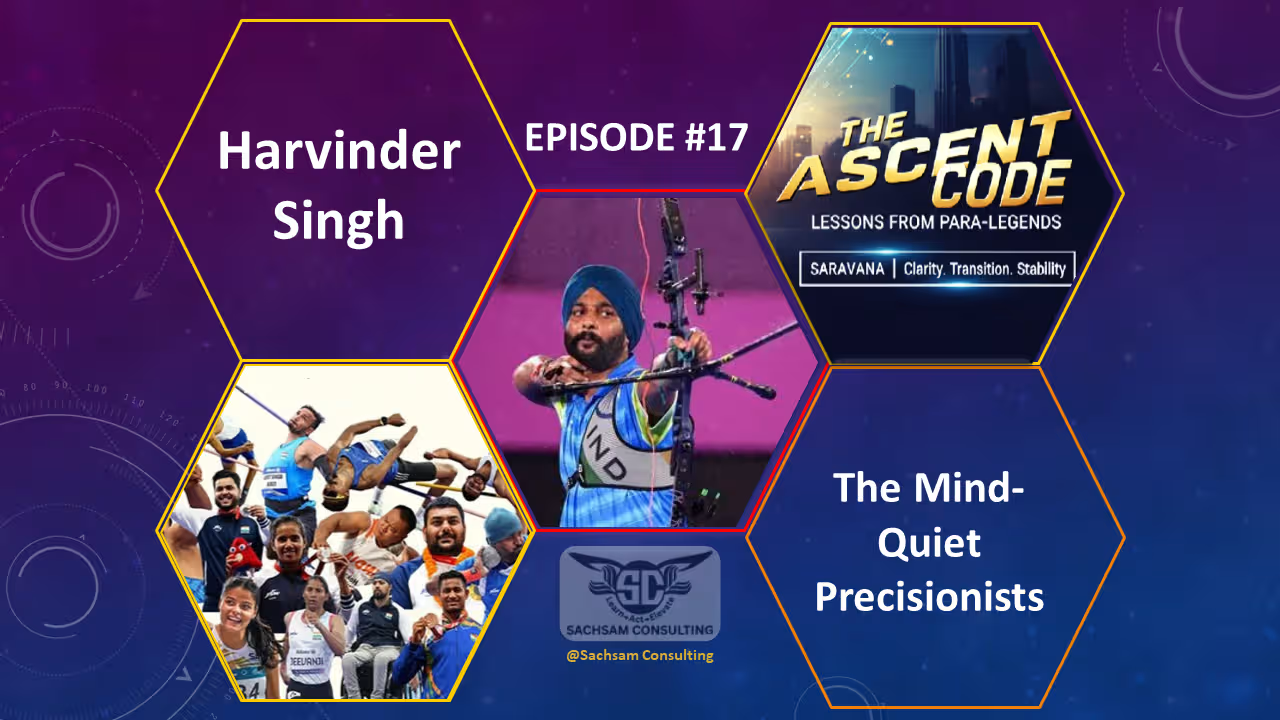
ASCENT CODE: Episode 17
The Scholar Archer
Harvinder Singh, The Mind‑Quiet Precisionists. A PhD student from a Haryana farming family who watched archery on television in 2012 and decided to become the first Indian archer to win a Paralympic Gold.
EXECUTIVE SUMMARY
Harvinder Singh contracted polio at age one and a half from a wrong injection given for dengue. He grew up in a middle‑class farming family in Haryana. In 2012, watching the London Olympics on television, he decided to take up archery while pursuing a PhD in Economics. Not instead of the doctorate. Alongside it.
Tokyo 2020: Bronze. India’s first‑ever archery medal at any Paralympics. Paris 2024: Gold. First Indian archer, para or able‑bodied, to win Paralympic Gold. He completed his doctorate and won Olympic Gold in the same career window.
⚙️ THE ACADEMIC‑ATHLETIC TRANSFER METRIC: PhD examination preparation trains sustained focus, performance under pressure, and composure through uncertainty. Olympic archery requires the exact same neural architecture. The same discipline produced both outcomes.
THE ASCENT CODE: THE PRECISION CODE OF ACADEMIC‑ATHLETIC TRANSFER: Academic rigour and athletic precision share the same neural substrate. Training one deepens the other. The discipline required to perform under examination conditions is the same discipline required to perform on an Olympic range.
THE CRISIS: A WRONG INJECTION AND A LIFE REDIRECTED
Harvinder Singh contracted polio at one and a half years old from a wrong injection given during treatment for dengue. The sterile smell of a Haryana medical facility, the particular cold of a treatment room when something goes irreversibly wrong: these are the coordinates of a beginning that redirected a life before it had started making its own choices.
He grew up in a middle‑class farming family. Not the grinding poverty of some earlier episodes, but not abundance either. The kind of household where education is valued because it is understood as the reliable path, and where sport exists as recreation rather than aspiration. Polio had marked him. But it had not removed the intellectual drive that the farming household’s emphasis on education was quietly building alongside it.
At Paris 2024, Harvinder Singh won Gold in para‑archery. He became the first Indian archer, para or able‑bodied, to win a Paralympic Gold medal. The wrong injection at eighteen months created the condition that qualified him for the category. The PhD he completed while training built the mind that won the Gold.
THE ORIGIN: TELEVISION, A DOCTORATE, AND A DECISION
The shadow phase in Harvinder’s story is not institutional invisibility. It is a different kind of gap: a highly capable person without a competitive arena that matched his specific profile. He was academic, disciplined, and physically impaired. Para‑sports existed, but the connection between his profile and archery had not yet been made.
In 2012, watching the London Olympics on television changed the coordinates. He saw archery, recognised the combination of stillness and sustained precision the sport demands, and made a deliberate decision: pursue it alongside the doctorate. Not instead of it. He would treat archery as a second intellectual discipline, directly relevant to his Economics training rather than a competing demand on his time.
That framing was the turning point. The doctoral rigour built his archery focus. The archery training built his doctoral resilience. Each domain made the other harder and more productive.
THE GRIND: DOCTORAL RIGOUR MEETS OLYMPIC PRECISION
Balancing PhD study with elite para‑archery training meant operating at intensity in two demanding domains simultaneously. Archery equipment is expensive: high‑precision bows and arrows represent a significant financial commitment that a farming family’s resources could not easily absorb. Every element of the preparation had to be deliberately managed.
- Competing at national and international para‑archery level while maintaining doctoral research progress, developing the scheduling discipline that both domains required.
- Building the pre‑shot routine and breath control architecture that para‑archery demands, drawing explicitly on the mental frameworks his Economics training had developed.
- Qualifying for and competing in the Tokyo 2020 Paralympic Games, winning Bronze and becoming the first Indian to medal in Paralympic archery.
Verified Achievements
• Tokyo 2020 Paralympics: Bronze Medal, para‑archery (India’s first archery medal)
• Paris 2024 Paralympics: Gold Medal, para‑archery (first Indian archer, para or able‑bodied, to win Paralympic Gold)
Bronze at Tokyo. Gold at Paris. First in India at both. He did not just compete. He established an entirely new category of Indian sporting achievement, in the same four‑year arc that most athletes use to consolidate a single result.
THE ASCENT CODE: THE PRECISION CODE
Here is the assumption most athletes and coaches operate under: elite sport requires full‑time dedication. Part‑time training produces part‑time results. The scholar‑athlete, balancing academic demands with elite preparation, is making a career compromise. Harvinder Singh’s Gold at Paris 2024 is direct evidence against that assumption.
The mental rigour required to complete a PhD under examination pressure is not separate from what archery demands. It is the same discipline: holding a precise cognitive framework intact when external pressure is at its peak, executing a specific process reliably when the result matters most, and maintaining composure through the periods of uncertainty that both academic research and Olympic competition inevitably produce. Harvinder did not train archery despite the PhD. The PhD trained archery.
I see this pattern often in leaders who treat their intellectual development and their professional performance as separate tracks. The reading, the analysis, the structured thinking: they file these as professional development, disconnected from their actual performance under pressure. Harvinder’s career is the counter‑argument. The domain where you sharpen your mind sharpens your performance in every arena that demands precision under pressure.
THE HOW-TO FRAMEWORK: THE PRECISION CODE IN 4 STEPS
- Identify the Structural Transfer Between Disciplines
Harvinder identified the specific structural overlap: both disciplines require sustained focus under examination conditions, reliable process execution when stakes are high, and composure through uncertainty. Map the specific overlap between your intellectual and performance domains. Generic transfer claims produce nothing. Precise structural mapping produces a training system. - Treat Apparent Conflict as Mutual Reinforcement
The conventional view was that PhD and archery competed for time. Harvinder reframed them as mutually reinforcing. When you face two demanding commitments, before concluding they conflict, ask whether the rigour of one is building the capacity the other requires. Often it is. - Apply Doctoral‑Level Preparation to High‑Stakes Performance
A doctoral candidate maps every counterargument before the viva and addresses every gap before the examiner finds it. Apply the same standard before a board presentation, negotiation, or critical decision. Map counterarguments, address gaps, enter the room with your framework intact. - Build Your Pre‑Performance System From Your Intellectual Architecture
Harvinder’s pre‑shot routine drew on frameworks his Economics training had built. Your intellectual discipline has already developed cognitive structures for organising complexity and reaching decisions under uncertainty. Identify them. Build them into your pre‑performance routine. Do not improvise when your intellectual work has already built the framework.
THE REFRAME: THE DOCTORATE WAS THE TRAINING
Return to that Haryana television set in 2012. The London Olympics on screen. A PhD student watching archery and recognising something in the combination of stillness and precision that the sport required: a mirror of what academic life at the highest level already demanded from him.
The wrong injection that gave him polio was not the beginning of a limitation story. It was the beginning of a categorisation that would eventually place him on a range where his specific combination of physical impairment, intellectual discipline, and meditative precision produced a world‑first result. The polio was the credential. The doctorate was the training. The Gold at Paris was the examination result.
Most professionals treat their intellectual life and their competitive performance as separate tracks. Harvinder’s career proves they are the same track. As of 2026, he serves as an Archery Coach and Officer at SAI, training the next generation with a framework that only a scholar‑athlete could have built. The Precision Code, in its most complete form, is not mental stillness alone. It is the architecture of a trained mind, brought to the range and released.
SELF AUDIT
- • Where in your intellectual development are you building mental rigour that you are not consciously applying to your highest‑stakes professional performances? Name the specific transfer.
- • What two demanding commitments in your life are you treating as in conflict, when the rigour of one might be building the capacity the other requires?
- • Are you preparing for your highest‑stakes moments at doctoral standard, mapping every counterargument and addressing every gap before the examination begins?
👇 Drop your answer in the comments. The #AscentYouTribe learns together.
THE SCIENCE OF DOMAIN TRANSFER IN EXECUTIVE FUNCTION
Cognitive neuroscience research on executive function documents that high‑level academic training produces measurable improvements in attentional control, working memory capacity, and cognitive flexibility — the same executive functions that precision sports performance demands at elite level. Doctoral‑level study, which requires sustained attention under pressure, complex multi‑variable problem solving, and composure during prolonged uncertainty, builds precisely the neural architecture that Olympic archery exploits.
Harvinder’s dual training system was not a compromise. It was a multiplier. Each domain recruited the same prefrontal cortical networks, building deeper executive control than either alone would have produced. Sports psychology research confirms that athletes who engage in high‑level intellectual work alongside physical training demonstrate superior composure under pressure than those whose development was sport‑exclusive. The scholar is building the archer.
Next on The Ascent: Episode 18: Pramod Bhagat, The Bio‑Mechanical Re‑Engineers.
SARAVANA KUMAR
Clarity | Transition | Inner Stability
Harvinder Singh is the episode I return to when leaders tell me they do not have time to read, think, or develop intellectually while performing at high intensity professionally. He completed a PhD and won an Olympic Gold in the same career window. He did not choose between intellectual rigour and competitive excellence. He understood they were building the same thing. Your reading, your structured thinking, your analytical work: these are not separate from your performance under pressure. They are the preparation for it.
#SaravanaSays
Your Growth Journey Starts Here
All the ways to connect, learn, and grow with the Tribe — in one place. Choose your favourite platform and stay plugged into daily momentum.
KEYWORDS: Ascent Code Harvinder Singh, Precision Code, Mind‑Quiet Precisionists, Paris 2024 Paralympic Gold archery, Tokyo 2020 Bronze archery, first Indian Paralympic archery Gold, PhD athlete India, scholar‑athlete archery, executive function archery, polio athlete India, SAI archery coach.
HASHTAGS: #AscentCode #AscentYouTribe #SaravanaSays #SaravanaKumar #PrecisionCode #Clarity #Transition #InnerStability #HighPerformance #MindsetEngineering #ResilienceEngineered #SuccessSystems #AcademicPrecision #LeadershipPrinciples #ScholarAthlete #SelfOptimization #HarvinderSingh #ParalympicsIndia #ParaArchery #Paris2024 #IndianAthletes #PrecisionSport #MindQuiet



Comments
2[…] Read → […]
[…] Episode 17: Harvinder Singh, The Mind‑Quiet Precisionists […]