

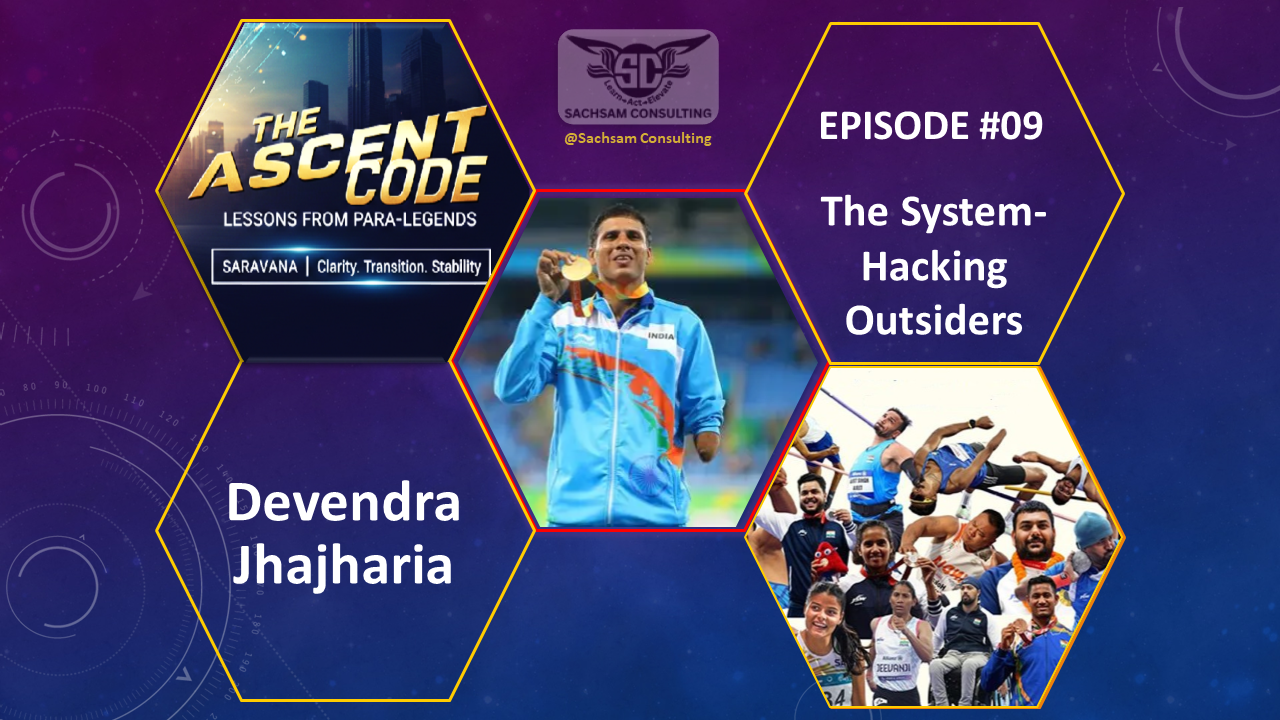
ASCENT CODE: Episode 9
Two Decades of Rural Dominance
Devendra Jhajharia, The System-Hacking Outsiders. How a boy from Churu, Rajasthan, trained with a wooden javelin and no para-athletics system to win two Paralympic Golds twelve years apart.
EXECUTIVE SUMMARY
At age eight, Devendra Jhajharia touched an 11,000-volt electric cable while climbing a tree in Churu, Rajasthan. His left hand was amputated. In 1990s rural India, para-athletics did not exist as a concept. He trained with javelins carved from wood. No coach. No system. No one watching.
At Athens 2004, he won Gold with a world record. Then his event was removed from the Paralympic programme. He waited twelve years. At Rio 2016, he returned and broke his own world record to win Gold again. At Tokyo 2020, he won Silver. Three Games. Two Golds. One Silver. Built from Churu, with a wooden javelin.
⚙️ THE WOODEN JAVELIN METRIC: Training with equipment that forgives nothing forces mechanical precision that competition-grade gear never demands. The roughness was the teacher.
THE ASCENT CODE: THE MAVERICK CODE OF STRATEGIC PERSISTENCE: Your standard does not need an audience to remain real. Long-term mastery requires the discipline to maintain elite form over decades, regardless of external validation or institutional silence.
THE CRISIS: THE EIGHT-YEAR-OLD AND THE ELECTRIC CABLE
Devendra Jhajharia was eight years old and climbing a tree in Churu district, Rajasthan, when he touched a live 11,000-volt electric cable. The current took his left hand. The sharp smell of burning flesh, the scream that came from somewhere outside himself, the dry heat of Rajasthan dust mixing with the metallic taste of shock: these are the coordinates of a before-and-after that would define the next sixty years of his life.
The hospital ward carried the sharp antiseptic smell that marks every rural medical facility in India. His family was not wealthy. Churu in the early 1990s had no para-sports infrastructure, no rehabilitation pathway into athletics, and almost no public awareness that disability sport existed at any competitive level. The social isolation that followed amputation in rural India at that time was a second injury layered on the first.
At Athens 2004, he threw 62.15 metres, set a world record, and won Paralympic Gold. He repeated it at Rio 2016, twelve years later. Two Golds. One Silver. Three Games. Built from Churu, with a wooden javelin, and no system behind him.
THE ORIGIN: THE SCHOOL SPORTS MEET THAT CHANGED EVERYTHING
The shadow phase after the amputation stretched across years of social marginalisation. In 1990s rural Rajasthan, a child with a visible disability faced casual mockery as a daily condition. Para-sports did not exist as a concept in his environment. The path from an eight-year-old amputee in Churu to an international javelin thrower was not visible from where he was standing. There was no template.
The turning point was a school sports meet. Devendra was mocked for his disability by other students. He chose to compete in the open category against able-bodied peers rather than withdraw. He won. That moment gave him two things simultaneously: evidence that his remaining arm carried genuine power, and a competitive identity that the mockery had tried to deny him. He did not need a specialist to identify his potential. He found it himself, in the worst conditions possible.
He began throwing with javelins carved from wood, no specialist coaching, no infrastructure. The entire early development phase was self-constructed on arid Rajasthani ground.
THE GRIND: TWENTY YEARS AT THE TOP
The arc of Devendra’s career is unlike any other athlete in this series. It is not a rise-and-peak story. It is a sustained plateau of world-class performance maintained across two full decades, interrupted by a twelve-year institutional gap when his event was removed from the Paralympic programme entirely.
- Transitioning from wooden training javelins to competition-grade equipment as access gradually improved, rebuilding technique each time the implement changed.
- Maintaining elite physical conditioning through the twelve-year period between Athens 2004 and Rio 2016 when his F46 event was absent from the Paralympic schedule.
- Returning at Rio 2016, over a decade after his first Gold, to compete against a new generation of athletes who had trained specifically to beat his benchmark.
Achievements
• Athens 2004 Paralympics: Gold Medal, F46 Javelin (World Record, 62.15m)
• Rio 2016 Paralympics: Gold Medal, F46 Javelin (World Record, 63.97m)
• Tokyo 2020 Paralympics: Silver Medal
Two world records in two different Games. The second set twelve years after the first. Not talent. Duration.
THE ASCENT CODE: THE MAVERICK CODE OF STRATEGIC PERSISTENCE
Here is the uncomfortable truth about long careers: most people do not have them. They have bursts. A period of strong performance followed by a gradual decline they call “moving on” or “evolving priorities.” Very few people maintain world-class output across two decades. Devendra Jhajharia did it with one hand, from Churu, without a system.
The conventional narrative about athletic greatness focuses on peak performance. The single best result. The highlight. The Maverick Code that Devendra demonstrates is different: it is about the discipline to sustain the conditions for peak performance long after the initial motivation has run its course, long after the novelty has faded, and long after institutional support has either arrived belatedly or disappeared entirely.
I see this pattern repeatedly in professionals navigating long careers. The technical skills rarely erode first. The discipline around maintaining them does. They stop doing the unglamorous daily work once the peak arrives. Devendra kept grinding for twelve years without a Games. That is the version of strategic persistence most people never develop. You do not need validation to maintain your standard. The work is the work, whether the stage is present or absent.
THE HOW-TO FRAMEWORK: THE MAVERICK CODE IN 4 STEPS
- Define Your Standard Independently of External Validation
Devendra’s standard was not “win the next competition.” It was a specific technical level he could measure regardless of whether a competition existed. If your standard depends on external recognition to feel real, it will not survive the periods when recognition is absent. Define it by criteria you control. - Build Maintenance Systems for the Gaps
Twelve years between Athens and Rio required Devendra to maintain elite conditioning without competitive cycles driving him. Build explicit maintenance systems for your skills during career gaps and transitions. A weekly practice structure is not glamorous. It is what separates people who return strong from those who return rusty. - Treat Resource Scarcity as a Design Constraint
Wooden javelins produced a world record. Poor equipment forced more deliberate technique because every throw had to count. When resources are limited, the question is not “how do I get more?” but “how do I extract maximum value from what I have?” - Re-enter After the Gap at Full Standard
Devendra did not return cautiously at Rio 2016. He broke his own world record. When you return to a domain after a gap, the target is not “back to where I was.” It is higher. The gap, used correctly, lifts your ceiling rather than lowers it.
THE REFRAME: THE WOODEN JAVELIN WAS NOT THE PROBLEM
Return to that arid Rajasthani field. No professional equipment. No coach with international experience. No federation mapping his development. A boy with one hand throwing a javelin carved from wood, in a region that did not know para-athletics existed.
The wooden javelin did not slow him down. It sharpened his technique, because poor equipment forgives nothing. Every release angle, every grip position, every approach run had to be precise, because the instrument could not compensate for technical error the way high-grade competition equipment can. The resource constraint produced a more technically refined thrower than optimal resources might have.
Most professionals look at their constraints and see the reason they have not achieved more. Devendra’s career inverts that logic completely. The constraints built the capabilities. The twelve-year gap built the mental discipline. The absence of a system forced the construction of a self-directed one that outlasted every system around it. As of 2026, he serves as President of the Paralympic Committee of India, shaping para-sport policy from the inside. The system-hacker became the system-builder.
SELF AUDIT
- • What is your professional standard, defined by criteria you control, independent of whether anyone is watching, measuring, or rewarding it right now?
- • If your current role or domain disappeared for twelve months, what maintenance system would you run to ensure you return at full capability?
- • Where are you treating a resource constraint as a reason to wait, when the correct move is to treat it as a design constraint and build within it?
👇 Drop your answer in the comments. The #AscentYouTribe learns together.
THE SCIENCE OF LONG-TERM MOTOR RETENTION
Sports science distinguishes between performance and learning. Performance is what you produce in a given session. Learning is the relatively permanent change in capability that persists over time. Research on motor skill retention shows that skills built through high-repetition, variable-condition practice are significantly more durable than skills built through blocked, optimal-condition practice.
Devendra’s wooden-javelin, variable-surface training in Churu produced exactly the kind of deep motor encoding that resists degradation over long periods. His twelve-year retention of world-class mechanics reflects this directly. Skills built under constraint create stronger neural pathways than skills built on forgiving equipment with expert correction.
Next on The Ascent: Episode 10: Praveen Kumar, The Gen-Z Speed-Runners.
SARAVANA KUMAR
Clarity | Transition | Inner Stability
The twelve-year gap between Athens and Rio is the number I keep coming back to this week. Most professionals cannot sustain elite discipline for twelve months without external accountability, let alone twelve years without a stage. Devendra did not need the stage to keep training. The work was the answer, regardless of whether anyone was counting. That is the rarest version of professional mastery: the kind that does not require an audience to remain real. Ask yourself honestly: would your standard survive twelve months of silence? Start building the version that would.
#SaravanaSays
Your Growth Journey Starts Here
All the ways to connect, learn, and grow with the Tribe — in one place.
KEYWORDS: Ascent Code Devendra Jhajharia, Maverick Code, System-Hacking Outsiders, Athens 2004 Paralympics, Rio 2016 Paralympics, para-javelin world record, F46 category, strategic persistence, long-term mastery, wooden javelin training, Churu Rajasthan athlete, Paralympic Committee of India, rural India para-athletics, disability sport leadership, two-decade career.
HASHTAGS: #AscentCode #AscentYouTribe #SaravanaSays #SaravanaKumar #MaverickCode #Clarity #Transition #InnerStability #HighPerformance #MindsetEngineering #ResilienceEngineered #SuccessSystems #CareerPivot #LeadershipPrinciples #StrategicPersistence #SelfOptimization #DevendraJhajharia #ParalympicsIndia #ParaJavelin #Athens2004 #Rio2016 #IndianAthletes #LegacyBuilding



Comments
2[…] Episode 9: Devendra Jhajharia, The System-Hacking Outsiders […]
[…] Read → […]