

Introduction
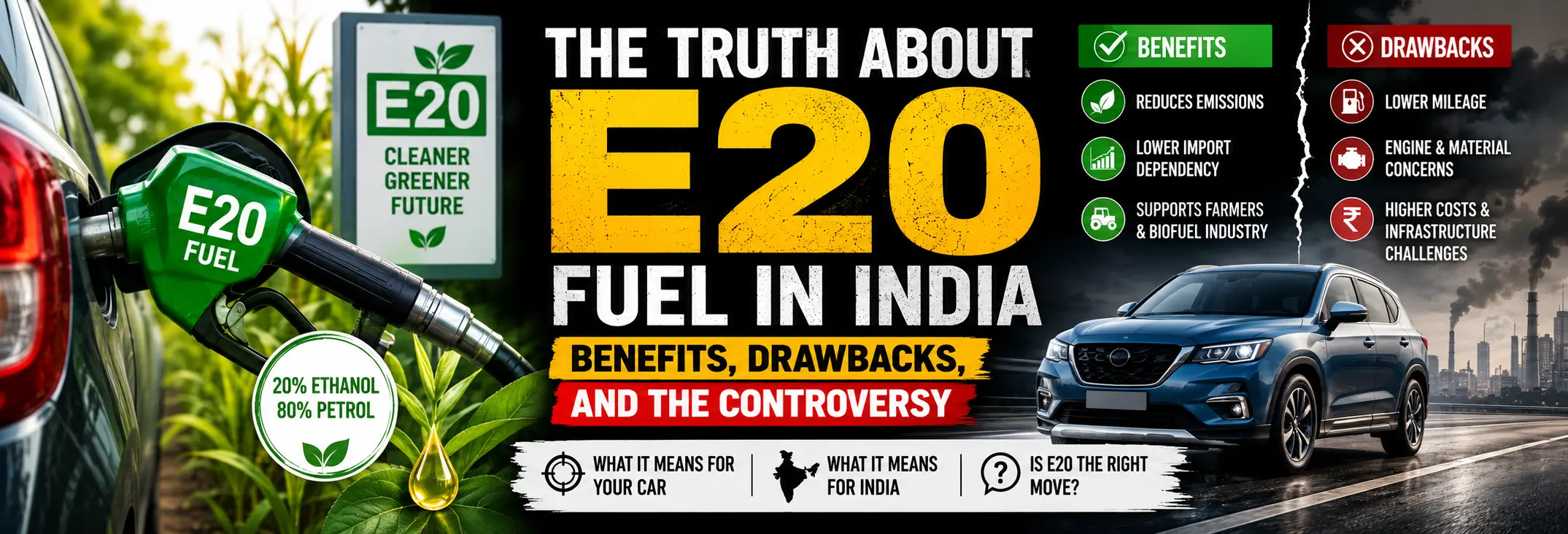
Since 2025, E20 petrol: a blend of 20% ethanol and 80% petrol, has become the default petrol available at most fuel stations across India. The government sees ethanol blending as a major step towards reducing the country’s dependence on imported crude oil and improving energy security.
However, the policy has also sparked debate among consumers, automotive experts, and critics over its impact on vehicles, fuel efficiency, water resources, and food security.
Why is India pushing ethanol?
India imports more than 85% of its crude oil, making the country heavily dependent on international oil markets. To reduce this dependence, the government has been increasing ethanol blending in petrol for several years. The long-term vision extends beyond E20, with higher ethanol blends such as E85 and E100 already being introduced on a limited scale.
On June 5, the Petroleum Minister inaugurated an E85 fuel outlet at an Indian Oil station in Delhi. Currently, only a limited number of such outlets exist, but the government aims to expand the network significantly over the coming years (5000 ROs by December 2027).
Why are people concerned?
While ethanol blending offers environmental and energy-security benefits, critics argue that it also comes with several drawbacks.
One commonly raised concern is fuel efficiency. Since ethanol contains less energy than petrol, vehicles running on higher ethanol blends may experience lower mileage. Some drivers have also reported changes in engine performance, although the impact varies depending on the vehicle.
Another concern involves older vehicles. Many vehicles manufactured before E20-compatible standards were introduced were not specifically designed for higher ethanol blends. Owners of such vehicles may need to replace certain fuel-system components if compatibility issues arise.
Ethanol is also hygroscopic, meaning it absorbs moisture from the air. Automotive experts note that prolonged exposure to moisture can contribute to corrosion in certain metal parts and degradation of some rubber components if vehicles are not designed for higher ethanol concentrations.
The controversy around consumer choice
Another criticism is that consumers have limited choice. As E20 has become the default petrol at most retail outlets, some people argue that drivers of older vehicles have little option but to use it, even if their vehicles were originally designed for lower ethanol blends.
Questions have also been raised about insurance coverage for damage allegedly caused by incompatible fuel. Consumers are advised to carefully review their insurance policy documents and vehicle manufacturer recommendations, as coverage can vary.
Political controversy
The rapid expansion of ethanol blending has also generated political debate.
Some critics have questioned whether there is a conflict of interest because Road Transport and Highways Minister Nitin Gadkari’s son is associated with an ethanol-related company. Gadkari has rejected these allegations. He has stated that his son’s company contributes less than 0.5% of India’s ethanol production and that decisions regarding ethanol procurement, pricing, and policy are made by the Petroleum Ministry and the Union Cabinet rather than by him personally.
The food and water debate
Initially, the government’s vision for ethanol production emphasized second-generation ethanol made from agricultural waste such as crop residue and paddy straw, materials that are often burned by farmers.
However, a significant share of India’s ethanol today is produced from food crops. A large proportion comes from garins like maize and rice and sugarcane.
Critics argue that this raises concerns over resource use. Sugarcane is among India’s most water-intensive crops, requiring large quantities of water for cultivation. Since much of India’s sugarcane is grown in water-stressed states such as Maharashtra, some experts worry that increasing ethanol production could place additional pressure on already limited water resources.
It is said that to prodeuce 1L ethanol from sugarcane requires 3500L of water.
Maize has also become an important feedstock for ethanol production. Industry experts note that rising demand for maize has contributed to higher prices in some periods, potentially affecting poultry feed costs and, indirectly, the prices of chicken and eggs.
For maize, 4500L of water is required to produce 1L of ethanol.
Rice has become another point of discussion. Some critics argue that diverting rice towards ethanol production could affect food distribution, while the government maintains that its ethanol policy balances energy needs with food security.
At present, nearly 25% of broken rice is handed to over 80 crores of people. The govt’s plan is to cut share that to 10% and send more to distilleries for ethanol production. It takes upto 10000L of water for 1L of ethanol.
Looking ahead
India is now among the world’s largest producers and consumers of ethanol, and the government’s roadmap extends beyond E20 to higher ethanol blends such as E22, E27, E30, E85, and eventually E100.
Supporters view this as an important step towards energy independence and lower oil imports. Critics, however, argue that the transition raises important questions about vehicle compatibility, consumer choice, water usage, food security, and the long-term sustainability of relying on crop-based ethanol.
Be kind. Be honourable.