
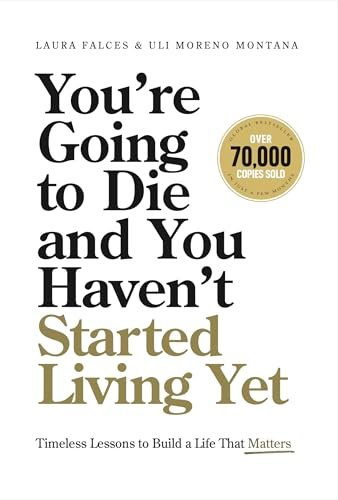

Summary of “You’re Going to Die and You Haven’t Started Living Yet”
Core Premise
The authors open with a powerful idea: we come into the world looking like our parents, but we leave shaped by our decisions. Life is like poker — the winner isn’t the one with the best cards, but the one who plays best with the hand they’re dealt. While circumstances matter, what truly determines our path is how we respond to them.
The central fear is not death itself, but dying without ever having started living. If we don’t decide what we believe, someone will decide for us. If we don’t solve our own problems, we’ll rely on others. If we aren’t clear on who we are, we’ll become what everyone else expects.
Key Themes
The Relationship With Ourselves
The authors emphasize that we spend more time talking to ourselves than to anyone else, yet we rarely take care of this relationship. Silence isn’t something to escape — it’s where we find ourselves. Learning to be okay alone, without distractions, is foundational. We need tools for this: reading, reflecting, walking in silence, journaling. Breaking the habit of self-criticism and learning self-kindness is essential.
Principle 1: “No one can move forward if they forget themselves.”
The Happiness Trap
Modern society sells the promise that happiness is a destination. This creates endless pursuit without satisfaction. Consumer culture thrives on making us feel perpetually dissatisfied — the same system that points out our flaws sells us the solutions. The authors argue that happiness isn’t a permanent state but a consequence of how we live. Discomfort, restlessness, and sadness are normal — they’re signals, not mistakes.
Principle 2: “Happiness isn’t a destination you reach, but a consequence of how you live.”
The Nine Pillars of Well-Being
The book identifies nine areas that shape mental health: getting stuck in our thoughts, quality of relationships, living disconnected from nature, work satisfaction, status and respect, social comparisons, handling uncertainty, physical health, and genetics. Balance across these pillars determines our sense of well-being.
Principle 3: “If you don’t build a solid foundation, you’ll end up lost in your own instability.”
Taking Action
Most people never start. They wait for motivation that never comes. The authors argue that action comes before motivation — discipline is behavior that doesn’t depend on mood. The first step is all that’s needed; you don’t need the whole map. Failure is normal and expected. The Pareto Principle (80/20) applies: most of our effort yields nothing, but a small portion produces results.
The real enemy is ourselves — our thoughts, self-sabotage, and attention to negative patterns. Retraining the mind is possible through conscious choice of attention.
Principle 4: “The first step doesn’t place anyone at their destination, but it does move them out of where they are.”
Habits and Routines
Small actions repeated create massive change over time. The book presents four principles for habit formation: make good habits visible and bad ones hidden; make good habits appealing and bad ones off-putting; make good habits easy and bad ones difficult; use satisfaction as reinforcement and embarrassment as deterrent.
Principle 5: “Life doesn’t change through big decisions, but through small actions repeated.”
Breaking Free from Complacency and Victim Mentality
Complaining is passive resistance that keeps us stuck. A victim mindset hands control of our lives over to circumstances. The authors advocate accepting what we cannot change (Serenity Prayer) and taking responsibility for what we can. Reframing circumstances changes how we face them.
Principle 6: “The strongest chains aren’t the ones that bind the body, but the ones that paralyze the will.”
The Power of Environment
We become the sum of the five people we spend the most time with. Our tribe shapes our decisions, habits, and standards. If we want to become different people, we must seek environments where those qualities exist. But not every relationship needs to serve our growth — some simply share everyday life.
Principle 7: “If we cultivate our environment, we harvest our destiny.”
Time and Productivity
We live in constant busyness, measuring our value by how much we do rather than whether it matters. Time is the only nonrefundable resource. The authors advocate doing fewer things, not more, as long as they’re truly worth it. Rest (doing nothing) is as valuable as any task.
Workplace productivity traps us: Parkinson’s Law states that work expands to fill available time. More hours don’t equal better results. Effort without strategy is just exhaustion.
Principle 8: “Obsessing over making the most of your time is the easiest way to waste it.”
Discomfort as Strength
The Biosphere 2 experiment showed that trees protected from wind grew tall but collapsed under their own weight — wind creates resilience. Similarly, small doses of discomfort (exercise, cold, fasting, facing fears) strengthen us. Asking for help isn’t weakness — it’s human.
Principle 9: “A fire that doesn’t burn doesn’t forge.”
Generalists vs. Specialists
In a world obsessed with specialization, the authors argue for generalists who can connect across fields. Complex problems can’t be solved from a single perspective. Adaptability matters more than narrow expertise.
Principle 10: “The more diverse the paths, the more of the map you get to explore.”
Relationships and Communication
We become what we leave in other people’s hearts. True listening means letting go of being the main character. Asking real questions shows genuine care. Vulnerability and honesty build deeper connections. Take care of existing relationships before they wither.
Principle 11: “You are what you leave in other people’s hearts.”
Critical Thinking
In an age of information overload, skepticism is essential. Three questions to ask: Who’s telling me this? How do they know? What are they trying to sell me? Truth requires independent sources and withstands cross-checking. Repetition doesn’t make something true.
Principle 12: “If you don’t question what you hear, you end up speaking in someone else’s voice.”
Cognitive Biases
We trust our perception too much. Narrative bias makes us fill gaps with stories. Confirmation bias makes us seek what confirms our beliefs. Sunk cost fallacy keeps us invested in lost causes. Availability bias makes us overestimate sensational information. The self-serving bias credits success to skill and failure to luck.
Principle 13: “The biggest lies don’t come from outside, but from within.”
Money and Wealth
Real wealth isn’t possessions — it’s control over your time. What you spend matters more than what you earn. Bad debt destroys freedom; good debt can generate income. Financial literacy is essential. Compound interest rewards patience. Learning to be happy with less gives freedom.
Principle 15: “If you don’t learn to manage your money, you’ll spend your life working for it.”
Expectations
Expectations shape our happiness more than reality. The less we expect, the more satisfied we become. Well-being isn’t in what’s coming next. Expectations grow faster than circumstances.
Principle 16: “If you expect too much from life, you end up unable to accept it.”
Fear of Judgment
We care too much about what others think. Perfectionism is fear of judgment in disguise. Trying to please everyone leads to exhaustion. Handling criticism requires separating useful feedback from attacks. Setting boundaries teaches people how to treat us.
Principle 18: “If you live to please everyone, you die without ever being anyone.”
Conflict and Biology
The idea that “if something bothers you, it’s because you’re judging it” ignores biology. Under threat, fight-or-flight activates — this isn’t failure of emotional intelligence. Real self-control isn’t about suppressing emotions but knowing what to do with them.
Principle 19: “Self-control isn’t about choosing what to feel, but about knowing what to do with what you feel.”
Love and Relationships
Satisfying couples share: sexual attraction, compatible values, trust without judgment, shared humor, mutual respect, daily affection, space for independence, and reciprocity. Without reciprocity, everything falls apart. Four questions help evaluate relationships: Would I want a loved one with someone like my partner? Do I love who they are now? Would I choose this path again? Do I feel emotionally safe? Can they read my emotions?
Principle 23: “If you have to go looking for reasons to convince yourself they’re the right person, they probably aren’t.”
Purpose and Meaning
Purpose is what gives value and meaning. It rarely appears — we must create it. Acting from the heart, even with mistakes, is where values solidify. We need at least one reason that keeps us moving, so that when the end comes, one life feels like enough.
Final Principle: “To honor presence, imagine absence.”
Conclusion
The book ends with a call to appreciate life by imagining its absence. Memento mori, remembering death, isn’t morbid; it’s a tool for living fully. Gratitude changes how we experience life. The question isn’t whether we’ll die, but whether we’ll start living before we do.