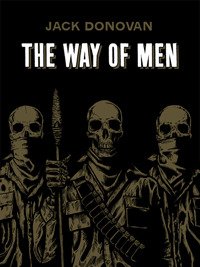
The Way of Men by Jack Donovan redefines masculinity through the lens of primal virtues: Strength, Courage, Mastery, and Honor. Drawing from anthropology, history, and personal experience, this book challenges modern myths about manhood and calls men to reclaim their identity through brotherhood, discipline, and purpose. A powerful guide for any man seeking to live with integrity, resilience, and authenticity in a world that undervalues true strength.
The Way of Men is a bold and controversial exploration of what it means to be a man in the modern world.
Written by Jack Donovan, an author, martial artist, and thinker on male identity, this book challenges the idea that masculinity is outdated or inherently toxic. Instead, Donovan argues that there is a timeless, primal core to masculinity, rooted in biology, history, and survival—that still matters today.
He doesn’t promote cruelty or dominance over others. Rather, he defines masculinity through four core virtues:
Strength, Courage, Mastery, and Honor
Donovan’s central message is clear:
“A man should know how to fight, lead, provide, protect, and die for something greater than himself.”
This summary walks you through the key ideas of The Way of Men, offering a balanced, insightful breakdown of its philosophy, strengths, and criticisms, perfect for anyone interested in understanding modern masculinity beyond stereotypes.
Donovan begins by identifying a growing crisis: men are losing their sense of purpose and identity.
In a world that often tells men to suppress their instincts, downplay strength, and prioritize comfort over challenge, many have become:
He observes that:
“We live in a time where being a ‘good man’ often means being a harmless one.”
But Donovan argues that true masculinity isn’t about harm—it’s about readiness. A real man is not violent—but he is capable of violence if necessary to protect his tribe.
One of the most powerful concepts in the book is the tribal nature of men.
Donovan draws from anthropology and evolutionary psychology to show that:
“Men don’t bond over feelings, they bond over fire, blood, and mission.”
He contrasts ancient tribal societies with modern individualism, arguing that without a tribe, men lose motivation, direction, and meaning.
Key Insight: Brotherhood is not optional for men—it’s essential.
Donovan builds his philosophy around four fundamental masculine virtues:
Not just physical strength, but mental and emotional resilience.
“A weak man cannot serve his family or his people.”
Strength is not aggression, it’s capacity. It’s what allows a man to be a provider and protector.
The willingness to face danger, uncertainty, and death.
“Courage is the first virtue because it makes all others possible.”
Without courage, justice, loyalty, and honor mean nothing.
The pursuit of excellence in a craft, skill, or discipline.
“A man who masters nothing is mastered by everything.”
Donovan encourages men to train relentlessly, not for ego, but for competence.
Living by a code, even when no one is watching.
“Honor is what separates a warrior from a thug.”
These four virtues are not arbitrary, they are forged in the fires of survival and tested across millennia.
Donovan defends traditional male roles, not out of nostalgia, but out of necessity
He argues that:
He critiques a culture that:
“We’ve taught men to apologize for their nature instead of mastering it.”
His solution is not regression, but reconnection. Men must reclaim their identity not by rejecting civilization, but by becoming its guardians.
Donovan makes a sharp distinction between a good man and a nice guy.
“Being nice is not the same as being virtuous.”
He warns that nice guys are often disrespected, taken advantage of, and unfulfilled because they deny their natural instincts.
Important Lesson: Gentleness is a choice a strong man can make, not a mask a weak man wears.
While much of the book references primal or tribal contexts, Donovan shows how these principles apply today.
“You don’t find your tribe, you earn it through commitment.”
One of the most misunderstood parts of the book is Donovan’s view on violence.
He does not glorify mindless aggression. Instead, he says:
“The best warriors hope for peace but prepare for war.”
He emphasizes that true strength includes restraint. A man who controls his violence is more dangerous—and more honorable—than one who cannot.
Donovan draws from diverse sources:
He also references thinkers like:
These influences help ground his philosophy in both myth and reality.
Donovan explores why men feel lost in modern society:
He suggests that men need:
“A man without a mission becomes a ghost in his own life.”
He also critiques the idea that emotional expression alone defines maturity. While emotions matter, action defines a man.
Donovan offers practical steps men can take to reconnect with their nature:
Lift weights, practice a martial art, hike, swim—build physical resilience.
Take self-defense classes. Understand violence so you can avoid or end it quickly.
Become excellent at something difficult, woodworking, mechanics, coding, cooking.
Join a volunteer group, support a community project, mentor young men.
Spend time with other men in meaningful ways, training, working, traveling.
Define your values and stick to them, even when inconvenient.
“Masculinity is not given, it’s forged.”
Donovan encourages several powerful mindset shifts:
These shifts move men from passivity to purpose.
The Way of Men is not a call to return to barbarism. It’s a call for men to awaken their dormant strengths in a world that has tried to pacify them.
It teaches that:
As Donovan writes:
“The way of men is not easy. It is narrow, steep, and dangerous. But it is the only path worth walking.”
For any man who feels adrift, disconnected, or diminished, this book offers a rugged, uncompromising vision of what it means to stand tall—and live with meaning.