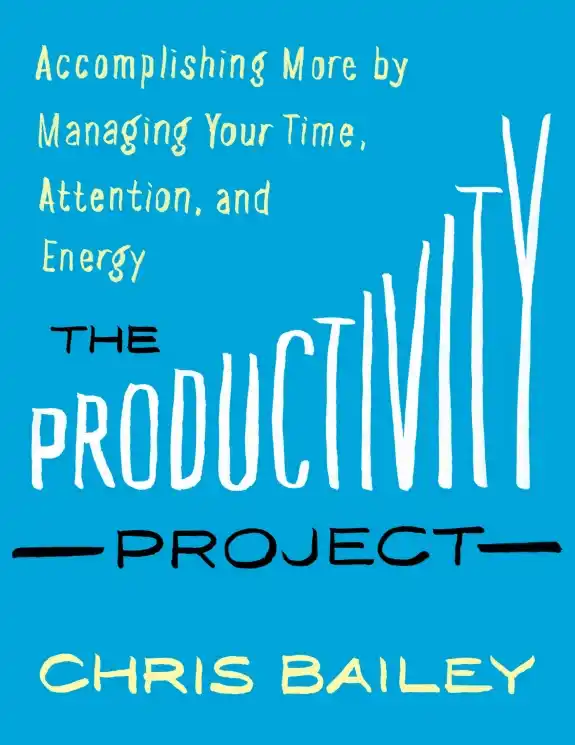
What if being productive wasn’t about doing more—but about doing what truly matters? In The Productivity Project , Chris Bailey shares the results of his year-long self-experiment to uncover the best ways to manage time, energy, and attention. From saying ‘no’ more often to improving focus and building better habits, this book offers practical insights for living a more intentional, productive life.
Chris Bailey’s “The Productivity Project” chronicles his year-long experiment to discover what truly makes people productive. Declining two job offers after college, Bailey spent 365 days reading countless books, interviewing productivity experts, and conducting over two dozen experiments on himself, from meditating 35 hours per week to working 90-hour weeks to living in total isolation. The result is a practical guide to accomplishing more by managing three interconnected resources: time, attention, and energy.
Bailey begins by challenging the factory-era notion that productivity equals efficiency. In today’s knowledge economy, productivity is not about how much you do but how much you accomplish. The most productive people work at a deliberate pace—fast enough to get things done, but slow enough to identify what’s important and work smarter rather than harder.
The book is organized around a powerful framework: productivity consists of three ingredients—time, attention, and energy. In factory jobs, managing time was sufficient. Today, with more demands, more distractions, and less time, we must manage all three. Time is the most limited resource. Attention determines the quality of our work. Energy provides the fuel to get things done.
Your Most Important Tasks
Bailey discovered through his meditation experiment that not all tasks are created equal. By forcing himself to meditate 35 hours in a week, he had only 20 hours left for work, which forced him to identify what truly mattered. He found that 80 percent of his accomplishments came from just three tasks.
Bailey recommends the “Impact Challenge”: list everything you’re responsible for, then identify the three tasks that allow you to accomplish the most with your time. These are your highest-impact tasks—the work that leverages your unique skills and creates the greatest value.
The Rule of 3
The book’s most powerful daily ritual is simple: each morning, decide the three things you want to accomplish by day’s end. Do the same at the start of each week. Three is the magic number because it’s small enough to force prioritization but large enough to encompass meaningful work. This rule helps you work deliberately, with intention, and gives you a guiding light when emergencies arise.
Biological Prime Time
Tracking his energy for three weeks, Bailey discovered his “Biological Prime Time”—the periods when he naturally had the most energy. Everyone has different peaks. By working on highest-impact tasks during these windows and lower-impact tasks when energy dips, you accomplish significantly more in less time.
Understanding Procrastination
Bailey discovered he procrastinated six hours per week—even while being called “the most productive man you’d ever hope to meet.” Procrastination is human: 95 percent of people admit to it. The research shows we procrastinate on tasks that are boring, frustrating, difficult, ambiguous, lacking personal meaning, or lacking intrinsic rewards. The more of these triggers a task has, the more aversive it becomes.
Inside our brains, procrastination is a battle between the emotional limbic system (which wants immediate pleasure) and the logical prefrontal cortex (which keeps long-term goals in mind). The limbic system evolved over millions of years; the prefrontal cortex is relatively new and weaker. Productivity requires strengthening the prefrontal cortex.
Bailey provides several strategies to overcome procrastination:
Flip the triggers: Make boring tasks less boring by changing location. Make frustrating tasks less frustrating by setting short timers. Add structure to ambiguous tasks by planning the next steps.
Create a procrastination list: When avoiding one task, work on another meaningful task instead.
List the costs: Write down everything putting off a task will cost you.
Just get started: The dread of doing something uses more energy than doing it. Even five minutes of progress overcomes initial resistance.
Your Future Self
Hal Hershfield’s research shows that our brains see our future selves as similar to strangers. This disconnect makes us give future us more work than we’d give ourselves today, save less for retirement, and put off unpleasant tasks. To bridge this gap, Bailey recommends:
Send a letter to your future self
Download an app like AgingBooth to see what you’ll look like later
Create a “future memory” of a better, more productive version of yourself
The Internet as Productivity Killer
The internet is the world’s largest candy store for your limbic system. Research shows we spend 47 percent of our online time procrastinating. Bailey’s experiment using his smartphone just one hour per day for three months was transformative. Disconnecting from the internet isn’t just about saving time—it prevents us from being tempted by lower-impact tasks. Bailey’s nightly shutoff ritual (8 p.m. to 8 a.m.) became one of his most valuable daily habits.
Bailey makes a provocative argument: in the knowledge economy, time management should take a backseat to managing attention and energy. Before the Industrial Revolution, time wasn’t precisely measured. Time zones didn’t exist until 1883, created for railroads. Today, when productivity is about accomplishment rather than hours worked, the nine-to-five workday is an outdated relic.
Working Less, Accomplishing More
Bailey’s experiment alternating between 90-hour and 20-hour workweeks revealed something surprising: he accomplished only slightly more during the 90-hour weeks. Working longer hours means investing less energy and attention per minute. Studies show productivity plummets after 35-40 hours per week, with 60-hour weeks producing the same output as 40-hour weeks in just three weeks.
For important tasks, Bailey recommends setting artificially short deadlines. When you give yourself less time, you naturally invest more energy and focus, making the task feel more urgent and less aversive.
Working During Prime Time
Blocking off your Biological Prime Time in your calendar and defending it religiously is one of the most powerful productivity tactics. During these periods, you bring double the energy and focus to your most important work.
Maintenance Day
Bailey created a “Maintenance Day” ritual: instead of spreading small tasks throughout the week, he lumps them all together—grocery shopping, cleaning, laundry, trimming nails, planning meals—and tackles them at once. This eliminates mental clutter, prevents perfectionism on low-return tasks, and frees up the rest of the week for meaningful work. During these tasks, he listens to audiobooks or podcasts to double his productivity.
Shrinking the Unimportant
Support tasks like email, meetings, and social media consume disproportionate time and attention. Bailey discovered he checked email 36 times daily. Each interruption costs about 25 minutes of refocus time. His solutions:
Set specific times for email instead of checking constantly
Limit meetings to four hours weekly
Keep all emails to five sentences or less
Turn off all notifications
Saying No
“The most productive word in your vocabulary is no.” Bailey learned to deliberately say no to low-return tasks. Greg McKeown’s “90 percent rule” suggests: when evaluating an opportunity, if it’s not a 90 or above on a 1-100 scale of value, don’t do it. Every no to something unimportant is a yes to something important.
Delegation
After calculating his time was worth roughly $50/hour, Bailey hired a virtual assistant. Paying more for someone highly qualified saved him time and attention in training. Delegation allows you to focus your energy on work that only you can do.
Emptying Your Brain
Your brain is for having ideas, not holding them. Bailey recommends a “brain dump”: write down everything on your mind—tasks, projects, worries, things you’re waiting for. The Zeigarnik effect shows that incomplete tasks weigh on our minds more than completed ones. Getting everything out of your head clears mental space.
Bailey’s organizational system includes a to-do list, a calendar, a “Waiting For” list (tracking things others owe you), project notes, and a worry list. He also maintains “hot spots”—seven life areas (Mind, Body, Emotions, Career, Finances, Relationships, Fun) with expanded lists of commitments in each, reviewed weekly to make course corrections.
Making Room for Mind Wandering
Your brain has two modes: “central executive” (focused) and “wandering” (daydreaming). Western culture overvalues the former and undervalues the latter. Research shows that when solving complex problems, unconscious processing can outperform conscious deliberation. Bailey’s mind-capture ritual—sitting with a notepad for fifteen minutes while his mind wanders—consistently generates valuable ideas, insights, and tasks.
The Joy of Being Deliberate
Research shows we spend 47 percent of our time mind wandering. A strong “attention muscle” enables deliberate work. Attention has three components: central executive (planning), focus (narrowing attention), and awareness (noticing what’s happening). Building all three makes you more productive.
Taming Attention Hijackers
Interruptions cost an average of 25 minutes of lost productivity. The average worker opens email 50 times and uses instant messaging 77 times daily. Bailey recommends disabling all notifications on all devices. Your devices exist for your convenience, not for everyone who wants to interrupt you.
The Art of Single Tasking
Multitasking creates a dopamine-addiction feedback loop. Studies show heavy multitaskers are worse at multitasking than light multitaskers—they simply perceive themselves as better. Multitasking makes you prone to errors, adds stress, takes longer, and impairs memory.
Single tasking builds your attention muscle. Every time you bring your wandering mind back to the task at hand, you strengthen executive control. Bailey recommends practicing single tasking through the Pomodoro Technique (25 minutes of focused work, 5-minute breaks), active listening, focused reading, and mindful eating.
Meditation
Meditation is simply single tasking practiced by itself. Bailey reframes meditation as “mindfulness from concentrate”—a way to work out your attention muscle. Studies show meditation reduces activity in the posterior cingulate cortex (responsible for mind wandering), improves focus, reduces stress, and increases gray matter. Five to ten minutes daily is enough to rewire your brain.
Energy and Food
Your brain consumes 20 percent of your calories despite being only 2-3 percent of your body mass. For sustained energy, Bailey recommends:
Eat fewer processed foods that digest slowly
Stop eating when you’re full
Mindful eating helps you notice fullness earlier
Caffeine and Alcohol
Caffeine borrows energy from later in the day—it prevents your brain from absorbing adenosine (the tired chemical), but adenosine continues building up until you crash. Drink caffeine strategically, not habitually, and only when you’ll benefit from the boost. Alcohol borrows energy from tomorrow. Both can be useful when used deliberately.
Exercise
Regular aerobic exercise increases blood flow to the brain, reduces stress, releases BDNF (a chemical that creates new brain cells), and boosts mood. Bailey gained 15 pounds of muscle during his project and found exercise gave him more energy, not less.
Sleep
“Every hour of sleep you miss costs two hours of productivity.” Sleep deprivation is a national epidemic. Compromising sleep to work longer hours is counterproductive—tasks take longer, mistakes increase, and you’ll accomplish less overall. Bailey created a nighttime ritual with blue-light reduction, caffeine cutoffs, and a cave-like sleeping environment.
Be Kind to Yourself
Negative self-talk is normal—research suggests 60-77 percent of our thoughts are negative. But being hard on yourself undermines productivity. Happier people are 31 percent more productive. Bailey recommends: take more breaks, recall three things you’re grateful for daily, journal about positive experiences, create subgoals, reward yourself, maintain a growth mindset, keep an Accomplishments List, and even look at cute baby animals (research shows they improve attention and performance).
People Give Productivity Meaning
Bailey’s most profound lesson came from ten days in total isolation: without people, productivity is meaningless. Deeper office friendships boost job satisfaction by 50 percent and make you seven times more likely to be engaged at work. Social connection is as predictive of longevity as obesity, high blood pressure, or smoking—in the opposite direction.
The Enduring Lesson
Productivity is not about doing more, faster—it’s about doing the right things deliberately and with intention. The most productive people understand their time, attention, and energy are finite. They identify what matters most, protect their focus, cultivate their energy, and never lose sight of why productivity matters: to create more space for what—and who—is truly important.
The changes Bailey discovered stuck beyond his year-long project. The tactics work because they address fundamental human needs: clarity of mind, sustained energy, protected attention, and meaningful connection. Productivity, done right, is not about rushing through life—it’s about living deliberately, with purpose and intention, and creating space for what matters most.