
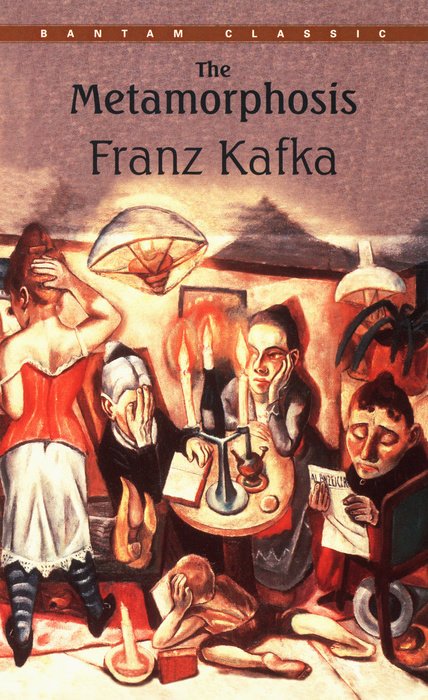

Summary of Franz Kafka’s “The Metamorphosis”
Overview
This Norton Critical Edition of Franz Kafka’s The Metamorphosis presents the complete novella in a new translation by Susan Bernofsky, alongside extensive contextual materials and critical essays. Published in 2016, this edition situates Kafka’s 1915 masterpiece within its literary, philosophical, and scientific contexts while offering diverse scholarly interpretations.
The Story Itself
The Metamorphosis opens with one of the most famous first sentences in literature: traveling salesman Gregor Samsa wakes to find himself transformed into “some sort of monstrous insect.” The narrative follows his gradual physical decline, his family’s shifting reactions, and his eventual death.
The story unfolds in three parts. In Part One, Gregor struggles to get out of bed while his family and his boss’s representative demand he come to work. When he finally emerges, his appearance terrifies everyone. His father drives him back into his room with a cane and newspaper, injuring him.
In Part Two, Gregor’s sister Grete becomes his caretaker, bringing him food he initially enjoys but increasingly rejects. The family begins working to support themselves, father as a bank porter, mother sewing lingerie, Grete as a salesgirl. Gregor grows accustomed to his insect body, learning to crawl on walls and ceiling. When his mother and sister try to remove his furniture, Gregor fiercely protects a framed picture of a woman in furs, causing his mother to faint.
In Part Three, the family takes in three lodgers. When Grete plays violin, Gregor ventures out, enchanted by the music. The lodgers see him and announce they’re leaving without paying. Grete declares “it” must go—refusing to call Gregor her brother. Gregor returns to his room and dies that night. Relieved, the family dismisses the lodgers, fires the cleaning woman, and takes a streetcar ride where they notice Grete has “bloomed into a pretty girl with a good figure.”
The Translator and Editor
Susan Bernofsky, an award-winning translator of German literature, provides a fresh English translation that captures both the humor and horror of Kafka’s original. She explains her key translation choices, notably the decision to render the ambiguous German “Ungeziefer” as “some sort of monstrous insect” rather than specifying “cockroach” or “dung beetle” as earlier translations did.
Mark M. Anderson, Professor of Germanic Languages at Columbia University, edits the volume and provides a preface, translator’s note, chronology, and one of the critical essays.
Contextual Materials
The edition includes selections from Kafka’s letters and diaries documenting the story’s composition. In November 1912, Kafka wrote to his fiancée Felice Bauer that the story “occurred to me in bed in my misery” and “demands to be written.” He completed it in three weeks, often writing late into the night. When his publisher wanted an illustration of the insect for the book’s cover, Kafka famously forbade it: “The insect itself cannot be depicted.”
The volume also reprints Kafka’s earlier fragment Wedding Preparations in the Country, where a protagonist imagines sending his “clothed body” out while he stays in bed “in the form of a large beetle”, showing the idea had been percolating for years.
Contemporary Works
The edition includes writings that influenced or resonated with Kafka:
-
Leopold von Sacher-Masoch’s Venus in Furs (1870): The novel about masochistic desire features a protagonist named Gregor and a woman in furs—directly connecting to the picture Gregor refuses to surrender. The theme of voluntary abasement before a powerful woman echoes throughout Kafka’s story.
-
Friedrich Nietzsche’s On the Use and Abuse of History and Thus Spoke Zarathustra: Nietzsche’s ideas about forgetting, becoming, and the human as “a rope fastened between animal and Overman” provide philosophical context for Gregor’s regression and transformation.
-
Hugo von Hofmannsthal’s “The Lord Chandos Letter” (1902): A fictional letter describing a writer’s crisis of language, where the protagonist experiences mystical identification with rats, beetles, and a watering can. This anticipates Gregor’s condition and Kafka’s literalization of metaphor.
-
Rainer Maria Rilke’s animal poems: “The Panther” and “Archaic Torso of Apollo” demonstrate the early twentieth-century interest in adopting animal perspectives and encountering art as a commanding, transformative force.
-
Johannes V. Jensen’s “The Condignog” (1909): A Danish story about a man who transforms into a lizard-creature when hungry and isolated. Unlike Kafka’s tale, the metamorphosis appears hallucinatory and ends with redemption through a woman’s recognition.
-
Jakob von Uexküll’s The Environment and Inner World of Animals (1909): A biologist’s call to abandon anthropocentrism and adopt “the standpoint of the animal.” Uexküll argued each creature inhabits a unique “environment” determined by its design—a concept that illuminates Gregor’s alienated perception.
Critical Essays
The volume collects eight scholarly interpretations spanning seventy years:
Günther Anders (1960) argues Kafka uses “literal metaphor”, taking common figures of speech literally. Gregor becomes a “bug” because his family considered him one. Anders emphasizes Kafka’s “agnosticism” and the “paralysis of time” in his work, comparing the story’s beauty to the Medusa’s petrifying gaze.
Walter H. Sokel (1956) reads the metamorphosis as a “punishment fantasy” fulfilling Gregor’s secret wish to rebel against his dehumanizing job while simultaneously punishing him for that desire. Gregor’s loss of human speech marks his complete transformation.
Nina Pelikan Straus (1989) offers a feminist reading, arguing Grete’s experience is crucial to the story’s meaning. Grete “blooms” as Gregor withers, exchanging roles with her brother. But Straus concludes this exchange merely perpetuates the system—Grete will likely be sold into marriage as Gregor was sold into labor.
Mark M. Anderson (1992) situates the story in fin-de-siècle aestheticism, arguing Gregor becomes a kind of artwork—flat, dry, framed by his room. His crawling on walls and ceiling represents a childlike, playful escape from “the traffic of clothes” and commercial exchange.
Elizabeth Boa (1996) compares The Metamorphosis to Charlotte Perkins Gilman’s The Yellow Wallpaper, examining how both stories explore confinement, gender roles, and “creeping” as resistance. She notes the mother’s asthma and coughing as forms of inarticulate protest.
Carolin Duttlinger (2007) analyzes the story’s relationship to photography, connecting Kafka’s childhood portraits (he called himself “the ape of my parents”) to Gregor’s soldier photograph and the fur-clad woman. Photography represents both identity construction and its deformation.
Kári Driscoll (2013) focuses on voice and speech, comparing Gregor’s transformation to Actaeon in Ovid’s Metamorphoses. Gregor’s voice becomes a “rustle” that escapes meaning, placing him between human and animal. The mother’s coughing, the father’s hissing, and the manager’s cry all inhabit this liminal space.
Dan Miron (2010) explores Kafka’s fascination with Yiddish theater in 1911–12, noting the “raisins and almonds” in Gregor’s meal reference a popular Yiddish operetta. Kafka’s relationship with actor Yitzhak Levy was deeply ambivalent, attracted to the “authentic” Eastern Jewish body yet repulsed by it.
Key Themes Across the Criticism
The essays collectively explore several persistent questions: Is Gregor’s transformation punishment or liberation? Why does Kafka refuse to specify the insect’s species? What explains Gregor’s lack of curiosity about his own metamorphosis? How does the story reflect Kafka’s own struggles with family, work, Judaism, and writing? The consensus is that the story resists definitive interpretation, its power lies precisely in its ambiguity.
Conclusion
This Norton Critical Edition presents The Metamorphosis as a work that continues to generate new readings across theoretical frameworks. The combination of Bernofsky’s accessible translation, extensive contextual materials, and diverse critical interpretations makes it an invaluable resource for understanding Kafka’s strange, heartbreaking, and darkly comic masterpiece about family, work, alienation, and what it means, or fails to mean, to be human.