
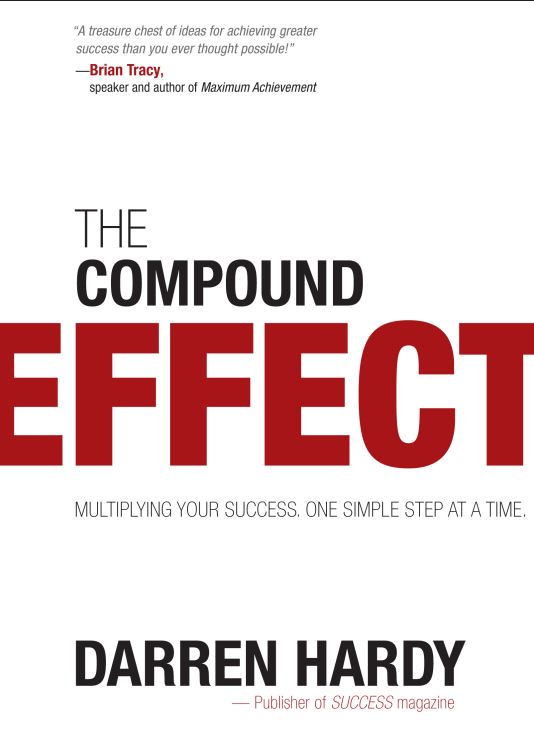

In a world obsessed with quick fixes, miracle pills, and overnight success, Darren Hardy, the publisher of SUCCESS magazine, offers a radical antidote: the Compound Effect. This book argues that the secret to extraordinary success is not a single, massive, heroic effort, but the relentless and consistent application of small, smart choices over time. Hardy draws on his personal journey—from a disciplined childhood to becoming a self-made millionaire by twenty-seven—and his years of studying the world’s top achievers to reveal the core, unglamorous fundamentals that drive lasting success.
The Core Principle: Small Choices, Big Results
The Compound Effect is the principle of reaping huge rewards from a series of small, seemingly insignificant actions. Hardy illustrates this with a powerful analogy: the choice between taking 3 million in cash immediately or a single penny that doubles invalue everyday for 31days. The penny, which seems foolish for weeks, ultimately grows to over 10.7 million, far surpassing the lump sum. The same principle applies to life. By cutting just 125 calories a day and reading for a short time, one person can lose 33 pounds and gain a promotion in 31 months, while a peer adding 125 calories a day and watching more TV can become 67 pounds heavier and see his marriage and career suffer. The process is so gradual it’s almost invisible, but the compounded results are dramatic and undeniable.
Part 1: Choices – Taking the Wheel
Hardy states that everything in your life is an accumulation of your choices. The biggest challenge isn’t making intentionally bad choices, but sleepwalking through them unconsciously. To break this cycle, the first step is taking 100% personal responsibility for your life, no more blaming, excuses, or victimhood.
His most powerful tool for this is tracking. To change an area of your life (e.g., finances, weight), you must first become aware of your actions. Hardy insists you carry a small notebook and write down every single action related to that goal—every penny spent, every bite eaten. This simple act of measurement brings unconscious habits into the light, allowing you to make smarter choices. A 4dailycoffee,whentrackedandcompoundedover20years,revealsatruecostofnearly52,000 in lost investment growth. Tracking is the idiot-proof system that initiates all change.
Part 2: Habits – Uprooting the Old, Planting the New
Choices, repeated over time, become habits. Hardy quotes Aristotle: “We are what we repeatedly do.” Since 95% of our behavior is habitual, success or failure is largely a matter of habit. The problem is the trap of instant gratification: a bad habit’s negative consequences are invisible in the moment, making it easy to indulge.
To break bad habits, Hardy offers five “Game Changers”:
-
Identify Your Triggers: Use the “Big 4’s” (who, what, where, when) to understand what prompts the behavior.
-
Clean House: Physically remove all enablers of the bad habit from your environment.
-
Swap It: Replace a bad habit with a less harmful one (e.g., replacing chips with carrot sticks for the crunch sensation).
-
Ease In or Jump In: Decide whether to make a gradual change or go cold turkey, based on what works for you.
To install good habits, he provides techniques like setting up your environment for success, thinking in terms of “addition” (adding good things instead of focusing on deprivation), and creating a Public Display of Accountability (PDA) by telling friends, family, or social media about your commitment. Most importantly, Hardy stresses that change is hard, and that’s a good thing—the difficulty is what separates the extraordinary from the ordinary.
Part 3: Momentum – Harnessing “Big Mo”
Once you have established good habits and routines, you can generate momentum, or “Big Mo.” Momentum is the force that transforms slow, plodding effort into unstoppable success. It’s Newton’s First Law in action: objects in motion tend to stay in motion. Getting started is the hardest part, like pushing a merry-go-round from a standstill, but once it’s spinning, it’s easy to keep going.
The key to momentum is consistency. Hardy warns that missing even a few days doesn’t just lose those days’ results; it kills your momentum entirely, forcing you to start over from zero. He uses the analogy of a hand-pumped well: you must pump consistently for a long time (fighting inertia) before a few drops appear, and then eventually a steady stream flows. If you stop pumping, the water falls back down, and you have to start the exhausting process all over again. To maintain momentum, Hardy recommends “bookending your days” with powerful morning and evening routines that set you up for success and allow you to cash out your performance.
Part 4: Influences – Guarding Your Mind
Your success is also heavily influenced by three external forces: your input, your associations, and your environment.
-
Input (Garbage In, Garbage Out): Your brain is wired to seek the negative for survival. The media bombards you with fear and scandal (“dirty water”). To counter this, you must actively “flush your glass” with positive, instructional, and inspirational content. Hardy turns his car into “Drive-Time U,” listening to educational CDs instead of news radio.
-
Associations (Who You Hang With): Jim Rohn taught that you become the combined average of the five people you spend the most time with. Hardy categorizes associations into those you need to dissociate from completely, those you limit your time with, and those you seek to expand your time with, including mentors and a “peak-performance partner” for accountability.
-
Environment: Your surroundings shape your perspective. If you want to achieve more, you may need to change your environment to match your aspirations. Further, you must stop tolerating negative situations, as you get in life what you tolerate.
Part 5: Acceleration – Going the Extra Mile
Finally, Hardy shows how to multiply your results. This happens when you push past your “wall”—the point of fatigue, pain, or difficulty where most people quit. Growth doesn’t happen during the easy reps; it happens when you push out those last few reps after you’ve hit your max. This “little extra” effort multiplies the impact.
He also advocates doing the unexpected and beating expectations. While everyone sends Christmas cards, he sends handwritten Thanksgiving cards. While a job candidate could do a video interview, Hardy advises flying across the country to show up in person. Oprah, Richard Branson, and Nordstrom built their reputations by consistently doing more than was expected, creating “WOW” moments that build trust, loyalty, and accelerate success.
In conclusion, The Compound Effect is a call to abandon the fantasy of the quick fix. It provides a simple, no-excuses blueprint: take 100% responsibility, track your choices, build good habits, create routines, find your powerful “why,” and then let the slow, steady, and consistent application of small disciplines compound into a life of extraordinary success.