
Tell your heart that the fear of suffering is worse than the suffering itself. And that no heart has ever suffered when it goes in search of its dreams, because every second of the search is a second’s encounter with God and with eternity.
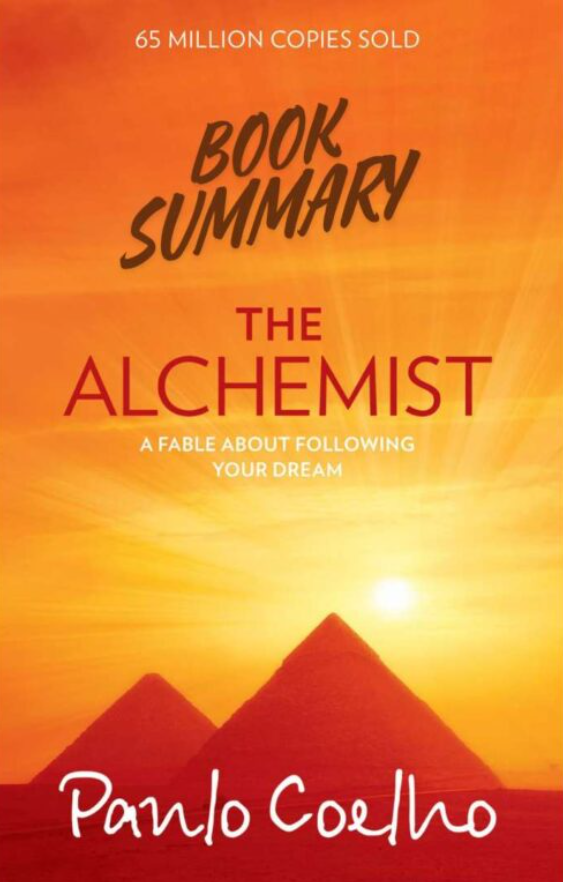
“The Alchemist” is a philosophical novel by Brazilian author Paulo Coelho, first published in 1988. It has since become one of the best-selling books in history, translated into over 80 languages. The story follows Santiago, a young Andalusian shepherd, on his journey from Spain to Egypt in search of a treasure he dreams about. The novel explores themes of destiny, personal growth, and the spiritual journey of self-discovery.
The story opens with Santiago, a young shepherd from Andalusia, Spain, spending the night in an abandoned church with his flock. He notices an enormous sycamore tree growing where the sacristy once stood. Santiago chose to become a shepherd not because he lacked education, he had studied at a seminary until age sixteen, but because he wanted to travel and see the world. His father, though disappointed, gave him three ancient gold coins to buy sheep and pursue his dream.
Santiago is content with his simple life, learning more from his sheep than from books. However, he has begun thinking about a merchant’s daughter he met the previous year while shearing sheep. She is the reason he is traveling toward Tarifa, where she lives.
That night, Santiago has the same dream he had a week earlier: a child transports him to the Egyptian pyramids and tells him he will find a hidden treasure there. Each time, he wakes just as the child is about to reveal the exact location.
In Tarifa, Santiago visits an old Gypsy woman who interprets dreams. She tells him he must go to the pyramids, where he will find treasure, and asks for one-tenth of whatever he discovers. Disappointed by this simple interpretation, Santiago decides to forget about dreams and focus on practical matters.
While sitting in a plaza reading a book, Santiago is approached by an old man who strikes up a conversation. This man claims to be Melchizedek, the King of Salem. He reads Santiago’s book, commenting that it describes “people’s inability to choose their own Personal Legends.” When Santiago asks what a Personal Legend is, the king explains:
“It’s what you have always wanted to accomplish. Everyone, when they are young, knows what their Personal Legend is. At that point in their lives, everything is clear and everything is possible. They are not afraid to dream, and to yearn for everything they would like to see happen to them in their lives. But, as time passes, a mysterious force begins to convince them that it will be impossible for them to realize their Personal Legend.”
This mysterious force, the king explains, actually helps people realize their destiny by testing their determination. He reveals the central philosophy of the book: “when you really want something, it’s because that desire originated in the soul of the universe. It’s your mission on earth. And when you want something, all the universe conspires to help you achieve it.”
The king knows about Santiago’s dream and offers to tell him how to reach the treasure in exchange for one-tenth of his sheep. After demonstrating his supernatural knowledge by writing details of Santiago’s life in the sand, Melchizedek convinces the shepherd. He gives Santiago two stones from his gold breastplate—Urim and Thummim—which signify “yes” and “no” and will help him read omens when he cannot decide for himself.
Before leaving, Melchizedek tells Santiago a story about a shopkeeper’s son who sought the secret of happiness from the wisest man in the world. The wise man gave the boy a spoon with two drops of oil and told him to explore his palace without spilling any. The boy returned having seen nothing because he focused only on the spoon. Sent back to observe the palace’s wonders, he returned having lost the oil. The secret, the wise man revealed, is “to see all the marvels of the world, and never to forget the drops of oil on the spoon”, balancing awareness of life’s wonders with attention to one’s responsibilities.
Santiago sells his remaining sheep and sails to Tangier, Morocco. Within hours of arriving, he is robbed by a man who promised to guide him to the pyramids. Left destitute in a foreign country where he cannot speak the language, Santiago weeps in the marketplace. He finds Urim and Thummim in his pouch and remembers the king’s words about following omens. This gives him hope, and he decides to see himself not as a victim but as an adventurer in search of his treasure.
Santiago finds work with a crystal merchant who has run a shop at the top of a hill for thirty years. Though initially reluctant, the merchant hires Santiago after the boy cleans his dirty crystal glasses, attracting customers.
Over time, Santiago suggests improvements: building a display case to attract customers from the bottom of the hill, and later selling tea in crystal glasses. Both ideas succeed brilliantly, transforming the merchant’s failing business into a thriving enterprise.
The merchant reveals he has always dreamed of making the pilgrimage to Mecca but never went. He explains: “I’m afraid that if my dream is realized, I’ll have no reason to go on living. You dream about your sheep and the Pyramids, but you’re different from me, because you want to realize your dreams. I just want to dream about Mecca.”
This contrast between dreaming and doing becomes a crucial lesson for Santiago. He observes: “Every blessing ignored becomes a curse.” The merchant now sees possibilities he never knew existed, making him more aware of what he’s missing.
After eleven months and nine days, Santiago has earned enough to return to Spain and buy twice as many sheep as he originally owned. However, handling Urim and Thummim reminds him of the old king and his Personal Legend. He realizes that returning to shepherding would mean abandoning his dream.
Santiago meets an Englishman at a caravan supply warehouse who recognizes Urim and Thummim and explains they were used by priests in biblical times for divination. The Englishman is traveling to find a legendary alchemist living at the Al-Fayoum oasis in Egypt, hoping to learn the secrets of alchemy, transforming lead into gold and discovering the Elixir of Life and the Philosopher’s Stone.
Santiago joins a caravan crossing the Sahara toward Egypt. He becomes friends with a camel driver who shares profound wisdom: “Because I don’t live in either my past or my future. I’m interested only in the present. If you can concentrate always on the present, you’ll be a happy man.”
The camel driver tells his story: he once had a prosperous orchard near El Cairum until an earthquake flooded the Nile and destroyed everything. Forced to become a camel driver, he learned that “people need not fear the unknown if they are capable of achieving what they need and want.”
The Englishman teaches Santiago about alchemy and the Soul of the World, the universal spirit connecting all things. He explains that alchemists spend years purifying metals, and in doing so, purify themselves. The Master Work consists of the Elixir of Life (liquid) and the Philosopher’s Stone (solid).
Santiago learns that the most important alchemical text, the Emerald Tablet, contains only a few lines. The Englishman notes that all other books exist simply to help people understand those few lines. Santiago reflects: “Everyone has his or her own way of learning things. His way isn’t the same as mine, nor mine as his. But we’re both in search of our Personal Legends.”
As they travel, rumors of tribal wars intensify. The caravan must travel silently, without fires at night. Guides warn of danger. The camel driver tells Santiago: “Once you get into the desert, there’s no going back. And, when you can’t go back, you have to worry only about the best way of moving forward. The rest is up to Allah, including the danger.”
The caravan reaches the oasis, a neutral territory with fifty thousand date palms, three hundred wells, and countless tents. Here, travelers can rest until the tribal wars end. Tradition holds that oases cannot shelter armies or troops.
While searching for the alchemist, Santiago meets a beautiful Arab woman named Fatima at a well. Looking into her dark eyes, he experiences a profound connection: “He learned the most important part of the language that all the world spoke, the language that everyone on earth was capable of understanding in their heart. It was love.”
Santiago realizes this is the omen he has been seeking his entire life. He tells Fatima he loves her and wants her to be his wife.
Fatima explains that she is a desert woman who has always known that men must sometimes leave. She understands Santiago’s need to pursue his dream: “If I am really a part of your dream, you’ll come back one day.” She teaches that love does not imprison, it liberates. “I want my husband to wander as free as the wind that shapes the dunes.”
One afternoon, while contemplating love and the desert, Santiago sees two hawks fighting and has a sudden vision: armies with swords drawn riding into the oasis. He tells the camel driver, who advises him to warn the tribal chieftains.
The chieftains are skeptical but listen because of Santiago’s sincerity and because tradition teaches them to respect messages from the desert. They arm their men and prepare. When five hundred tribesmen attack the next morning, they are ambushed and defeated.
That night, a mysterious horseman appears before Santiago, the alchemist, who tests the boy’s courage with a sword to his forehead. The alchemist explains that Santiago’s ability to see the hawk’s message shows he has connected with the Soul of the World. He offers to guide Santiago through the remaining desert.
Santiago hesitates, unwilling to leave Fatima. The alchemist paints a compelling picture of what will happen if he stays: happiness for a year, then regret, then abandonment by the omens, and eventually a life of wealth without purpose. He concludes: “You must understand that love never keeps a man from pursuing his Personal Legend. If he abandons that pursuit, it’s because it wasn’t true love.”
Santiago agrees to continue. He says goodbye to Fatima at dawn, promising to return.
The alchemist teaches Santiago to listen to his heart. At first, Santiago’s heart speaks of fear, love, and betrayal. But he learns to understand it: “Tell your heart that the fear of suffering is worse than the suffering itself. And that no heart has ever suffered when it goes in search of its dreams, because every second of the search is a second’s encounter with God and with eternity.”
The alchemist explains that before a dream is realized, the Soul of the World tests everything learned along the way: “That’s the point at which most people give up. It’s the point at which, as we say in the language of the desert, one ‘dies of thirst just when the palm trees have appeared on the horizon.'”
He shares an important truth: “Every search begins with beginner’s luck. And every search ends with the victor’s being severely tested.”
When captured by warring tribes, the alchemist tells their leader that Santiago can turn himself into the wind. Given three days, Santiago must perform this miracle or they will die.
Santiago despairs, he doesn’t know how to become wind. But the alchemist reminds him he has learned to speak to his heart, the desert, and the wind. “If a person is living out his Personal Legend, he knows everything he needs to know.”
On the third day, Santiago stands before the tribal chieftains. He speaks with the desert, explaining love as the force that transforms and connects all things. He speaks with the wind, explaining that all creation shares the same soul. He speaks with the sun, learning that love is the force that transforms and improves the Soul of the World.
Finally, Santiago reaches through to the “hand that wrote all”, the divine source. He realizes that the Soul of the World is part of the Soul of God, and that his own soul is part of that same divine essence. Understanding this, he performs the miracle: a powerful sandstorm (simum) engulfs the camp, and when it clears, Santiago stands unharmed on the far side.
The awestruck chieftain releases them with an escort.
At a Coptic monastery, the alchemist demonstrates his power by transforming lead into gold using a sliver from the Philosopher’s Stone. He divides the gold into four parts: for the monk, for Santiago, for himself, and a fourth for Santiago should he need it.
Before parting, the alchemist tells Santiago a story about a Roman centurion whose words of faith in Jesus became immortal: “My Lord, I am not worthy that you should come under my roof. But only speak a word and my servant will be healed.” The lesson: “No matter what he does, every person on earth plays a central role in the history of the world.”
Santiago reaches the pyramids at last and weeps with joy and gratitude. Where his tears fall, a scarab beetle appears, in Egypt, a symbol of God. Santiago digs frantically but finds nothing.
Robbers attack him, beat him, and steal his gold. As they leave, one mocks him: “Two years ago, right here on this spot, I had a recurrent dream, too. I dreamed that I should travel to the fields of Spain and look for a ruined church where shepherds and their sheep slept. In my dream, there was a sycamore growing out of the ruins of the sacristy, and I was told that, if I dug at the roots of the sycamore, I would find a hidden treasure. But I’m not so stupid as to cross an entire desert just because of a recurrent dream.”
Santiago understands. The treasure was never in Egypt, it was back in Spain, at the abandoned church where his journey began. He returns home, digs beneath the sycamore tree, and finds a chest of Spanish gold coins, precious stones, gold masks adorned with feathers, and stone statues embedded with jewels.
He takes out Urim and Thummim and places them in the chest, reminders of the old king he will never see again.
The wind brings the scent of Fatima’s perfume and the touch of her kiss. Santiago smiles, knowing she has been waiting faithfully. “I’m coming, Fatima,” he says.
The journey has taught him that the real treasure was not the gold but the wisdom gained, the love found, and the Personal Legend fulfilled. The physical treasure was simply confirmation that he had followed his path correctly.
Everyone has a destiny, a “Personal Legend” they are meant to fulfill. Santiago’s journey from shepherd to treasure-finder represents the universal human quest for purpose. The novel teaches that pursuing this destiny is life’s most important endeavor. Those who abandon their Personal Legend live unfulfilled lives, like the crystal merchant who dreams of Mecca but never goes.
Coelho’s most famous message: “When you want something, all the universe conspires in helping you to achieve it.” This doesn’t mean the path is easy, Santiago faces robbery, discouragement, and near-death experiences. It means that sincere desire aligned with one’s purpose attracts help from unexpected sources. People, circumstances, and even natural elements cooperate with those pursuing their true path.
The crystal merchant fears realizing his dream because the reality might not match his fantasy. The Englishman fears failure, which delays his alchemical work for ten years. Santiago learns that “the fear of suffering is worse than the suffering itself.” Most people give up not because they lack ability but because fear convinces them they cannot succeed.
Your heart knows your true desires. Santiago’s heart speaks of love, fear, and ultimately guides him to his treasure. The alchemist teaches: “Wherever your heart is, that is where you’ll find your treasure.” Learning to distinguish your heart’s voice from external noise is essential spiritual practice.
The world communicates through signs. Melchizedek tells Santiago to “follow the omens.” The hawks’ fight warns of attack; the scarab beetle appears where tears fall; even the robber’s mockery reveals the treasure’s true location. Learning to read these signs helps navigate life’s path.
Santiago’s real treasure is the wisdom, love, and self-knowledge gained along the way, meeting the king, working for the crystal merchant, crossing the desert, learning from the alchemist, and finding Fatima. The physical gold at the end confirms his journey but is secondary to his transformation.
Fatima’s love for Santiago is expressed through releasing him. She understands that true love does not prevent someone from fulfilling their destiny. The alchemist explains: “Love never keeps a man from pursuing his Personal Legend. If he abandons that pursuit, it’s because it wasn’t true love.”
The Englishman studies alchemy for years without progress; Santiago learns through experience. The alchemist states: “There is only one way to learn, through action.” Practical experience teaches what theory cannot. Santiago’s conversations with the desert, wind, and sun succeed because he has lived his learning.
The camel driver teaches: “If you can concentrate always on the present, you’ll be a happy man.” The past is memory, the future mystery, only the present contains real life. The story of the boy with the spoon of oil illustrates balancing awareness of life’s wonders with attention to immediate responsibilities.
The physical treasure was buried where Santiago’s journey began, but he could only find it after completing his quest. This profound paradox teaches that we often possess what we seek, but only experience and self-discovery allow us to recognize it. Home is not just a place; it’s a perspective earned through growth.
Love is the force that transforms and improves the Soul of the World. When Santiago explains love to the sun, he says: “When we love, we always strive to become better than we are.” Love connects all things and drives evolution toward perfection, turning lead into gold, shepherds into alchemists, strangers into soulmates.
The alchemist’s final story about the centurion reveals that every person matters. The centurion’s words of faith became immortal scripture. Similarly, Santiago’s journey touches everyone he meets—the Gypsy, the crystal merchant, the Englishman, Fatima, and the alchemist. No life is insignificant; each contributes to the world’s story.
“Every search begins with beginner’s luck and ends with the victor’s being severely tested.” The path to any significant achievement follows this pattern: initial success gives confidence, then obstacles test commitment. Those who persist through the final, most difficult tests—like Santiago facing death at the military camp—reach their goal.
Beyond words, there exists a universal language understood by all creation, the language of enthusiasm, love, and purpose. Santiago learns this language through his sheep, through nature, and through human connection. It allows communication across species and cultures, revealing the fundamental unity of all things.
Santiago ultimately discovers that the Soul of the World is part of the Soul of God, and his own soul participates in this divine reality. This realization gives him power to perform miracles. The external journey to the pyramids mirrors an internal journey to self-discovery and connection with the divine.
In conclusion, “The Alchemist” is a timeless fable about following one’s dreams, listening to one’s heart, and recognizing that the journey itself is the true treasure. Its enduring popularity stems from its universal message of hope, its accessible wisdom, and its affirmation that every person has a unique destiny to fulfill. Santiago’s story reminds us that the universe truly does conspire to help those who have the courage to pursue their Personal Legends.