
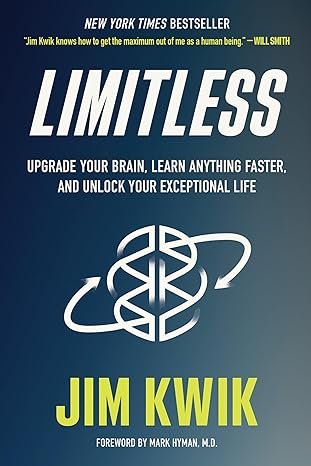

Summary of LIMITLESS Jim Kwik
Jim Kwik’s Limitless begins with a deeply personal story that shapes everything that follows. As a child, a head injury in kindergarten left him with severe learning difficulties. He couldn’t focus, couldn’t concentrate, and reading was torture. A frustrated teacher once pointed at him and said, “That’s the boy with the broken brain,” and he carried this label for years, believing his brain was permanently damaged. Yet through a combination of determination, curiosity, and the guidance of a mentor, Kwik discovered something extraordinary: learning how to learn is the ultimate superpower. This realization transformed his life and became his mission to share with the world.
The book is built on a simple but powerful framework: becoming limitless requires alignment of three elements, Mindset (the what), Motivation (the why), and Methods (the how). When these three work together, you achieve what Kwik calls “limitless momentum.” But before you can upgrade your brain, you must recognize the forces working against you.
The Four Supervillains of the Digital Age
Kwik identifies four modern threats to our cognitive potential, each amplified by technology itself. Digital Deluge is the overwhelming flood of information we face daily, we now consume as much data in a single day as someone from the 15th century absorbed in an entire lifetime. This constant input creates stress, anxiety, and mental fog, impairing our ability to think clearly. Digital Distraction keeps us perpetually divided, with studies showing it takes an average of 23 minutes to refocus after an interruption. Each notification delivers a hit of dopamine that reinforces our distraction habits, literally reshaping our brains to be less focused. Digital Dementia describes how outsourcing our memory to smart devices causes our cognitive abilities to atrophy, we no longer memorize phone numbers, directions, or even facts, and our memory muscles weaken from disuse. Digital Deduction represents the most insidious threat: we let technology do our thinking for us, surrendering our critical reasoning to search engines and algorithms. If you wouldn’t let another person do your thinking, Kwik asks, why would you let a device do it?
Mindset: Breaking Free from Limiting Beliefs
The first pillar of Kwik’s framework is mindset, the deeply held assumptions about yourself and what’s possible. All behavior is driven by belief, and most of us are imprisoned by beliefs we accepted without question. Kwik calls these LIEs (Limited Ideas Entertained). Among the most damaging are the beliefs that intelligence is fixed (Carol Dweck’s research proves it isn’t), that we only use 10% of our brains (neuroscience confirms we use 100%), that mistakes are failures (Einstein made countless errors), and that genius is born (Bruce Lee became a genius through relentless practice). Each of these lies limits potential before any effort is made.
To overcome limiting beliefs, Kwik offers three keys: name the belief, get to the facts (most limiting beliefs are simply wrong), and create a new, more empowering belief. He also suggests giving your inner critic a cartoonish name and personality, mock it for its negativity. The more you can separate this voice from your true self, the more you can prevent it from holding you back. Understanding that genius takes multiple forms, dynamo, blaze, tempo, and steel, helps you recognize that your unique intelligence is valid and valuable
Motivation: Purpose, Energy, and Small Steps
The second pillar is motivation, which Kwik defines not as something you have but as something you do. His formula is elegantly simple: Motivation = Purpose × Energy × Small Simple Steps (S³). Purpose is the reason you act, it’s what you’re here to share with the world. Energy is the fuel that sustains action, and small simple steps create momentum without overwhelming you.
Purpose begins with understanding who you are. The two most powerful words are “I am”, whatever follows them determines your destiny. Studies show that people who identify as “voters” are 13% more likely to vote than those who simply consider voting an action they might take. Identity shapes behavior. Your purpose should be tied to your deepest values and aligned with how you want to serve others.
Energy requires proper brain care. Kwik outlines ten recommendations: a brain-healthy diet rich in foods like avocados, blueberries, and salmon; regular exercise that boosts the hippocampus; eliminating Automatic Negative Thoughts (ANTs); creating a clean environment; surrounding yourself with positive peers; protecting your brain from injury; continuing to learn new things; managing stress; and getting quality sleep. Sleep is particularly crucial, during sleep, your brain performs “housekeeping,” flushing toxins linked to Alzheimer’s disease. Without sleep, you cannot form or maintain the neural pathways that let you learn and create new memories.
Small simple steps are the key to sustainable motivation. The Zeigarnik effect shows that uncompleted tasks create mental tension that exhausts us. Breaking large tasks into tiny, achievable steps reduces this tension and creates momentum. Kwik shares the story of Xiang, who suffered from schizophrenia and started with just two small habits, brushing his teeth with his opposite hand and taking a cold shower each morning. These tiny wins built confidence that eventually led him to change his diet, start jogging, read his first book, and enroll in computer science classes. A single small change can cascade into a transformed life.
The ultimate expression of motivation is flow, the state where time disappears, action feels effortless, and productivity soars. Flow requires eliminating distractions, having clear goals, doing something you love, and pushing yourself slightly outside your comfort zone. The enemies of flow, multitasking, stress, fear of failure, and lack of conviction, must be actively managed.
Methods: Focus, Study, Memory, Reading, and Thinking
The third pillar provides practical techniques for accelerated learning. Focus is the ability to concentrate brain power on a single task. Concentration is like a muscle—it gets stronger with practice. Dandapani, a former monk, defines concentration as keeping your awareness on one thing for an extended period. Using a visual pacer while reading, creating a clutter-free environment, and practicing the 4-7-8 breathing method all improve focus.
Study requires active engagement rather than passive consumption. Active recall, closing the book and writing down everything you remember—is far more effective than re-reading. Spaced repetition, reviewing material at increasing intervals, combats the forgetting curve and creates lasting memory. Your state matters: sitting up straight and smiling actually makes you feel more capable. Using scent and baroque music can enhance learning. Taking notes by hand forces you to process information, making it more memorable than typing.
Memory is trainable. There’s no such thing as a good or bad memory, only a trained or untrained memory. Kwik uses MOM to remember the framework: Motivation, Observation, and Methods. The loci method (or memory palace), dating back 2,500 years, involves associating information with familiar locations. The Baker/baker Paradox shows that associations matter, you’re more likely to remember someone is a baker (occupation) than that their last name is Baker because the occupation connects to a network of associations. BE SUAVE helps remember names: Believe, Exercise, Say it, Use it, Ask, Visualize, and End with the name.
Speed reading is essential in the information age. Leaders are readers. Barriers include regression (re-reading words), outdated skills (reading techniques stuck in elementary school), and subvocalization (saying words in your head, which limits speed to speaking speed). Using your finger as a visual pacer increases speed by 25-100%. Pushing your speed limits actually improves comprehension by keeping your brain engaged. Reading faster is like driving on a racetrack, your focus intensifies, and you process more effectively.
Thinking requires multiple perspectives. Edward de Bono’s Six Thinking Hats provides a structured approach: White for information, Yellow for optimism, Black for difficulties, Red for emotions, Green for creativity, and Blue for managing the process. Exponential thinking means solving underlying problems rather than working harder for incremental improvement. Instead of making something 10% better, ask how you can achieve 10X improvement through entirely different approaches. Naveen Jain exemplifies this, instead of finding better ways to transport water, he asked why there was a water shortage and discovered that agriculture was using most of it. Solving that underlying problem created abundance.
Understanding Your Brain Type and Using AI
Kwik introduces the Brain Animal C.O.D.E. assessment, which identifies four cognitive archetypes: Cheetah (quick-thinking and adaptable), Owl (analytical and detail-oriented), Dolphin (creative and innovative), and Elephant (emotionally intelligent and empathetic). Understanding your type helps you play to your strengths, address weaknesses, and interact more effectively with others who think differently. Teams with diverse brain types are more powerful, Cheetahs bring speed, Owls bring analysis, Dolphins bring creativity, and Elephants bring cohesion.
Artificial intelligence should be viewed as Augmented Intelligence, a tool that enhances rather than replaces human capabilities. AI can create personalized learning paths, manage information overload, enhance memory through spaced repetition, and provide accountability. However, AI cannot replace human reasoning, creativity, emotional intelligence, or critical thinking. Knowledge and reasoning are not the same, AI can access vast knowledge but cannot truly think or apply reflective reasoning. The future belongs to those who combine their unique human abilities with AI’s processing power.
Becoming limitless is not about perfection, it’s about progress. It’s about understanding that your brain is the most powerful tool in existence and learning how to use it effectively. It’s about breaking free from the limiting beliefs that imprison you, finding purpose that fuels action, mastering methods that accelerate learning, and creating momentum that sustains transformation.
Kwik concludes by emphasizing that the hero’s journey always includes a return, a responsibility to share what you’ve learned with others. The formula is simple: Learn. Earn. Return. With your newfound knowledge, help those around you learn better and faster. As Kwik puts it, “The life you live are the lessons you teach. Be limitless.”
The key message of Limitless is that your potential is not fixed. You can upgrade your brain the way you upgrade your phone. You can learn anything faster. You can remember anything you choose. You can focus deeply and think clearly. The only limits that truly exist are the ones you accept without question. When you align your mindset, motivation, and methods, you become unstoppable. The journey to becoming limitless begins with a single step, and that step is yours to take right now.