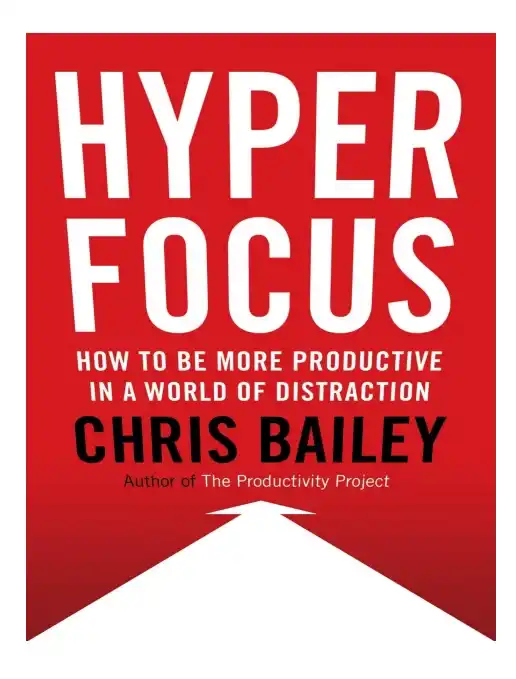
True productivity isn’t about being busy—it’s about being intentional with your attention. In Hyperfocus , Chris Bailey shows how to master your focus, eliminate distractions, and do fewer things better. By balancing deep work with creative downtime, you’ll achieve more in less time—and finally get the results that matter most.
Chris Bailey’s “Hyperfocus” explores the science of attention and productivity in an age of constant distraction. Drawing on extensive research and personal experimentation, Bailey presents a practical framework for managing our most valuable resource—our attention—through two complementary mental modes: hyperfocus and scatterfocus.
Bailey begins by establishing that attention is everywhere, yet we manage it poorly. Studies show that knowledge workers can focus for an average of just forty seconds before being distracted or interrupting themselves. This fragmented attention undermines productivity, creativity, and overall well-being. The problem is compounded by our devices, which provide endless streams of novel, pleasurable, and threatening stimuli that hijack our brain’s evolutionary wiring.
The author argues that we operate much of our lives on “autopilot mode,” making decisions unconsciously about where to direct our attention. Up to 40 percent of our actions are habits that require no conscious deliberation. While this is necessary for routine tasks, it becomes problematic when we apply it to our most important work.
Bailey explains that our attention has two fundamental constraints. First, our brain receives eleven million bits of information per second from the environment, but we can consciously process only forty of them. Second, our short-term memory—what Bailey calls “attentional space”—can hold only about four chunks of information at once. This limited workspace is where we process thoughts, make decisions, and work on tasks.
Understanding these limits is crucial. When we overload our attentional space by trying to focus on too many things simultaneously, we experience stress, forgetfulness, and decreased performance. The author introduces the concept of “meta-awareness”—the practice of noticing what occupies our attention—as a key skill for managing attentional space effectively.
To make better decisions about where to direct attention, Bailey categorizes tasks using two criteria: whether they are productive (accomplish a lot) and whether they are attractive (fun to do). This creates four quadrants:
Purposeful Work: Tasks that are both productive and meaningful but not necessarily attractive. These are the tasks we’re uniquely suited for and that create the most significant impact.
Necessary Work: Tasks that are productive but unattractive—like meetings and administrative duties that must be done.
Distracting Work: Tasks that are attractive but unproductive—social media, news websites, and other low-return activities that should be consumed in small doses.
Unnecessary Work: Tasks that are neither productive nor attractive—often forms of procrastination that keep us busy without accomplishing anything.
The most productive people spend the majority of their time on purposeful and necessary work, consciously avoiding the distractions and unnecessary tasks that consume so much of our days.
Hyperfocus is Bailey’s term for the brain’s most productive state—when we direct our complete attention to one important task. The author outlines four stages to achieve hyperfocus:
Choose a productive or meaningful object of attention – Set a clear intention before beginning.
Eliminate external and internal distractions – Tame both environmental interruptions and mental “open loops” that compete for attention.
Focus on the chosen object – Commit to concentrating on that one thing for a predetermined period.
Continually draw your focus back – When your mind inevitably wanders, gently redirect it to your original intention.
Setting strong intentions is critical. Bailey cites research showing that specific “implementation intentions” (plans that include when, where, and how you’ll accomplish something) can double or triple your odds of success. The Rule of 3—choosing three main tasks to accomplish each day—provides a simple framework for daily intention setting.
Distractions are infinitely easier to deal with in advance than after they appear. Bailey advocates creating a “distraction-free mode” for hyperfocus periods—eliminating every controllable distraction so your brain has no choice but to work on your chosen task. This includes using distraction-blocking apps, putting phones in another room, and creating environments conducive to deep work.
For the rest of the day, Bailey recommends working with “reduced distractions”—becoming more deliberate about when and how we engage with email, meetings, social media, and other common interruptions. Small changes like disabling notifications, scheduling specific times for email, and questioning the value of recurring meetings can reclaim hours of productive time.
The author also emphasizes simplifying our environments. Environmental cues—whether a phone on the table or an app icon on a screen—can pull us away from our intentions. By consciously designing our physical and digital spaces, we make it easier to focus on what matters.
Perhaps counterintuitively, Bailey argues that intentional mind wandering—which he calls “scatterfocus”—is just as essential as hyperfocus. While hyperfocus is the brain’s most productive mode, scatterfocus is its most creative. When we deliberately let our minds wander, we connect seemingly unrelated ideas, plan for the future, and recharge our mental energy.
Research shows our mind wanders 47 percent of the time, visiting the past (12%), present (28%), and future (48%). This prospective bias—our tendency to think about the future during mind-wandering—makes scatterfocus a powerful tool for planning and goal setting. The author distinguishes three styles of scatterfocus:
Capture Mode: Letting your mind roam freely and capturing whatever arises—valuable for identifying unresolved tasks and commitments.
Problem-Crunching Mode: Holding a specific problem loosely in mind while letting thoughts wander around it—useful for tackling complex, non-linear problems.
Habitual Mode: Engaging in a simple, pleasurable task (like walking or doing dishes) while letting the mind wander—the most powerful style for generating creative insights.
Bailey frames creativity and expertise as a process of collecting and connecting “dots”—pieces of information, experiences, and knowledge. The more valuable dots we collect, the more connections we can make in scatterfocus mode. This is why consuming high-quality information matters: we are what we pay attention to.
The author provides a framework for auditing and improving the information we consume, categorizing it as useful, balanced, entertaining, or trashy. By deliberately choosing to consume more useful information and eliminating the “trash” that adds nothing to our lives, we build richer constellations of dots to connect during scatterfocus periods.
Mental energy depletes throughout the day, shrinking our attentional space and reducing our ability to focus. Bailey emphasizes the importance of taking regular breaks—approximately fifteen minutes for every hour of work—to recharge. The best breaks are low-effort, enjoyable activities that allow the mind to wander freely.
Sleep is equally critical. A sleep deficit can shrink attentional space by up to 60 percent, making complex tasks take twice as long. The author recommends treating sleep as an investment in productivity rather than a luxury.
Throughout the book, Bailey offers numerous practical tactics for managing attention better:
Set three daily intentions and keep them visible
Use an hourly awareness chime to check what’s occupying your attentional space
Create a distraction-free mode for hyperfocus periods
Take breaks strategically—before you need them
Practice meditation and mindfulness to expand attentional space
Audit your information diet and consume more valuable dots
Work around your energy levels—hyperfocus during peak energy, scatterfocus during low energy
Bailey concludes by reinforcing that attention is the most powerful tool we have to live a productive, creative, and meaningful life. How we manage our attention determines not only what we accomplish but also the quality of our experiences and relationships. By deliberately alternating between hyperfocus and scatterfocus, we can harness the full power of our minds—focusing deeply when we need to produce and opening our attention when we need to create, plan, or rest.
The quality of our attention determines the quality of our lives. In a world of endless distraction, learning to manage this precious resource may be the most essential skill we can develop.