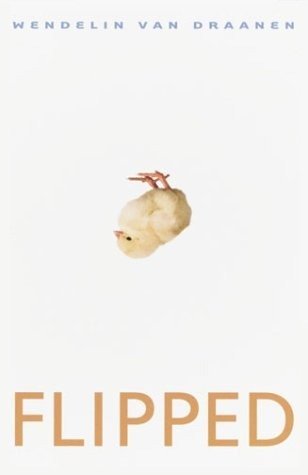
The Core Story: A Tale of Two Perspectives
The novel begins in the summer before second grade, when the Loski family moves into the neighborhood across the street from the Bakers. Juli Baker is a free-spirited, confident, and slightly unusual girl who falls instantly and completely for Bryce Loski—specifically, for his “dazzling” blue eyes. She barges into his life, helps his family move in, holds his hand, and decides he will be her first kiss.
Bryce, on the other hand, is horrified. He sees Juli as an annoying, pushy, embarrassing girl who won’t leave him alone. From second grade through the start of eighth grade, Bryce does everything he can to avoid her—hiding behind his mother, running away, and even dating other girls to throw her off his trail.
But then something shifts. Slowly, almost without realizing it, Bryce begins to see Juli differently. Meanwhile, Juli—who has spent years chasing Bryce—starts to notice the cracks beneath his perfect exterior. Their roles reverse. The girl who couldn’t stop loving him begins to pull away, and the boy who couldn’t stand her begins to fall.
Juli Baker: The Girl Who Sees Magic
Juli is the heart of this novel. She is not your typical romantic heroine. She’s not especially popular or conventionally pretty. She raises chickens in her backyard, climbs trees, and talks passionately about things like perpetual motion machines and the beauty of a sunrise. She’s smart, stubborn, and unapologetically herself.
What makes Juli so memorable is her depth. She is the one who understands, early on, that the whole can be greater than the sum of its parts. Her father teaches her this lesson while painting. He tells her that a cow by itself is just a cow, a meadow by itself is just grass and flowers, and the sun is just a beam of light—but put them all together, and you have magic. Juli internalizes this lesson and applies it to the world around her, especially to the enormous sycamore tree at the top of the hill.
That tree becomes Juli’s sanctuary. From its highest branches, she can see the entire world. She watches sunrises that take her breath away. She feels both humble and majestic. The tree represents everything beautiful and transcendent in life. When the tree is marked for cutting down to make room for a new house, Juli refuses to come down. She sits in those branches for hours, pleading with the workers, with her classmates, with anyone who will listen. In the end, the tree is cut down anyway, and Juli is devastated.
But her father gives her a gift: a painting of the tree, with a tiny girl in its branches looking out at the sunrise. He tells her he wants the spirit of that tree to be with her always. And Juli begins to understand that the things we love never truly leave us.
Bryce Loski: The Boy Who Learns to See
Bryce begins the novel as a classic coward. He is passive, afraid of confrontation, and deeply influenced by his father’s narrow-minded opinions. He throws away the fresh eggs Juli gives him every week for two years rather than simply telling her his family doesn’t want them. He laughs when his friend makes a cruel joke about Juli’s mentally disabled uncle. He dates shallow girls like Shelly Stalls and Miranda Humes because it’s easier than facing his true feelings.
But Bryce is not a bad person. He is a boy who has never been forced to look beneath the surface—until Juli forces him. His grandfather, Chet Duncan, moves in with the family and immediately recognizes something special in Juli. He tells Bryce: “Some of us get dipped in flat, some in satin, some in gloss. But every once in a while you find someone who’s iridescent, and when you do, nothing will ever compare.”
This is the turning point for Bryce. He starts to see Juli clearly for the first time. He notices her strength, her integrity, her willingness to stand up for what she believes in. He realizes that all the girls he thought were beautiful—Shelly, Miranda—are ordinary compared to her. He has been looking at the wrong things his entire life.
By the end of the novel, Bryce has undergone a genuine transformation. He stands up to his friend Garrett for mocking Juli. He confronts his father’s prejudice. And finally, he plants a sycamore tree in Juli’s front yard—a living apology, a symbol of everything he should have done years ago.
Family and Class: The Hidden Layer Beneath the Romance
Flipped is not just a love story. It is also a thoughtful exploration of family dynamics and economic class. The Bakers are poor. They rent their house, drive beat-up cars, and Juli’s father spends most of his money caring for his mentally disabled brother, David. The Loskis are comfortably middle class. Mr. Loski looks down on the Bakers, calling their yard a “dive” and implying that they are trash.
But as the novel progresses, we see that wealth has nothing to do with worth. The Bakers are loving, loyal, and kind. Juli’s father works as a mason but paints landscapes in his spare time. He sacrifices financial comfort to care for his brother because it is the right thing to do. When Bryce’s mother finally learns the truth about David, she is moved to tears—and ashamed of her own assumptions.
Mr. Loski, by contrast, is revealed to be shallow and judgmental. He mocks the Baker boys’ band, accuses them of being drug dealers, and slaps his own daughter across the face for talking back. He is the novel’s cautionary figure: a man who has never learned to look beneath the surface.
The Sycamore Tree: The Novel’s Most Powerful Symbol
The sycamore tree is the emotional anchor of Flipped. For Juli, it is a place of wonder, beauty, and freedom. It is where she learns to see the world differently. When the tree is cut down, she loses something irreplaceable. But her father’s painting keeps its spirit alive.
When Bryce plants a new sycamore tree in Juli’s yard, he is not just apologizing. He is saying that he finally understands what the tree meant to her. He is saying that he wants to build something together, from the ground up. It is a quiet, powerful gesture—and Juli recognizes it for what it is.
The novel ends on a note of hopeful uncertainty. Juli comes outside to look at the tree. She sees Bryce watching from his window. He waves. She waves back. And for the first time in six years, she considers that maybe, just maybe, there is more to Bryce Loski than she knows.
Why Flipped Endures
Flipped has remained popular for over two decades because it captures something universal about growing up. Most of us have had a crush on someone who didn’t feel the same way. Most of us have been blind to someone’s true character because we were too focused on their surface. Most of us have had to learn—slowly, painfully—what really matters in a person.
The novel teaches that love is not about instant attraction or dazzling eyes. It is about seeing someone clearly, respecting them fully, and being brave enough to admit when you’ve been wrong. It is about becoming the kind of person worth loving.
Juli says it best: “Maybe it’s time to meet him in the proper light.”
By the end of the story, both Juli and Bryce are finally ready to do just that.
Flipped book summary, Wendelin Van Draanen, Flipped novel review, young adult romance, dual perspective narrative, sycamore tree symbolism, Juli Baker, Bryce Loski, first love stories, books about growing up, coming of age novels