
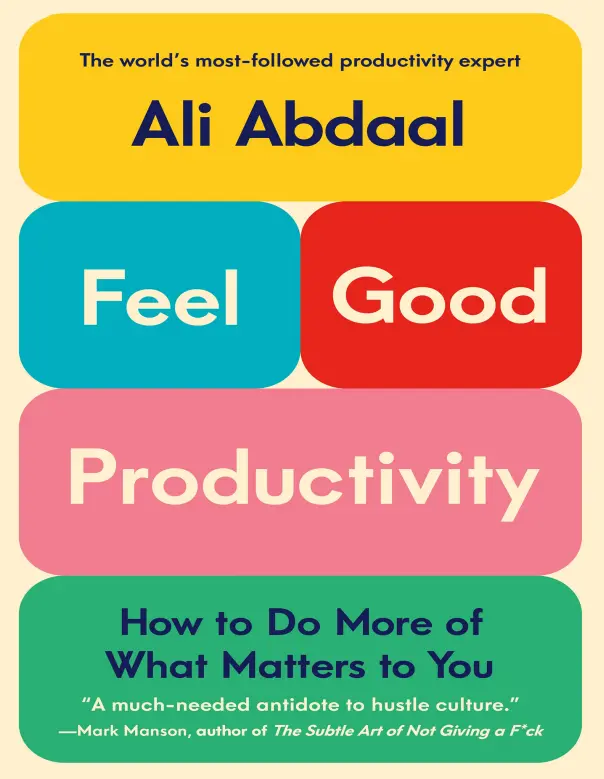
Feel Good Productivity redefines productivity as a tool for living a joyful, meaningful life. Ali Abdaal shows that working smart means working happily—by aligning your habits with your values, energy, and goals. This book blends science, psychology, and real-world examples to help you achieve more—without burnout, stress, or sacrifice.
Feel Good Productivity is a fresh take on time management and getting things done, not by pushing harder, but by working smarter and feeling better while doing it.
Written by Ali Abdaal , former doctor turned productivity expert, YouTuber, and author, this book challenges the traditional view that productivity must be exhausting or stressful.
Instead, Abdaal argues that the best productivity systems are those that make you feel good , energized, motivated, and in control.
“The goal isn’t just to do more, it’s to enjoy what you’re doing.”
Drawing from psychology, neuroscience, and real-life examples, including his own experience juggling medicine, content creation, and fatherhood, Abdaal presents a framework for sustainable productivity that doesn’t burn you out.
This summary gives you a clear, engaging breakdown of the book’s core ideas, perfect for applying in work, study, or personal life.
Most productivity advice focuses on:
But Abdaal points out a key flaw:
Productivity should serve your happiness, not steal it.
He shares how many high-achievers suffer from burnout because they ignore their well-being in pursuit of efficiency.
Key Insight: If your productivity system makes you miserable, it won’t last, and it won’t help.
Abdaal defines feel good productivity as:
“Doing more of what matters to you, in a way that leaves you energized, not exhausted.”
It’s about aligning your habits, goals, and mindset with what truly motivates you, so productivity becomes enjoyable, not punishing.
Unlike traditional models, this approach recognizes that:
Important Lesson: Feeling good while being productive isn’t a luxury, it’s a strategy.
Motivation starts with meaning. Ask yourself:
When you understand your purpose, even hard work feels meaningful.
Dopamine is the brain’s reward chemical. Abdaal explains how to use it to your advantage:
Key Insight: Make work feel rewarding, and your brain will keep coming back for more.
Abdaal encourages readers to stop forcing themselves to be productive when they’re tired or distracted.
Instead:
Important Lesson: High energy beats forced discipline every time.
Abdaal outlines three essential elements of feel good productivity :
Knowing exactly what to do, and why, is the foundation of effective action.
Without clarity:
Abdaal suggests:
“Clarity reduces resistance. Resistance kills motivation.”
Productivity isn’t about time—it’s about how you feel during that time .
Abdaal emphasizes:
He also highlights the importance of mental rest —not just physical downtime—to avoid burnout.
“You can’t pour from an empty cup. But most people try anyway.”
One of the biggest obstacles to productivity is the belief that you need to be perfect—or you might as well not start.
Abdaal teaches:
“A little bit done regularly beats a lot done once.”
This mindset helps build momentum without pressure.
Abdaal fills the book with science-backed strategies that are easy to apply:
If a task takes less than two minutes, do it immediately. This avoids mental clutter and builds a habit of action.
Work intensely for 90 minutes, then take a 20-minute break. This mimics our natural ultradian rhythm and boosts focus.
Focus on improving by just 1% each day. Small gains compound into massive change over time.
Group similar tasks together (e.g., answering emails, making phone calls) to reduce switching costs and improve flow.
Use checklists, habit trackers, or apps to see how far you’ve come. Seeing progress—even small—keeps you going.
Key Insight: Productivity should feel satisfying, not stressful.
For professionals, Abdaal offers insights on how to stay productive without burning out:
“You can’t be productive if you’re drained.”
He also discusses how managers can support teams by creating environments where employees feel motivated and supported—not pressured and punished.
Abdaal expands beyond work to talk about how feel-good productivity applies to personal life and relationships:
“Feeling good isn’t selfish—it’s strategic.”
By taking care of yourself first, you become more capable of helping others and enjoying life.
Throughout the book, Abdaal uses stories and research to illustrate his ideas:
These examples prove that feel good productivity isn’t just theory, it works in real life.
Important Lesson: You don’t have to reinvent yourself, you just need to optimize how you already work.
Abdaal introduces several mindset shifts that transform how we think about productivity:
“Your mindset shapes your habits. Your habits shape your life.”
Abdaal provides practical frameworks you can use right away:
Helps you prioritize tasks based on urgency and importance.
Schedule specific blocks for deep work, shallow work, and rest.
Write six tasks each evening for the next day—and finish them before moving on.
Work in focused bursts (25–50 minutes), then take short breaks.
Attach new habits to existing ones—for example, “After I brush my teeth, I’ll meditate for five minutes.”
Key Insight: The best productivity systems fit your lifestyle—not someone else’s.
Feel Good Productivity is not about doing more—it’s about doing what matters, in a way that supports your health, happiness, and growth.
Abdaal reminds us that:
As he writes:
“You can be productive and happy at the same time.”
That’s the whole point.
Comments
1Amazing book