
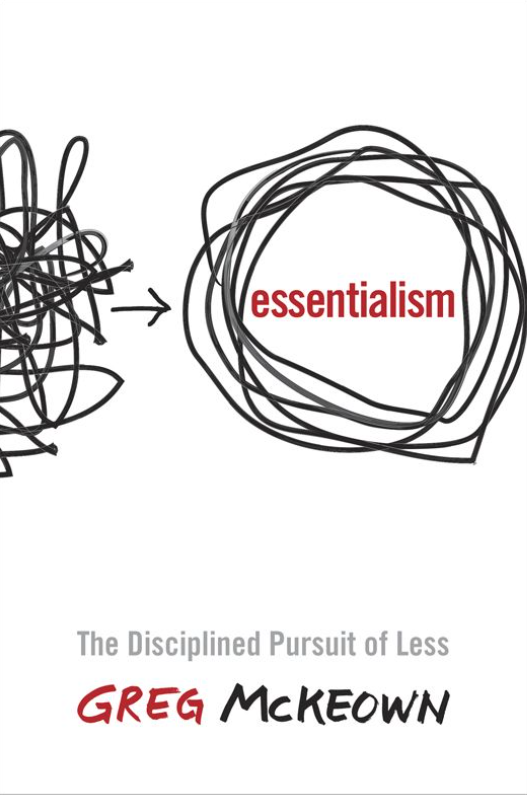

The core problem of modern life, argues Greg McKeown, is that we have too many choices and opportunities, leading to diffused efforts and a life of busyness without real productivity. The solution is not time management or getting more done, but adopting the mindset of an Essentialist: a disciplined, systematic approach to discerning what is absolutely essential, then eliminating everything else, so we can make the highest possible contribution to what truly matters. The guiding principle is captured in three German words: Weniger aber besser , “Less but Better.”
Part I: Essence – The Core Mindset
To think like an Essentialist, you must replace three false assumptions with three core truths:
-
“I have to” → “I choose to.” You always have the power to choose. When you forget this, you learn helplessness and allow others to choose for you.
-
“It’s all important” → “Only a few things really matter.” The Pareto Principle (80/20 rule) applies everywhere: a tiny fraction of efforts produce the vast majority of results. Most things are noise; very few are vital.
-
“I can do both” → “I can do anything but not everything.” Trade-offs are real and unavoidable. Trying to straddle two incompatible strategies leads to failure. The essential question is not “How can I do it all?” but “Which problem do I want to solve?”
Part II: Explore – Discerning the Vital Few from the Trivial Many
An Essentialist actually explores more options than a Nonessentialist, but does so deliberately to ensure they pick the right one later. Key practices include:
-
Escape: Create space to think. Schedule time with no agenda, no technology, just to focus. Silence is not a luxury; it is necessary for clarity.
-
Look: Be a journalist of your own life. Listen for what is not being said. Identify the “lead” or the headline. Keep a journal to spot patterns over time.
-
Play: Play is not trivial; it is essential for brain plasticity, creativity, and reducing stress. It broadens your range of options and helps you see new possibilities.
-
Sleep: Protect your ability to prioritize. Sleep deprivation impairs your judgment as much as alcohol. Top performers sleep more, not less, to regenerate.
-
Select: Apply extreme criteria. If the answer isn’t a definitive “Hell Yeah!” then it should be a “No.” Use the 90 Percent Rule: if an opportunity scores below 90% on your most important criterion, reject it automatically.
Part III: Eliminate – Cutting Out the Trivial Many
This is the hardest part because it involves saying no to people and social pressure.
-
Clarify: One essential intent (“Get everyone in the UK online by 2012”) is more powerful than a thousand vague goals. Clarity of purpose makes a thousand future decisions easier.
-
Dare: Learn the graceful “no.” Separate the decision from the relationship. Use scripts: “I’m flattered but I don’t have the bandwidth,” or “Yes, what should I deprioritize?” A clear no is more respectful than a vague yes.
-
Uncommit: Overcome sunk-cost bias—the tendency to keep investing in a losing proposition because you’ve already invested. Pretend you don’t own it yet. Ask: “If I weren’t already involved, how hard would I work to get into this?”
-
Edit: See yourself as the editor of your life. Cut out options, condense activities, and correct course. A good editor knows that subtraction adds value. “To write is human, to edit is divine.”
-
Limit: Set clear boundaries. If you don’t prioritize your life, someone else will. Boundaries are not constraining; they are liberating because they protect your ability to focus on what is essential.
Part IV: Execute – Making the Vital Things Effortless
Execution should not be a matter of force and willpower but of smart systems.
-
Buffer: Prepare for the unexpected. Add a 50% buffer to your time estimates. Extreme preparation (like Roald Amundsen for the South Pole) is the unfair advantage.
-
Subtract: Identify and remove the “slowest hiker”—the primary obstacle holding back all progress. Instead of adding more pressure, ask: “What is getting in the way?” Removing one key obstacle accelerates everything.
-
Progress: Focus on small wins. The most powerful motivator is making progress in meaningful work. Start small, celebrate minor achievements, and build momentum.
-
Flow: Design the right routines. A routine makes the essential the default behavior. Michael Phelps’ pre-race routine was so ingrained that winning became a natural extension. Identify your triggers and create new ones to automate good habits.
-
Focus: Live in the present. Ask constantly: “What’s important now?” Stop multitasking and start multifocusing. The past is gone; the future is not here; only the present moment is where you can execute.
Conclusion: The Essentialist Life
Living as an Essentialist means living a life of meaning, not just a list of accomplishments. It requires the courage to choose what is truly essential and to eliminate everything else. The reward is not just greater success, but more clarity, more control, and more joy in the journey. The question is not “How can I get it all done?” but “What is the one thing I came here to do with my one wild and precious life?”