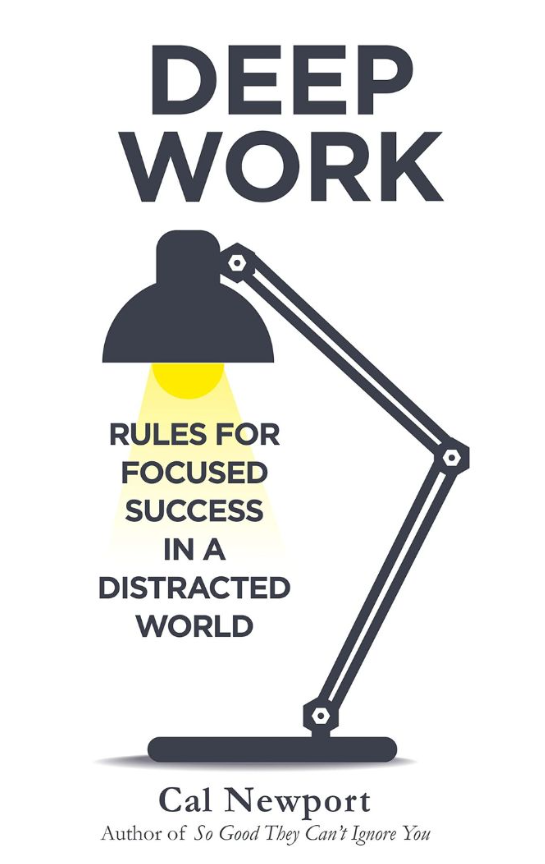
Deep work is the ability to focus without distraction on a cognitively demanding task. It’s a skill that allows you to quickly master complicated information and produce better results in less time. In short, deep work is like a superpower in our increasingly competitive economy. And yet, most people have lost the ability to go deep, spending their days instead in a frantic blur of email and social media, not even realizing there’s a better way
Cal Newport opens by telling the story of Carl Jung, who built a stone tower in the woods of Bollingen, Switzerland, to escape the distractions of his busy life in Zurich. Jung didn’t go there to vacation, he went there to think deeply and develop his revolutionary ideas that would eventually split him from Sigmund Freud and create analytical psychology.
Newport defines two key concepts that form the foundation of the entire book:
Deep Work: Professional activities performed in a state of distraction-free concentration that push your cognitive capabilities to their limit. These efforts create new value, improve your skill, and are hard to replicate.
Shallow Work: Non-cognitively demanding, logistical-style tasks, often performed while distracted. These efforts tend not to create much new value and are easy to replicate.
The book’s central argument is the Deep Work Hypothesis: The ability to perform deep work is becoming increasingly rare at exactly the same time it is becoming increasingly valuable in our economy. As a result, the few who cultivate this skill and make it the core of their working life will thrive.
Newport shares examples of deep workers throughout history: Mark Twain wrote Tom Sawyer in a secluded shed, Woody Allen has never owned a computer and writes on a manual typewriter, J.K. Rowling stayed off social media while writing Harry Potter, and Bill Gates took regular “Think Weeks” where he isolated himself to read and think deeply.
Meanwhile, the average knowledge worker now spends more than 60 percent of their workweek on electronic communication and internet searching, with nearly 30 percent of their time dedicated just to reading and answering email. This fragmented attention makes deep work nearly impossible.
Newport examines our changing economy through the work of MIT economists Erik Brynjolfsson and Andrew McAfee, who argue that we’re in the “early throes of a Great Restructuring” driven by digital technology. Three groups will thrive in this new economy:
1. High-Skilled Workers: Those who can work well with intelligent machines. Example: Nate Silver, who mastered complex data analysis tools to become the country’s most famous election forecaster.
2. Superstars: Those who are the best at what they do. Example: David Heinemeier Hansson, a programming superstar who created Ruby on Rails and can work remotely from anywhere in the world.
3. The Owners: Those with capital to invest in new technologies. Example: Venture capitalist John Doerr, who funded companies like Google and Amazon.
To join the first two groups, you need two core abilities: the ability to quickly master hard things, and the ability to produce at an elite level. Both depend on deep work.
Why deep work helps you learn quickly: Research on deliberate practice by Anders Ericsson shows that mastering hard skills requires intense concentration. Neuroscience explains this through myelin, a fatty tissue that grows around neurons when you practice a skill repeatedly with focus. This myelin acts as insulation, allowing the neural circuits to fire faster and more accurately. Diffused attention doesn’t isolate the right circuits, so learning doesn’t stick.
Why deep work helps you produce at an elite level: Newport introduces the concept of “attention residue” from researcher Sophie Leroy. When you switch between tasks, part of your attention remains stuck on the previous task, reducing performance on the new one. By working in long, uninterrupted stretches, you eliminate this residue and maximize output.
The chapter addresses the obvious counterexample: What about Jack Dorsey, co-founder of Twitter and Square, who lives a famously distracted life running multiple companies? Newport explains that executives are a special case, they’re essentially decision engines who need constant input. Their approach doesn’t apply to most knowledge workers. Unless you have strong evidence that distraction is essential for your specific profession, you should prioritize depth.
Despite its value, deep work is becoming increasingly rare. Newport explores why businesses have embraced distraction through three trends:
Trend 1: The Metric Black Hole – It’s incredibly difficult to measure the impact of depth versus distraction on the bottom line. When Atlantic Media’s CTO calculated the actual cost of all the time employees spent on email, he discovered it was equivalent to buying a company jet, over a million dollars a year. But without clear metrics, these costs remain hidden.
Trend 2: The Principle of Least Resistance – In the absence of clear feedback, people tend toward whatever is easiest in the moment. Constant connectivity makes life easier because you can get immediate answers and run your day out of your inbox rather than doing difficult advance planning. When Harvard professor Leslie Perlow forced consultants to take one day off from connectivity each week, they feared disaster, but instead found they delivered better results to clients.
Trend 3: Busyness as a Proxy for Productivity – Knowledge workers often can’t point to tangible outputs like a repaired motorcycle or a published paper. So they fall back on visible busyness, sending emails at all hours, attending meetings, responding instantly to messages, to prove they’re working. This is an industrial-age mindset that doesn’t fit knowledge work. The most productive people, like Wharton professor Adam Grant, do the opposite: they batch their teaching into one semester and disappear for days to focus on research.
The Cult of the Internet – We’ve developed a technopoly where anything internet-related is automatically assumed to be good. When Jonathan Franzen suggested novelists shouldn’t tweet, he was widely ridiculed, not because people disagreed with his logic, but because questioning social media itself had become taboo. This ideology, combined with the metric black hole, allows distraction to flourish while depth struggles.
Newport makes three arguments for why deep work leads to a satisfying life:
The Neurological Argument: Winifred Gallagher discovered after a cancer diagnosis that the quality of your life depends on what you choose to focus on. Research shows that our brains construct our reality based on where we direct our attention. If you spend your day in shallow tasks; email, meetings, distractions, your mind constructs a world of stress and triviality. If you spend it in deep work, your mind constructs a world of importance and meaning.
The Psychological Argument: Mihaly Csikszentmihalyi’s research on “flow” shows that people are happiest when they’re deeply immersed in challenging activities. Using the Experience Sampling Method (where people were paged at random moments to report what they were doing and how they felt), researchers found that people are actually happier at work than at leisure, because work provides structure, goals, and challenges that enable flow.
The Philosophical Argument: Philosophers Hubert Dreyfus and Sean Dorrance Kelly argue that craftsmanship provides meaning in a secular age. The craftsman doesn’t arbitrarily decide what’s valuable, the inherent qualities of the material and the task reveal meaning. This applies to knowledge work too. Writing elegant code or crafting a persuasive argument can provide the same sense of sacredness as shaping wood or forging metal. Deep work is the tool that allows you to access this meaning.
Newport introduces the Eudaimonia Machine, an architectural concept designed solely for deep work, with rooms progressing from gallery to salon to library to office to deep work chambers. Since most of us don’t have access to such spaces, we need strategies to create depth in our distracted world.
The key insight: Willpower is limited and depletes throughout the day. Research by Roy Baumeister shows that resisting desires, including the desire to check email or surf the web, uses up your finite willpower reserves. You need routines and rituals that minimize the willpower required to start and maintain deep work.
Strategy 1: Decide on Your Depth Philosophy
Newport presents four philosophies for integrating deep work:
Monastic: Eliminate or radically minimize shallow obligations. Practitioners like Donald Knuth (who hasn’t had email since 1990) and Neal Stephenson (who doesn’t answer correspondence) focus exclusively on one clearly defined goal. This works only if your contribution to the world is discrete and individualized.
Bimodal: Divide your time, dedicating clear stretches to deep pursuits and leaving the rest open. Carl Jung did this, retreating to Bollingen for intense periods while maintaining a busy practice in Zurich. The minimum unit for deep work in this philosophy is at least one full day.
Rhythmic: Transform deep work into a simple regular habit. Like Jerry Seinfeld’s “don’t break the chain” method, write every day and mark an X on the calendar. Or wake up at 5:30 every morning to work for two hours before your regular job. This works well for those whose jobs don’t allow multiday disappearances.
Journalistic: Fit deep work wherever you can into your schedule. Like Walter Isaacson writing his 900-page book in twenty-minute bursts while working full-time at Time magazine. This is the most difficult approach and requires confidence in your abilities, but it can yield surprising amounts of depth.
Strategy 2: Ritualize
Great thinkers like Charles Darwin and Robert Caro followed strict rituals. Darwin rose at seven, took a short walk, ate breakfast alone, worked from eight to nine-thirty, read letters, worked again from ten-thirty to noon, then solved problems while walking a prescribed route. These rituals minimized the friction of transitioning to depth.
Your ritual should address:
Where you’ll work and for how long
How you’ll work once you start (rules, processes)
How you’ll support your work (coffee, food, exercise)
Strategy 3: Make Grand Gestures
J.K. Rowling checked into a five-star hotel to finish the last Harry Potter book. Bill Gates took Think Weeks in a secluded cabin. The MIT physicist Alan Lightman retreats to an island without internet for two and a half months each summer. These grand gestures increase the perceived importance of the task, reducing procrastination and providing motivation.
Strategy 4: Don’t Work Alone
While open offices destroy depth, collaboration can enhance it. The key is the hub-and-spoke model: expose yourself to ideas in collaborative hubs, then retreat to private spokes to work deeply. The whiteboard effect, working side by side with someone on a problem, can push you deeper than working alone.
Strategy 5: Execute Like a Business
Newport adapts the 4 Disciplines of Execution (4DX) framework:
Focus on the wildly important: Identify a small number of ambitious outcomes.
Act on lead measures: Track time spent in deep work, not just outcomes.
Keep a compelling scoreboard: Post your deep work hours where you can see them.
Create a cadence of accountability: Do weekly reviews to plan and adjust.
Strategy 6: Be Lazy
Downtime is essential for three reasons:
It aids insights: Unconscious thought theory shows that complex problems are often solved when your conscious mind is resting.
It recharges energy: Attention restoration theory proves that time in nature (or any undemanding environment) replenishes your ability to concentrate.
The work it replaces isn’t important: You can only do about four hours of deep work per day anyway. Evening work is usually shallow and low-value.
Newport recommends a shutdown ritual at the end of each workday, reviewing incomplete tasks, making a plan for tomorrow, and saying “shutdown complete” to signal your brain that work is done. This counters the Zeigarnik effect, where incomplete tasks dominate our attention.
The ability to concentrate is a skill that must be trained. Adam Marlin, an Orthodox Jew who studies Talmud daily, found that this intense mental practice improved his business thinking. Research by Clifford Nass shows that constant attention switching online has lasting negative effects, chronically distracted people can’t filter out irrelevancy, can’t manage working memory, and become “mental wrecks.”
Strategy 1: Don’t Take Breaks from Distraction, Take Breaks from Focus
Instead of an Internet Sabbath (one day offline), schedule your Internet use. Keep a notepad listing when you’re allowed to go online. Outside those blocks, absolutely no connectivity. This trains your brain to resist the urge to seek distraction at the first hint of boredom.
Strategy 2: Work Like Teddy Roosevelt
Roosevelt had an amazing array of interests, boxing, wrestling, dancing, poetry, naturalism, and published his first book as a freshman. Yet he still got good grades. His secret: intense bursts of concentration. He would work on schoolwork with blistering intensity during short time blocks, then have freedom the rest of the day. Try this once a week: identify a deep task, set a hard deadline, and attack it with everything you have.
Strategy 3: Meditate Productively
Take periods when you’re physically occupied but mentally free, walking, jogging, driving, showering, and focus your attention on a single professional problem. This strengthens your concentration muscles. Two suggestions: watch for looping (rehashing what you already know) and structure your thinking (identify variables, define the next-step question, consolidate gains).
Strategy 4: Memorize a Deck of Cards
Memory training improves attention control. Daniel Kilov went from a struggling student with ADD to a PhD candidate after training his memory. The technique uses visualization, associate cards with memorable people and places, then mentally walk through familiar rooms placing those images. This structured focus strengthens your general ability to concentrate.
Baratunde Thurston, “the most connected man in the world,” tried disconnecting for 25 days and found it transformative, but soon slid back into distraction. The problem is that we use an “any-benefit” mindset: if a tool offers any possible benefit, we feel justified using it. This ignores the massive costs to our time and attention.
Newport proposes the Craftsman Approach: Identify the core factors that determine success and happiness in your life. Adopt a tool only if its positive impacts on these factors substantially outweigh its negative impacts.
Strategy 1: Apply the Law of the Vital Few
List your main professional and personal goals. For each, identify the two or three most important activities that support them. Then evaluate each network tool, does it have a substantial positive impact on these key activities? For most people, the answer will be no. Michael Lewis doesn’t tweet because it doesn’t help him research and write deeply. Malcolm Gladwell doesn’t use social media for the same reason.
The law of the vital few (80/20 rule) says that 80% of your results come from 20% of your activities. Focus on those.
Strategy 2: Quit Social Media for 30 Days
Like a “packing party” for your digital life, quit all social media for a month. Don’t announce it; just stop. After 30 days, ask: Would my life have been notably better with this service? Did anyone care that I wasn’t using it? If the answer is no to both, quit permanently.
This addresses the illusion that people care about your online presence. Most social media attention is based on a shallow exchange: I’ll pay attention to you if you pay attention to me, regardless of value.
Strategy 3: Don’t Use the Internet to Entertain Yourself
Arnold Bennett wrote in 1910 that people treat their work hours as “the day” and their free hours as meaningless epilogue. He argued for using free time deliberately, reading great literature, pursuing structured hobbies. Today, we fill free moments with addictive entertainment sites, which weakens our ability to resist distraction. Instead, plan your leisure time in advance. Give your brain quality alternatives.
The software company 37signals (now Basecamp) experimented with a four-day workweek and found that employees got just as much done. How? By eliminating shallow work, meetings, interruptions, office politics, while preserving deep work. They then gave employees the entire month of June off to work on their own projects, which produced valuable innovations.
Shallow work is inevitable, but you must keep it confined so it doesn’t impede your deep efforts. You can only do about four hours of deep work per day anyway, so the goal is to protect that time.
Strategy 1: Schedule Every Minute of Your Day
At the start of each day, divide your hours into blocks and assign activities. When interruptions occur, revise your schedule. The goal isn’t rigid adherence but thoughtful control. This forces you to confront how you’re actually spending time and make intentional choices.
Strategy 2: Quantify the Depth of Every Activity
Ask: How long would it take to train a smart recent college graduate to do this task? If months or years, it’s deep work. If days or weeks, it’s shallow. Use this to bias your time toward depth.
Strategy 3: Ask Your Boss for a Shallow Work Budget
Have a conversation about what percentage of your time should be spent on shallow work (typically 30-50%). This provides cover for saying no to shallow commitments and restructuring projects to minimize shallowness. If your boss insists on 100% shallow, it’s time to find a new job.
Strategy 4: Finish Your Work by 5:30
Fixed-schedule productivity forces you to be ruthless about what you take on and efficient with your time. Radhika Nagpal, a Harvard professor, set a 50-hour workweek limit and still earned tenure early. She did this by drastically limiting travel, reviews, and other shallow commitments. The scarcity mindset makes you say no more often and organize your efforts more efficiently.
Strategy 5: Become Hard to Reach
Three tips for email:
Make senders do more work: Use a sender filter that requires them to explain why their message matters. This reduces volume and resets expectations.
Do more work when you send or reply: Instead of quick responses, think through the whole project and describe a complete process. This minimizes back-and-forth.
Don’t respond: If a message is ambiguous, uninteresting, or responding wouldn’t produce anything good, just don’t reply. People adjust to your habits.
Newport shares his own journey with deep work. As a graduate student, he maintained productivity while rarely working past five. As a professor with increased obligations, he refined his habits and actually increased his output. During his “year of extreme depth,” he wrote this book while publishing nine academic papers, more than doubling his average, while still never working evenings.
The story of Bill Gates founding Microsoft illustrates the power of depth. For two months, Gates worked with such intensity that he would collapse asleep on his keyboard, wake up, and pick up where he left off. This “prodigious feat of concentration” enabled him to build a billion-dollar industry in less than a semester.
Deep work is not a moral stance or philosophical statement, it’s a pragmatic recognition that the ability to concentrate is a skill that gets valuable things done. The deep life requires hard work and drastic changes to habits, but it generates a life rich with productivity and meaning. As Winifred Gallagher said, “I’ll live the focused life, because it’s the best kind there is.”
In an economy where shallow work is everywhere and easily replicated, the ability to concentrate deeply on cognitively demanding tasks is increasingly rare and increasingly valuable. Those who cultivate this skill will thrive; those who don’t will struggle to keep up.
You can’t rely on willpower alone to maintain focus. Your willpower depletes throughout the day like a muscle. Instead, create routines and rituals that minimize the energy required to start and sustain deep work. Schedule your deep work sessions in advance, create a consistent environment, and follow set procedures.
Instead of trying to eliminate distraction entirely, schedule when you’ll give in to it. Set specific times for email and social media, and keep the rest of your time absolutely free. This trains your brain to resist the urge to seek novelty at the first hint of boredom.
What gets measured gets managed. Track your hours of deep work, post them where you can see them, and review your progress weekly. This simple practice dramatically increases the amount of depth you achieve.
Apply the craftsman approach: identify what really matters in your life, and only keep tools that substantially support those priorities. For most people, social media provides minor benefits at the cost of massive distraction. Try quitting for 30 days, you’ll likely discover no one notices and your life isn’t worse.
Most shallow work is less important than it seems. Ask for a specific budget for shallow tasks (30-50% is reasonable). Say no to commitments that don’t support your core goals. Finish your workday at a fixed time, this forces you to prioritize and eliminates the option of filling time with low-value activity.
Regular rest is essential for insights, for recharging your attention, and because you can only do about four hours of deep work per day anyway. Develop a shutdown ritual that clears your mind of work concerns, then truly disconnect.
The ability to tolerate boredom is essential for deep work. If you fill every idle moment with your phone, your brain loses the ability to concentrate when you need it. Practice being bored, wait in line without checking email, sit through a commercial without reaching for your phone.
Inject occasional bursts of extreme intensity into your work. Set ambitious deadlines and attack tasks with everything you have. This builds your concentration muscles and often produces better results than spreading work out over longer periods.
Neurology shows that your brain constructs your reality based on where you direct your attention. Spend your days in shallow distraction, and your world becomes shallow and stressful. Spend them in deep work on meaningful problems, and your world becomes rich with purpose and satisfaction. The focused life is genuinely the best kind there is.