
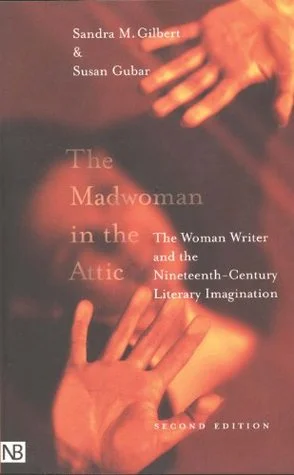

The Madwoman in the Attic: Complete Summary & Analysis
The Central Argument
Gilbert and Gubar begin with a provocative question: What does it mean to be a woman writer in a culture where literary authority is defined as fundamentally male? They argue that throughout Western literary history, the act of writing has been metaphorically linked to paternity—the pen as a penis, the author as a father who “begets” his text. For women, this creates an impossible situation: they cannot “father” texts, yet they are driven to write.
The authors propose that nineteenth-century women writers suffered from what they call an “anxiety of authorship” —a fear that they could not create, that writing would isolate or destroy them. This is distinct from Harold Bloom’s famous “anxiety of influence” (the male poet’s fear of his predecessors). For women, the problem is more fundamental: they lack legitimate precursors and must struggle against male definitions of what women are and should be.
The Angel and the Monster
A central insight of the book is that male literature has consistently reduced women to two extreme stereotypes:
The Angel in the House – The pure, selfless, domestic woman who exists only to serve and inspire men. Coventry Patmore’s poem of that name exemplifies this figure. The angel is beautiful, passive, and essentially dead to her own desires. Virginia Woolf famously declared that women writers must “kill” this angel to write freely.
The Monster – The angry, ambitious, sexual woman who rejects her assigned role. From Spenser’s Errour and Duessa to Swift’s disgusting female bodies, the monster represents male dread of female autonomy. She is the witch, the madwoman, the femme fatale.
Gilbert and Gubar demonstrate that these two figures are actually doubles of each other. Every angel contains a potential monster; every monster is a failed angel. Nineteenth-century women writers internalized this dichotomy, creating fictions in which mad doubles act out the rage the heroine cannot express.
The Key Strategy: Palimpsestic Writing
Because they could not openly rebel, women writers developed what the authors call palimpsestic techniques—writing in layers, hiding subversive meanings beneath acceptable surfaces. Like the palimpsest (a manuscript with hidden text beneath the visible writing), novels by women contain covert stories about female rage, ambition, and desire for freedom.
These hidden stories typically involve:
-
Imagery of enclosure – Attics, locked rooms, convents, graves, and ancestral mansions that trap female characters
-
Imagery of escape – Flights, mad dashes, journeys, and ultimately death as liberation
-
Mad doubles – Bertha Mason in Jane Eyre, the monster in Frankenstein, Catherine’s ghost in Wuthering Heights
-
Female diseases – Anorexia, agoraphobia, hysteria, and “spleen” as metaphors for female frustration
Part-by-Part Summary
Part I: Toward a Feminist Poetics
The opening section establishes the theoretical framework. Chapter 1, “The Queen’s Looking Glass,” analyzes how male authors have used women as mirrors for their own self-definition. Like the Queen in “Snow White,” women are trapped in a patriarchal gaze, forced to see themselves as male texts define them.
Chapter 2, “Infection in the Sentence,” introduces the concept of “anxiety of authorship.” Drawing on Emily Dickinson’s line about “infection in the sentence breeds,” Gilbert and Gubar show how women writers internalized the belief that creativity was unfeminine, even maddening.
Chapter 3, “The Parables of the Cave,” reinterprets Plato’s cave as a female space. For women, the cave is both prison and sanctuary—the womb, the tomb, but also the place of Sibylline prophecy where lost female traditions can be recovered.
Part II: Jane Austen’s Tenants of Possibility
The authors argue that even the most “proper” of women writers was secretly subversive. Austen’s juvenilia parodies romantic conventions while exposing how those conventions trap women. Her mature novels, particularly Northanger Abbey and Mansfield Park, use the gothic mode to explore female confinement and the terror of patriarchal authority.
The “madwoman” in Austen is not literally insane but appears as shrewish older women like Aunt Norris and Lady Catherine de Bourgh—figures who act out the anger the heroines must suppress.
Part III: Milton’s Daughters
This section examines how women writers responded to John Milton’s Paradise Lost, the foundational text of patriarchal poetry. Milton’s Eve is beautiful but secondary, created from Adam’s rib and blamed for the fall. His Sin is a grotesque female monster who births Death.
Mary Shelley’s Frankenstein is read as a feminist revision of Paradise Lost. The monster is both Adam and Eve—a created being abandoned by his maker, forced to learn language and identity alone. Victor Frankenstein’s “birth” of the monster is a parody of male creation that reveals the terror of maternity.
Emily Brontë’s Wuthering Heights is a “Bible of Hell” that reverses Milton’s values. The Heights, which Lockwood calls a “misanthropist’s heaven,” is actually a place of wild freedom. Catherine and Heathcliff’s androgynous union represents a lost female power that must be destroyed for civilization to triumph.
Part IV: The Spectral Selves of Charlotte Brontë
Charlotte Brontë’s novels are analyzed as variations on the theme of female doubling.
Jane Eyre contains the most famous madwoman in literature—Bertha Mason Rochester. Gilbert and Gubar argue that Bertha is Jane’s double, acting out the rage Jane cannot express. Bertha tears the wedding veil, sets fire to Thornfield, and ultimately destroys herself, freeing Jane to marry a humbled Rochester. The novel’s famous first-person narration allows Jane to tell her own story, but her triumph is qualified—she can only achieve happiness in the isolated wilderness of Ferndean.
Shirley and Villette explore the costs of female ambition. Lucy Snowe, the narrator of Villette, is so repressed that she can barely tell her own story. The novel’s ambiguous ending—does M. Paul return or die?—reflects Brontë’s inability to imagine a fully satisfying resolution for a woman artist.
Part V: George Eliot’s Captivity and Consciousness
George Eliot, the most intellectually ambitious of Victorian women novelists, struggled with her own anxiety of authorship. Her adoption of a male pseudonym and her omniscient narrative voice represent an attempt to claim male authority.
But Eliot’s fiction reveals deep ambivalence about female creativity. Middlemarch‘s Dorothea Brooke is a “Saint Theresa” who founds nothing—a brilliant woman trapped in a mediocre marriage. The novel’s famous “Preface” laments that many women’s lives have been “absorbed into the life of another.”
Eliot’s darker works, particularly “The Lifted Veil,” explore the horror of clairvoyant female consciousness. The story’s narrator, Latimer, has the “feminine” ability to read minds—a gift that isolates and destroys him.
Part VI: Nineteenth-Century Poetry by Women
The final section turns to women poets, who faced even greater obstacles than novelists. Lyric poetry, with its assertive “I,” seemed fundamentally inappropriate for women trained in selflessness.
Christina Rossetti‘s “Goblin Market” is read as an allegory of female temptation and renunciation. The goblin men offer luscious fruit (poetry, sexuality, self-assertion), but the virtuous sister Lizzie saves Laura by refusing to eat, offering herself as a sacrificial meal instead.
Elizabeth Barrett Browning‘s Aurora Leigh attempts to reconcile female ambition with feminine duty. The title character becomes a famous poet but ultimately subordinates her art to love, serving as a “helpmeet” to her blind husband.
Emily Dickinson receives the longest treatment. Gilbert and Gubar argue that Dickinson turned her life into a performance, adopting multiple personae—the little girl, the bride, the nun, the empress—to express contradictory aspects of female identity. Her famous white dress, her reclusiveness, and her poems’ gnomic compression all represent strategies for speaking while seeming silent.
Key Concepts Defined
Anxiety of Authorship: The fear that a woman cannot write—that creativity is inherently male, that attempting the pen will destroy her femininity or her sanity.
Palimpsest: A text with hidden layers. Women writers concealed revolutionary meanings beneath conventionally acceptable surfaces.
The Double: A character who acts out the heroine’s repressed desires. Usually a madwoman, monster, or witch.
Patriarchal Poetics: The male-defined literary tradition that equates authorship with paternity, creativity with masculinity.
Enclosure Imagery: The obsessive use of locked rooms, attics, convents, and graves to represent female confinement.
Major Writers Analyzed
-
Jane Austen (all six novels, with emphasis on Northanger Abbey and Mansfield Park)
-
Mary Shelley (Frankenstein, The Last Man)
-
Emily Brontë (Wuthering Heights, poems)
-
Charlotte Brontë (Jane Eyre, Shirley, Villette, The Professor)
-
George Eliot (Middlemarch, The Mill on the Floss, Daniel Deronda, “The Lifted Veil”)
-
Christina Rossetti (“Goblin Market,” “From House to Home,” Maude)
-
Elizabeth Barrett Browning (Aurora Leigh, sonnets)
-
Emily Dickinson (extensive analysis of dozens of poems)
Critical Reception and Legacy
When published in 1979, The Madwoman in the Attic was immediately recognized as a landmark. It won the 1980 MLA Prize for Independent Scholars and has become a foundational text in feminist literary criticism.
The book has also faced significant criticism. Some scholars argue that Gilbert and Gubar overgeneralize about “the woman writer,” ignoring differences of race, class, and nationality. The focus on British and American white women leaves out African American, colonial, and working-class writers.
Postcolonial critics, most famously Gayatri Chakravorty Spivak, have pointed out that Bertha Mason is a Creole woman from Jamaica—her “madness” is inseparable from colonialism and race. By making Bertha simply Jane’s double, Gilbert and Gubar may erase the specific violence of imperial history.
Despite these critiques, The Madwoman in the Attic remains essential reading for anyone interested in women’s literature, the history of the novel, or the relationship between gender and creativity.
The Second Edition Introduction
The 2000 edition includes a new introduction by Gilbert and Gubar, written as a dialogue between the two authors. They reflect on their collaboration, the feminist movement of the 1970s, and the intellectual debates that followed the book’s publication.
They acknowledge that feminist criticism has moved beyond their framework—incorporating queer theory, postcolonial studies, and cultural criticism. But they defend their original insights, arguing that the “madwoman” figure still speaks to women’s struggles for creative authority.
Why This Book Matters
The Madwoman in the Attic changed how we read women writers. Before its publication, Jane Austen was seen as a charming miniaturist, Emily Dickinson as a recluse who wrote nature poems, and Charlotte Brontë as a purveyor of gothic romance.
Gilbert and Gubar showed that these writers were engaged in a complex, covert, and often furious dialogue with the male literary tradition. Their seemingly domestic novels are actually radical critiques of patriarchy. Their images of madness and confinement are not gothic decoration but precise metaphors for the female condition.
The book also transformed literary studies as a discipline. It helped establish feminist criticism as a legitimate academic field and inspired generations of scholars to recover forgotten women writers and reread canonical texts from a feminist perspective.
Final Verdict
The Madwoman in the Attic is a monumental work of scholarship and a passionate call to see literature differently. It is demanding, dense, and occasionally problematic, but it rewards careful reading with profound insights into the relationship between gender, creativity, and power.
For anyone who loves nineteenth-century novels, for anyone who has ever wondered why so many Victorian heroines go mad, and for anyone interested in the hidden history of women’s voices, this book is essential reading.