

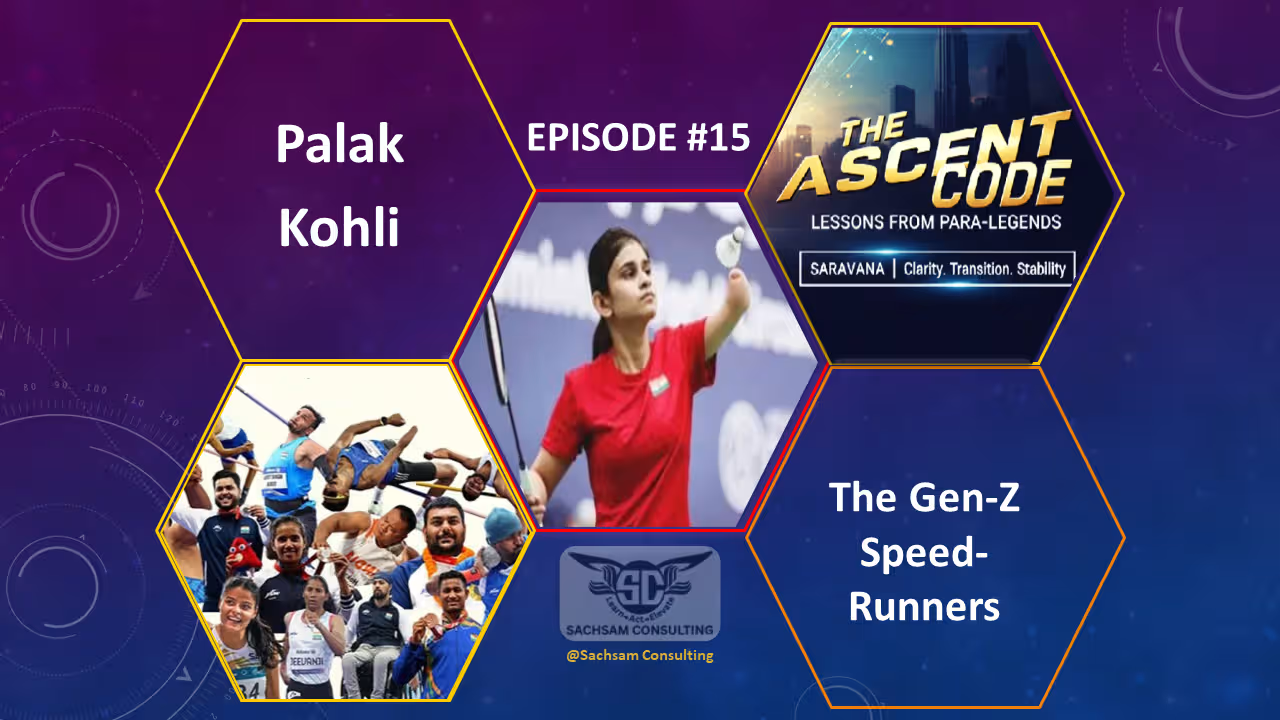
ASCENT CODE: Episode 15
The Youngest Qualifier
Palak Kohli, The Gen‑Z Speed‑Runners. Discovered at 15 in a shopping mall, qualified for Tokyo 2020 at 18 as the youngest para‑badminton player globally, World Championship Bronze by her early twenties.
EXECUTIVE SUMMARY
Palak Kohli was born with a congenital deformity in her left arm. At 15, a coach noticed her in a shopping mall. Not technique. Height. Physical presence. The coach suggested para‑badminton. She had no competitive racquet experience.
Three years later, she qualified for the Tokyo 2020 Paralympics as the youngest para‑badminton player to qualify globally. She reached the quarterfinals. At the 2024 World Championships, she won Bronze. She holds a global top 10 ranking in the SU5 category. Still in her early twenties. Still rising.
⚙️ THE DISCOVERY‑TO‑PODIUM METRIC: From shopping mall discovery to World Championship medal in seven years. No foundational decade. No early specialisation. Just opportunistic commitment at maximum intensity.
THE ASCENT CODE: THE SPEED‑RUN CODE OF OPPORTUNISTIC GROWTH: When a genuine rare asset meets the right identifier at the right moment, and the athlete commits without reservation, the conventional development timeline collapses. Discovery is the spark. Full commitment is the accelerant.
THE CRISIS: THE ARM THAT ARRIVED DIFFERENTLY
Palak Kohli was born with a congenital deformity in her left arm. Unlike the sudden‑trauma stories earlier in this series, there was no accident, no before and after. The deformity was the starting condition: a left arm that functioned differently, in a world designed around standard function.
Growing up with a visible physical difference accumulates quietly. The particular hum of fluorescent lights in medical waiting rooms during clinical assessments. The paperwork that categories a child before she has had a chance to define herself. The daily recalibrations around which activities to attempt. None of these moments is singular. Together, they built a teenager who had learned to exist inside a constraint without making it her limit.
At the 2024 World Championships, Palak Kohli won Bronze in SU5 para‑badminton. She holds a global top 10 ranking. She is still in her early twenties. The arm that arrived differently became the credential that placed her in the arena where she would dominate.
THE ORIGIN: THE MALL, THE COACH, THE THREE‑YEAR SPRINT
The shadow phase in Palak’s story is not invisible years of unrecognised effort. It is the absence of direction: a physically gifted teenager with a congenital impairment and no pathway into competitive sport. Para‑badminton was not in her frame of reference. No one had connected her physical profile to the SU5 category. She was capable and undirected, until a chance encounter changed the coordinates entirely.
A coach noticed her in a shopping mall. Not technique. Height. Physical presence. A trained eye reading a body and identifying an asset before any sporting context existed to frame it. The coach suggested para‑badminton. Palak was 15 with no competitive racquet experience. What followed was a three‑year compression of the standard development timeline. Rather than waiting to close the foundational gap gradually, she trained at an intensity that collapsed it. At 18, she qualified for Tokyo 2020: the youngest para‑badminton qualifier in global history.
THE GRIND: ZERO TO WORLD STAGE IN THREE YEARS
Every training session had to produce more per hour than peers with a decade of foundation behind them. Palak could not afford gradual progression. She developed match intelligence, technical precision, and competitive composure simultaneously rather than sequentially.
- Building badminton technique foundations while competing nationally and internationally in parallel, using match data to accelerate development rather than waiting for training to mature.
- Developing SU5‑specific shot mechanics adapted to a one‑arm technique, building precision and power from a physical profile no standard coaching manual had designed for.
- Competing at Tokyo 2020 at 18 and reaching the quarterfinals, using the highest‑level competitive exposure as developmental data rather than purely a results event.
Verified Achievements
• Tokyo 2020 Paralympics: Qualified and competed, reached quarterfinals (aged 18)
• 2024 World Championships: Bronze Medal, SU5 para‑badminton
• Global top 10 ranking, SU5 category (2026)
Youngest global qualifier at 18. World Championship medal by her early twenties. This career is not a completed story. It is a trajectory still rising.
THE ASCENT CODE: THE SPEED‑RUN CODE
Here is the assumption embedded in most talent development systems: start early or lose the race. That a decade of deliberate practice is non‑negotiable. That the player who begins at 8 will always outperform the one who begins at 15. Palak Kohli challenges that assumption directly with verifiable results.
She started at 15 with no foundation. Her Tokyo 2020 competitors had been playing since childhood. She qualified anyway, competed, reached the quarterfinals, and has since added a World Championship medal. The decade was not bypassed. It was compressed. Compression was possible because of two conditions: a genuine rare physical asset, and training density far beyond what conventional timelines demand.
I see this pattern often in professionals who believe they started their real career too late. They spent years in the wrong field, or the right field with the wrong intensity. Palak’s career is a direct counter. The question is not how many foundational years you have invested. It is what your genuine rare asset is and whether you are training it at the density required to compress the timeline. Late identification is not disqualifying. Low intensity after identification is.
THE HOW-TO FRAMEWORK: THE SPEED‑RUN CODE IN 4 STEPS
- Create Conditions for Discovery
Palak was found in a shopping mall, not a sports academy. The discovery was structurally accidental, but it happened because she was visibly present with her physical assets intact. Be in more arenas than your current one. Specialists who can identify your rare asset exist in unexpected contexts. You cannot be discovered in spaces you have not entered. - Commit Immediately and Completely
When the arena was identified, Palak committed at full intensity from day one. Three years, world stage. That timeline requires a commitment quality that cautious exploration cannot produce. Partial entry into the right arena wastes the advantage. Full commitment is what compresses the conventional timeline into something the system does not expect. - Train at Density, Not Volume
She could not close a foundational gap through volume. She used competition as a development tool from the earliest possible point, extracting maximum information from each match rather than waiting until training was complete. Calculate development value per session, not just total hours invested. Density of learning per hour produces faster capability growth than volume at lower intensity. - Hold the Long View While Running the Sprint
Palak is building toward Los Angeles 2028. The early breakthroughs are foundation, not ceiling. The Speed‑Run Code is not only about the first result. It is about using rapid early development as the base for sustained world‑class performance across a full career. Sprint to the stage. Then build the system that keeps you on it.
THE REFRAME: THE MALL WAS NOT RANDOM
Return to that shopping mall. The fluorescent hum. A 15‑year‑old with a congenital arm deformity moving through an ordinary afternoon, unaware that a trained observer was reading her height and physical presence as a competitive credential in a sport she had never considered.
The encounter looked accidental. It was not entirely. The coach was looking. Palak was present. The congenital deformity that limited her in some domains made her eligible for a competitive category where her height and athleticism created genuine advantages. The arm that arrived differently was not the problem. It was the ticket to the right arena. The constraint that defined her limitation in the mainstream world was the credential that qualified her for the space where she would dominate.
Most professionals who feel they found their arena late are waiting for another accidental confirmation of what they already sense. Stop waiting. Identify where your specific combination of assets and constraints creates the highest competitive value. Enter at full intensity. As of 2026, Palak is ranked global top 10, balancing education with training, preparing for Los Angeles 2028. The sprint is still running. So is the reframe.
SELF AUDIT
- • What arena gives your specific combination of assets and constraints the highest competitive advantage? Are you in it? If not, what is the real reason you are not?
- • Are you in cautious exploration mode when the situation calls for full commitment? What would three years of total intensity in your best arena actually produce?
- • How much development value are you extracting per work session? Are you using real performance situations as accelerators, or protecting yourself from them until you feel ready?
👇 Drop your answer in the comments. The #AscentYouTribe learns together.
THE SCIENCE OF ACCELERATED EXPERTISE
Cognitive science research on expertise development distinguishes between deliberate practice in training and retrieval practice in real performance. Studies on compressed development timelines consistently show that performers who integrate competitive exposure early build domain knowledge faster than those who delay until training feels complete. Competition forces pattern recognition, adaptive decision‑making, and error correction at a speed and fidelity that training simulation cannot replicate.
Palak’s early international competition, rather than extended preparation before competing, reflects this principle precisely. Each Tokyo quarterfinal match generated competitive intelligence that months of practice could not produce. Her 2024 World Championship Bronze is the compounded return on that early competitive investment. The Speed‑Run Code is not shortcuts. It is a different sequencing: front‑loading competitive exposure to accelerate pattern recognition, producing faster expertise than the conventional training‑first timeline allows.
Next on The Ascent: Episode 16: Rajinder Singh Rahelu, The Zero‑to‑One Pioneers.
SARAVANA KUMAR
Clarity | Transition | Inner Stability
The shopping mall moment stays with me. We expect discovery to happen in structured settings: assessment centres, talent programmes, formal mentoring. Palak was found in an ordinary afternoon by a coach who was simply looking. I tell every professional I work with: be visibly in the world. Show your capabilities in contexts beyond your current role. The right identifier is not waiting in the formal system. They are in the mall. Make sure they can see you.
#SaravanaSays
Your Growth Journey Starts Here
All the ways to connect, learn, and grow with the Tribe — in one place. Choose your favourite platform and stay plugged into daily momentum.
KEYWORDS: Ascent Code Palak Kohli, Speed‑Run Code, Gen‑Z Speed‑Runners, Tokyo 2020 Paralympics badminton, youngest para‑badminton qualifier, SU5 para‑badminton, 2024 World Championships Bronze, opportunistic growth, accelerated expertise, shopping mall discovery.
HASHTAGS: #AscentCode #AscentYouTribe #SaravanaSays #SaravanaKumar #SpeedRunCode #Clarity #Transition #InnerStability #HighPerformance #MindsetEngineering #ResilienceEngineered #SuccessSystems #CareerGrowth #LeadershipPrinciples #OpportunisticGrowth #SelfOptimization #PalakKohli #ParalympicsIndia #ParaBadminton #Tokyo2020 #IndianAthletes #GenZLeaders #YoungChampions



Comments
1[…] Read → […]