

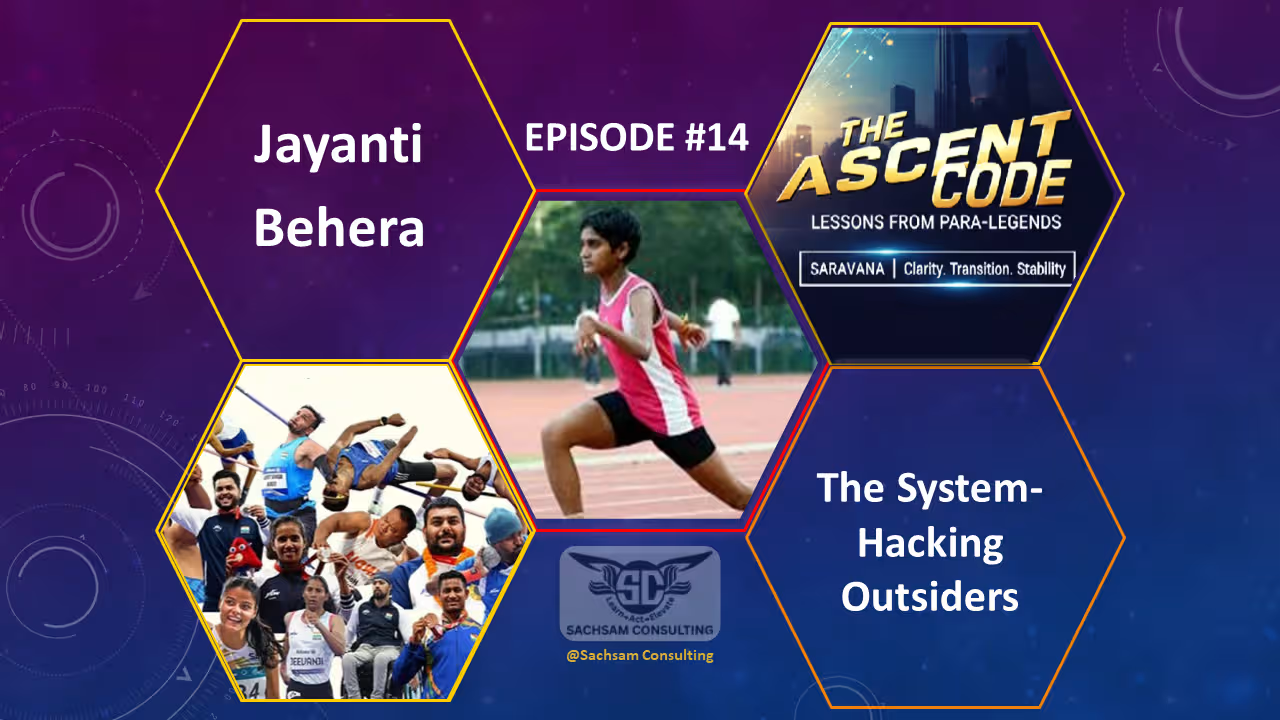
ASCENT CODE: Episode 14
Barefoot to the Podium
Jayanti Behera, The System‑Hacking Outsiders. How a girl from rural Odisha trained barefoot on dirt tracks with burn injuries and no resources to become India’s top female T47 sprinter.
EXECUTIVE SUMMARY
Jayanti Behera suffered severe burn injuries to her left hand and upper body as a toddler. Growing up in a poor village in Odisha, there were no running shoes. No proper nutrition. No synthetic track, no starting blocks, no coach with a stopwatch and a programme. There was the dirt. The open fields. She ran on it. Barefoot. For years.
At the 2018 Asian Para Games, she won three medals. She became India’s top female sprinter in the T47 category. The barefoot years on Odisha dirt were not the obstacle to that result. They were the preparation for it.
⚙️ THE BAREFOOT BIOMECHANICS METRIC: Barefoot training on natural surfaces builds foot and lower leg strength that cushioned‑shoe training suppresses. Ground‑contact mechanics, proprioceptive sensitivity, and forefoot strike patterns are developed at levels synthetic tracks do not produce.
THE ASCENT CODE: THE MAVERICK CODE OF INNATE VELOCITY: Raw talent trained under genuinely harsh conditions develops a physical and psychological resilience that controlled environments cannot replicate. The absence of the standard resource is not always a disadvantage. It is sometimes the training load that produces the edge.
THE CRISIS: BURNS, BAREFOOT, AND THE FIELDS OF ODISHA
Jayanti Behera was a toddler when severe burns scarred her left hand and upper body. The particular antiseptic sting of burn treatment wards, the dry heat of rural Odisha summers pressing against healing skin: these were among her earliest sensory memories. The injury was permanent. The left hand and upper body carried the evidence of it through every year of training and competition that followed.
Growing up in a poor village in Odisha, there were no running shoes. No proper diet calibrated for athletic development. No synthetic track, no starting blocks, no coach with a stopwatch and a programme. There was the dirt. The open fields. The particular hardness of sun‑baked Odishan earth underfoot in summer, and the grip of it when the rains softened it in July. She ran on it. Barefoot. For years.
At the 2018 Asian Para Games, Jayanti Behera won three medals. She became India’s benchmark female sprinter in the T47 category. The barefoot years on Odisha dirt were not the obstacle. They were the preparation.
THE ORIGIN: THE FIELD AS COACH
The shadow phase in Jayanti’s story is not a dramatic gap between injury and recovery. It is the long, structurally invisible period where genuine athletic talent was developing in a context that no talent identification system would have found it. Rural Odisha in the 2000s had no para‑athletics scouting infrastructure. A girl with burn scars running barefoot on a dirt field was not in any federation’s development pipeline.
The turning point came from local visibility. She competed at state level against able‑bodied sprinters and won. That result, generated without coaching support, brought her to the Odisha Government’s sports department, which sponsored her. She transitioned to a structured environment. But the physical foundation — the leg strength, the barefoot ground‑contact mechanics, the discomfort tolerance — came with her. It could not have been created any other way.
THE GRIND: ODISHA DIRT TO ASIAN PODIUM
The arc from village fields to international podium was built in two phases. The barefoot self‑developed phase built the raw physical foundation. The sponsored phase, once the Odisha Government’s support arrived, gave her structured competition exposure and professional coaching to refine the technique that the fields had already produced.
- Competing at national para‑athletics level, establishing herself as the T47 category benchmark and building the competitive experience that international competition demands.
- Developing sprint mechanics that accounted for the burn injury’s effect on upper body drive and arm mechanics, building a compensatory technique through competition rather than clinical prescription.
- Reaching the 2018 Asian Para Games as the standout Indian female sprinter, using the competitive platform to validate what years of unsupported training had built.
Verified Achievements
• 2018 Asian Para Games: Three medals
• India’s top female sprinter, T47 category, multiple national championships
Three medals at a single Asian Para Games. No shoes, no track, no coach, no institutional support. The dirt field was the gymnasium.
THE ASCENT CODE: THE MAVERICK CODE
Here is what elite running coaches know and rarely say publicly: barefoot training on natural surfaces builds foot and lower leg strength that cushioned‑shoe training does not. The Kenyan and Ethiopian distance runners who dominate global athletics grew up running barefoot on hard terrain. Their mechanical advantage is not genetic. It is structural, built through years of surface contact that modern training shoes, designed to reduce ground‑force impact, actually prevent.
Jayanti Behera trained on Odisha dirt without shoes not because she chose a superior method. She trained that way because she had no other option. But the result was the same: lower limb mechanics developed to a standard that controlled training surfaces rarely produce. The constraint imposed the training load. The training load built the edge.
I see this pattern often in professionals who describe their early career environments as damaging. They are partially right. Some conditions genuinely harm development. But I always ask: what did that difficult environment force you to develop that a comfortable one would not have demanded? Jayanti’s barefoot miles are the professional equivalent of a constraint that felt like poverty and functioned like training. Your harshest professional environment probably built something. The question is whether you have identified and deployed it.
THE HOW-TO FRAMEWORK: THE MAVERICK CODE IN 4 STEPS
- Audit the Harsh Environment for Hidden Outputs
Before dismissing a resource‑scarce period as difficult, extract what it built. Jayanti’s barefoot training built foot mechanics and discomfort tolerance that sponsored athletes rarely develop. Name the specific capability your hardest period produced. That capability is an asset, not a memory. - Win at the Level You Have Access To First
Jayanti did not wait for a para‑athletics pathway. She entered the competition available and produced a result that forced institutional notice. Enter the arena you can access now. Recognition follows output. It rarely precedes it. - Use Institutional Support to Refine, Not to Replace
When Odisha Government sponsorship arrived, Jayanti used it to refine the technique that barefoot training had already built. She added the programme to the foundation, not the other way around. New resources are amplifiers. Do not treat them as replacements for the self‑built capability. - Compete Through the Injury, Not Despite It
Her burn injury affected upper body mechanics. She developed compensatory technique through competition, not clinical prescription. Your professional limitations are best understood in live performance. Get in the arena. Real competition data tells you more than extended preparation.
THE REFRAME: THE DIRT TRACK WAS THE ADVANTAGE
Return to those Odisha fields. The dry heat on bare feet. The particular resistance of sun‑baked dirt against the ball of the foot. A girl with burn scars running because she wanted to, with nothing behind her and no one watching.
Every barefoot mile built foot strength, ankle stability, and ground‑contact mechanics that cushioned‑shoe training suppresses. The fields were not a lesser version of a track. They were a harder version. The poverty was not the obstacle to her career. It was, in the most specific mechanical sense, part of the training programme.
Most professionals carry a version of this. An early period of constraint that felt like disadvantage and functioned like development. The mistake is saying “I succeeded despite the difficult early years” rather than “I built specific capabilities through those years that controlled environments never produce.” Jayanti’s three medals are not a triumph over the dirt track. They are the output of it. As of 2026, she works for the Odisha Government and continues training for international podium finishes.
SELF AUDIT
- • What did your most resource‑scarce professional period force you to build that a well‑resourced environment would have made unnecessary? Name it as a specific capability, not as a general resilience.
- • Are you telling your own story as “despite” when the more accurate version is “through”? Where does the constraint appear in your narrative as damage rather than development?
- • What competition is available to you right now that you are not entering because it does not match the level you believe you should be competing at? Enter it. Win there first.
👇 Drop your answer in the comments. The #AscentYouTribe learns together.
THE SCIENCE OF BAREFOOT BIOMECHANICS
Biomechanics research on barefoot versus shod running consistently documents measurable differences in lower limb mechanics. Barefoot runners develop greater foot and ankle intrinsic muscle strength, higher proprioceptive sensitivity in the foot, and a forefoot strike pattern that reduces impact forces and increases ground‑reaction time efficiency. These mechanical advantages accumulate over years of training and are not easily replicated through late‑stage barefoot conversion programmes for athletes who have always trained in shoes.
Jayanti’s barefoot training built this profile before any formal coaching arrived. When coaching entered her development, it was applied to a lower limb system that had already self‑engineered toward the mechanics sports science now actively prescribes. The poverty that denied her shoes produced, without design, the training load that elite development programmes deliberately seek to replicate.
Next on The Ascent: Episode 15: Palak Kohli, The Gen‑Z Speed‑Runners.
SARAVANA KUMAR
Clarity | Transition | Inner Stability
The question I keep returning to after Jayanti’s story: how many of us are carrying a capability built in a harsh early environment and still describing it as damage rather than development? In thirty years of coaching, the professionals I have seen make the biggest leaps are those who stopped narrating their difficult early years as something they survived and started treating them as the specific training load that built their most distinctive capabilities. Name yours this week. The barefoot miles you ran are still in your legs.
#SaravanaSays
Your Growth Journey Starts Here
All the ways to connect, learn, and grow with the Tribe — in one place. Choose your favourite platform and stay plugged into daily momentum.
KEYWORDS: Ascent Code Jayanti Behera, Maverick Code, System‑Hacking Outsiders, Asian Para Games 2018, T47 para‑athletics, barefoot sprinting training, rural Odisha athlete, burn injury sprinter, innate velocity, para‑sprinting India, resource scarcity athlete, barefoot biomechanics, Odisha Government sports.
HASHTAGS: #AscentCode #AscentYouTribe #SaravanaSays #SaravanaKumar #MaverickCode #Clarity #Transition #InnerStability #HighPerformance #MindsetEngineering #ResilienceEngineered #SuccessSystems #CareerPivot #LeadershipPrinciples #InnateVelocity #SelfOptimization #JayantiBehera #ParalympicsIndia #ParaSprinting #AsianParaGames #IndianAthletes #WomenInSport #MaverickSpirit




Comments
2[…] Episode 14: Jayanti Behera, The System‑Hacking Outsiders […]
[…] Read → […]