

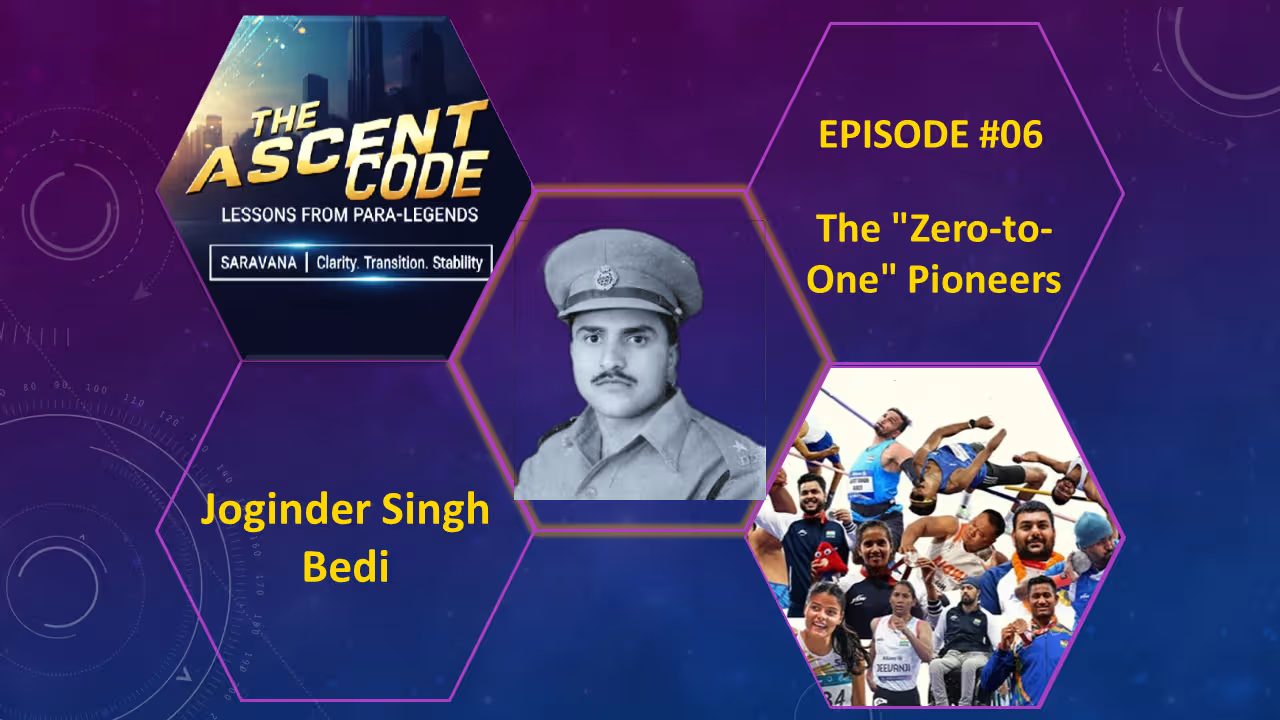
ASCENT CODE: Episode 6
The 1984 Multi-Medal Legend
Joginder Singh Bedi, The Zero-to-One Pioneers. How a war veteran with no coaching, no funding, and no throwing chair won three medals at a single Paralympics and set a record that stood for 37 years.
EXECUTIVE SUMMARY
This episode of Ascent Code is the story of an Indian soldier Joginder Singh Bedi who lost a limb in service, had no Paralympic funding, no specialist coach, and no modern equipment; yet at the 1984 Stoke Mandeville Games he entered three throwing disciplines and won three medals: one Silver and two Bronze. No Indian Paralympic athlete matched that haul in a single edition for 37 years, until Tokyo 2020.
His secret was not talent. It was transferable mastery. He took one asset, the explosive upper-body power built through years of military training, and deployed it across Shot Put, Javelin, and Discus simultaneously. He did not specialise. He dominated through depth of fundamentals.
THE ASCENT CODE: THE PIONEER CODE: You do not need perfect conditions to build a legacy. You need one core strength, developed to mastery, applied across every arena where it creates value.
THE CRISIS: THE SOLDIER WHO LOST A LIMB AND FOUND A STAGE
Joginder Singh Bedi was a soldier first. He served India and paid the price soldiers pay: a limb, lost in the line of duty. The rehabilitation ward carried the same antiseptic smell that marks every military hospital, a sharp, institutional scent that strips away rank and replaces it with a single category: patient.
The clank of metal frames and the low murmur of ward rounds replaced the drill ground. For a man trained to move with precision and purpose, enforced stillness was its own injury. He had to decide, in that ward, what kind of soldier he would be when he left it.
At the 1984 Stoke Mandeville Paralympic Games, Joginder Singh Bedi stepped into three throwing circles and walked away with three medals. One Silver. Two Bronze. An Indian Paralympic record that no athlete would break for 37 years. He built that record with no funding, no throwing chair, and no specialist coaching. He built it on military discipline and a fundamental truth: one strong core skill, applied well, outperforms three mediocre ones every time.
THE ORIGIN: MILITARY STRENGTH AS ATHLETIC FOUNDATION
Joginder was part of the early wave of Indian soldiers who used sport as rehabilitation after service injury. There was no structured para-athletics system waiting for him. No federation mapped his potential. No coach designed a programme around his disability. Sport was prescribed informally; what he did with it was entirely his own.
The shadow phase here was institutional invisibility. He existed in a space between identities: no longer a combat soldier, not yet recognised as a competitive athlete. Paralympic sport in India in the early 1980s had no infrastructure, no public profile, and almost no funding. Athletes at this level often covered their own travel costs or relied on modest military stipends. The system did not see him. He competed anyway.
The turning point was his selection for Stoke Mandeville 1984. It confirmed what he had privately understood: his military training had produced an upper-body power base that translated directly into throwing disciplines. Shot Put, Javelin, Discus; all three rewarded the same explosive shoulder mechanics he had spent years developing in uniform. He did not need to learn three new sports. He needed to apply one deep skill in three different contexts.
THE GRIND: THREE DISCIPLINES, ONE POWER BASE
Training in the early 1980s meant working without the equipment that modern para-athletes take for granted. No throwing chairs. No biomechanics analysis. No periodisation software. Joginder trained with what he had: his body, his discipline, and a military routine built around consistency over intensity.
- Developing explosive rotational power through repetition, adapting throwing mechanics to account for his limb loss.
- Competing across all three throwing events, using each discipline to reinforce the others rather than treating them as separate training loads.
- Self-funding travel and preparation for international competition with minimal institutional support.
Verified Achievements
• 1984 Stoke Mandeville Paralympics: Silver Medal (Shot Put), Bronze Medal (Javelin), Bronze Medal (Discus)
• Three medals in a single Paralympic edition: an Indian record that stood for 37 years until Tokyo 2020.
That record is the measure. Three medals. One Games. No system behind him. Just fundamentals, applied fully.
THE ASCENT CODE: THE PIONEER CODE
Here is the contrarian truth about specialisation: we tell people to find their niche, go deep, and ignore everything else. The world rewards depth, we say. Joginder Singh Bedi’s 1984 record challenges that directly.
He did not specialise. He mastered fundamentals so completely that they transferred across disciplines. Shot Put, Javelin, Discus: three different events, one power source. His competitive advantage was not sport-specific skill. It was core mechanical mastery, applied with intelligence to three related contexts.
I have seen this pattern in corporate careers too. The professional who understands first principles deeply outperforms the one who has memorised one process. When the market shifts, the specialist scrambles; the fundamentals-master pivots. You can apply this today. What is your core skill, the one that sits beneath your job title? Where else does that skill create value, if you point it at a different context?
Joginder built a 37-year record without a system. You have a system. The question is whether you are using your fundamentals as broadly as he used his.
THE HOW-TO FRAMEWORK: THE PIONEER CODE IN 4 STEPS
- Identify Your Core Power Base
Strip away your job title. Strip away your industry label. What is the fundamental skill underneath? Joginder’s was explosive rotational power. Yours might be structured thinking, persuasion, pattern recognition, or operational precision. Name it specifically. Vague assets cannot be deployed. Named assets can. - Map the Adjacent Disciplines
Once you know your core, find every domain where it creates value. Joginder saw Shot Put, Javelin, and Discus as three delivery mechanisms for the same power base. Look at your own field. Where else does your core skill produce results, with minor adaptation? Most professionals stop at one application. The Pioneer maps three. - Enter Each Arena Without Waiting for Permission
Joginder had no federation, no coach, no funding. He entered anyway. You do not need institutional endorsement to apply your skills in a new context. Start with small competitive tests: a new project, a cross-functional contribution, a different client type. Proof of transfer comes from doing, not from planning. - Build Depth Before Breadth
The Pioneer Code is not about spreading thin. It is about going deep on fundamentals first, then spreading wide. Joginder’s multi-discipline success was only possible because his core power was genuinely world-class. Breadth without depth is dilution. Depth that transfers is multiplication.
THE REFRAME: THE RECORD THAT WAITED 37 YEARS
Go back to that military hospital ward. The antiseptic smell. The clank of metal frames. A soldier deciding who he would be after the uniform could no longer define him.
Most people in that position ask: what can I still do? Joginder asked something different: what have I already built, and where can it take me? That is a harder question. It requires you to look at your existing assets without the labels that usually frame them. Not “I am a soldier,” but “I have explosive power and military discipline.” Not “I am a marketer,” but “I understand how people make decisions under pressure.”
The 37-year record is not really about throwing. It is about what happens when someone applies genuine mastery with zero institutional support and complete clarity of purpose. Joginder Singh Bedi – The pioneer does not just open a path, but he makes the path real enough for others to follow.
What have you already mastered? Where else can it go?
SELF AUDIT
- What is your core power base? Not your job title, not your industry. The fundamental skill underneath that has stayed constant across every role you have held.
- You are probably applying that skill in one context. Where are two other adjacent disciplines or domains where the same core skill would produce results, with minor adaptation?
- What is the one arena you have not entered yet, not because you lack the capability, but because no one has given you permission? What would it look like to enter anyway?
👇 Drop your answer in the comments. The #AscentYouTribe learns together.
THE SCIENCE OF TRANSFERABLE MASTERY
Motor learning research shows a well-documented phenomenon called positive transfer: skills acquired in one movement domain accelerate learning in related domains that share underlying mechanics. The rotational power mechanics of Shot Put, Javelin, and Discus are structurally similar. An athlete who achieves deep motor fluency in one naturally transfers a significant portion of that fluency to the others, reducing the acquisition time for each additional discipline.
Joginder’s three-medal performance was not luck or talent spread thin. It was positive transfer in action: military-grade explosive mechanics, applied across three disciplines that shared the same foundational movement pattern. Cognitive science shows the same principle holds in intellectual domains. Deep expertise in one field creates transferable mental models that accelerate competence in adjacent fields. The Pioneer Code works because the brain and body are both built for transfer, not just specialisation.
Next on The Ascent: Episode 7: Manish Narwal, The Mind-Quiet Precisionists.
SARAVANA KUMAR
Clarity | Transition | Inner Stability
Joginder Singh Bedi’s story sits differently with me than the others in this series. He built a 37-year national record with no system, no funding, and no recognition that matched his achievement. I think about the professionals I coach who say they are waiting for the right conditions to apply their full capability. Joginder did not wait. His conditions were worse than yours. His output was extraordinary. The Pioneer Code is a direct challenge: stop auditing your conditions and start deploying your fundamentals.
#SaravanaSays
Your Growth Journey Starts Here
All the ways to connect, learn, and grow with the Tribe — in one place. Choose your favourite platform and stay plugged into daily momentum.
KEYWORDS: Ascent Code Joginder Singh Bedi, Pioneer Code, 1984 Stoke Mandeville Paralympics, para-athletics India, transferable mastery, versatile athlete, military to sport transition, Zero-to-One Pioneers, Paralympic multi-medal, throwing disciplines, resilience engineering, career fundamentals, core skill transfer, disability leadership, Indian para-athlete legacy.
HASHTAGS: #AscentCode #AscentYouTribe #SaravanaSays #SaravanaKumar #PioneerCode #Clarity #Transition #InnerStability #HighPerformance #MindsetEngineering #ResilienceEngineered #SuccessSystems #CareerPivot #LeadershipPrinciples #TransferableMastery #SelfOptimization #JoginderSinghBedi #ParalympicsIndia #ParaAthletics #1984Paralympics #IndianAthletes #LegacyBuilding #PioneerSpirit




Comments
1[…] Episode 6: Joginder Singh Bedi, The Zero-to-One Pioneers […]