

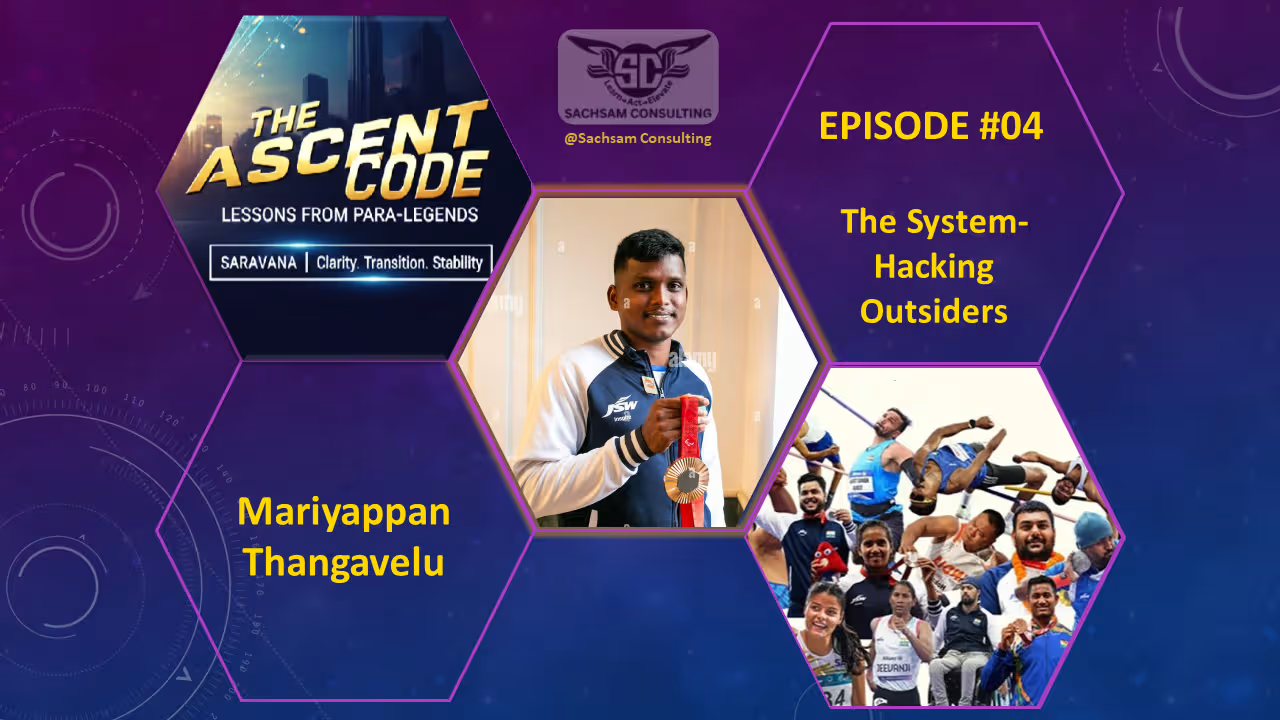
ASCENT CODE: Episode 4
Jumping Beyond Gravity
How a boy from a 100 sq. ft. hut turned mud-field training into three consecutive Paralympic podiums.
EXECUTIVE SUMMARY (TL;DR)
No spiked shoes. No jumping pit. Just a mother who borrowed ₹3 lakhs and a boy who refused to let a bus accident define his future. Ascent Code episode 4 explores Mariyappan Thangavelu’s story, a testament to what’s possible when determination meets opportunity or even when it doesn’t.
Instead of waiting for better conditions, Mariyappan redesigned his approach, developing an adapted scissor technique that worked with his body, not against it. That decision produced a result the world had not seen before: Gold (Rio 2016, 1.89m), Silver (Tokyo 2020), Bronze (Paris 2024), three consecutive Paralympic podiums across twelve years of elite competition.
THE ASCENT CODE; THE MAVERICK CODE: When the system is not built for you, redesign the rules. Success is built by optimizing every constraint available, right now, with what you have.
 IMAGE COURTESY : WIKIPEDIA
THE CRISIS: THE ACCIDENT THAT CHANGED MARIYAPPAN THANGAVELU’S LIFE
Mariyappan Thangavelu was five years old and walking to school in Keelakattaivalai, Salem district, when a bus driven by a drunk driver mounted the road and crushed his right leg below the knee. The morning had begun like any other, red dust, wood smoke, the ordinary sounds of a village waking up. In seconds, the physics of his life changed permanently.
He would later remember the sharp antiseptic sting of the hospital ward and the hollow echo of metal crutches scraping against tiled corridors as he relearned how to move. His mother Saroja, who sold vegetables at the local market, borrowed ₹3 lakhs for his treatment, a debt that would take years to repay in small, steady increments. For a child in rural Tamil Nadu in the mid-1990s, with no safety net and no infrastructure, this moment could easily have defined the outer boundary of his life.
Yet here is what is recorded: at the 2016 Rio Paralympic Games, Mariyappan Thangavelu cleared 1.89m and won Gold. Then Silver at Tokyo 2020. Then Bronze at Paris 2024. Three consecutive podiums. The constraint was real. So was the response to it.
THE ORIGIN: THE INVISIBLE YEARS AND THE MENTOR
Between childhood and recognition, there is always a shadow phase, a period of building that the world does not see and the record does not capture. For Mariyappan, that phase was defined by scarcity: a 100 sq. ft. hut, limited financial resources, no structured pathway into elite sport, and no coaching system that had ever heard his name. He existed in the gap between what he was becoming and what any institution was yet prepared to acknowledge.
The turning point was a teacher. R. Rajendiran, Mariyappan’s school physical education teacher, watched him competing in school athletic events alongside able-bodied students, not losing gracefully, but actually competing. Rajendiran noticed something technically unusual: without any coaching, Mariyappan had already begun instinctively adapting his takeoff mechanics to his impaired right foot, developing a modified scissor technique that distributed jump power asymmetrically. He directed Mariyappan to district-level competition. That single act of recognition transformed invisible effort into directed purpose.
THE GRIND: FROM MUD FIELD TO MEDAL STAND
Training happened on rough mud surfaces without spiked shoes. There were no standard jumping pits, no synthetic runways, no international-level equipment. Every session on that uneven ground was an unplanned experiment in constraint engineering, Mariyappan building arm drive and body positioning to compensate for the takeoff mechanics his impaired foot could not provide conventionally.
- Competing at district and national para-athletics championships, refining the scissor technique with each competition cycle.
- Reaching a performance plateau in 2014 and returning to foundational mechanics rather than abandoning the approach.
- Qualifying for the Rio 2016 Paralympic Games, where he would compete on a world-class synthetic runway for the first time in international competition.
Verified Achievements
• Rio 2016: Gold Medal, T42 High Jump (1.89m)
• Tokyo 2020: Silver Medal
• Paris 2024: Bronze Medal
Three consecutive Paralympic podiums across three Games. The technique built on mud transferred perfectly to the world stage, because it had been stress-tested against imperfect conditions thousands of times before that stage ever appeared.
THE ASCENT CODE: THE MAVERICK CODE
The standard reading of Mariyappan’s story is the adversity narrative: a boy with nothing built something extraordinary through grit. That reading is true. It is also incomplete, because the lesson it delivers is passive, adversity builds character. The Maverick Code extracts something more precise.
Mariyappan did not work harder within the standard system. He identified the specific mechanism the missing resource was supposed to provide, and built an alternative that achieved the same output. No spiked shoes meant inconsistent ground-force transfer, so he developed arm drive. No pit meant imprecise landing, so he built body positioning through repetition. No coach meant no external correction, so he built self-observation and iterative adjustment.
The Maverick Code: When systems are not designed for you, identify what specific output the missing resource was providing, build an alternative mechanism to deliver that output, and develop that alternative to world-class standard. The constraint does not redirect you into a lesser version of the goal. It redirects you into a more mechanically sophisticated path toward the same one. This applies to careers, businesses, and any pursuit navigating limited resources.
THE HOW-TO FRAMEWORK: THE MAVERICK CODE IN 4 STEPS
- Map the Constraint Precisely
Do not describe what you lack in general terms. Identify the specific functional output the missing resource was providing. Mariyappan lacked spiked shoes, which meant he lacked reliable ground-force transfer at takeoff. That is a solvable problem, not a terminal condition. Vague awareness of scarcity produces nothing. Precise diagnosis is the first act of the Maverick. - Identify the Alternative Mechanism
For every unavailable resource, ask what else can produce the same functional output. Mariyappan’s answer was arm drive and upper-body momentum. Your answer will be specific to your situation. The question forces lateral thinking that people operating with standard resources never develop, because they never need to. This is where the constraint begins to generate advantage rather than limitation. - Build the Alternative to World-Class Standard
The failure point for most people is stopping at “good enough.” Mariyappan did not develop adequate arm mechanics, he developed exceptional arm mechanics, refined through thousands of mud-field repetitions. Constraints only become advantages when the alternative mechanism is built beyond minimum viability. Half-built workarounds remain workarounds. Fully built alternatives become competitive edges. - Test Under Real Competitive Pressure Immediately
Practice alone does not complete the calibration. District competitions, national championships, qualification events — enter every level of available competition as soon as access allows. External pressure converts adaptive mechanics into reliable systems. Mariyappan’s technique was not confirmed until competition tested it repeatedly. When the world stage finally appeared, the system was already proven.
THE REFRAME: THE MUD WAS THE ADVANTAGE
Return to that Salem road. The red dust. The wood smoke. The five-year-old with metal crutches scraping against tiled hospital floors, relearning how to move in a world that had not been designed to accommodate him.
What the Keelakattaivalai story reveals is that the mud field was not the obstacle standing between Mariyappan and the podium. It was the laboratory that produced the specific technique, the arm drive, the asymmetric scissor takeoff, the constraint-calibrated body positioning, that no athlete training on perfect synthetic surfaces ever had reason to develop. The mud field did not hold him back. In a precise mechanical sense, it produced a performance system that optimal-condition training never could have generated.
The constraint was the curriculum. The limitation was the school. As of 2026, Mariyappan Thangavelu serves as a Senior Sports Officer at SAI, holds the Padma Shri and the Khel Ratna, and actively mentors young high jumpers across Tamil Nadu. The system-hacker became the system-builder. That is the Maverick Code completed.
SELF AUDIT
- • What resource are you waiting for before you begin building seriously, and what specific alternative mechanism does its absence force you to develop right now?
- • Where have you built a capability precisely because the standard tool was unavailable? Have you recognized that constraint-built skill as a competitive asset, or are you still treating it as a gap?
- • Who in your environment is the equivalent of R. Rajendiran, the person who has already seen your capability before you have fully acted on it?
👇 Drop your answer in the comments. The #AscentYouTribe learns together.
THE SCIENCE OF CONSTRAINT-INDUCED PERFORMANCE SYSTEMS
Rehabilitation neuroscience documents a principle called Constraint-Induced Movement Therapy, a method that deliberately restricts a functional limb to force the brain to recruit and strengthen alternative neural pathways. The counterintuitive finding is consistent: the constrained system often develops superior motor performance compared to patients who trained without restriction. The brain forced to find a new route builds that route with greater depth and resilience.
Mariyappan’s development is a natural enactment of this principle at competitive scale. Training on irregular mud surfaces, without standard equipment, with an impaired takeoff foot, his motor system was forced to build high-fidelity programmes for every component of the jump. The arm drive, the approach calibration, the landing mechanics, each was stress-tested against imperfection before the world stage arrived. His competitors trained under optimal conditions. He trained under conditions that built a deeper system. At Rio, that difference showed in gold.
Next on The Ascent: Episode 5; Kumar Nitesh — The Gen-Z Speed-Runners.
SARAVANA KUMAR
Clarity | Transition | Inner Stability
As I sat with Mariyappan’s story this week, I kept returning to the mud field. Not as a symbol of hardship , but as a technical insight. The conditions that look like disadvantage from the outside often produce the deepest competitive preparation from within. The Maverick Code is not about enduring constraint. It is about extracting from it. This is not a story about overcoming disadvantage. It is a story about engineering advantage from it. Whatever your mud field is right now — I hope this episode gives you a different way to look at it.
#SaravanaSays
Your Growth Journey Starts Here
All the ways to connect, learn, and grow with the Tribe — in one place. Choose your favourite platform and stay plugged into daily momentum.
KEYWORDS: Ascent Code Mariyappan Thangavelu, Maverick Code, Rio 2016 Paralympics, Paris 2024 Paralympics, Para High Jump India, High Performance Mindset, Career Resilience, Leadership under Constraint, Keelakattaivalai, Tamil Nadu para athlete, Padma Shri sportsperson.
HASHTAGS: #AscentCode #AscentYouTribe #SaravanaSays #SaravanaKumar #MaverickCode #Clarity #Transition #InnerStability #HighPerformance #MindsetEngineering #ResilienceEngineered #SuccessSystems #CareerPivot #LeadershipPrinciples




Comments
4[…] Episode 4: Mariyappan Thangavelu, The System-Hacking Outsiders […]
[…] Episode 4 — Mariyappan Thangavelu — The System-Hacking Outsiders […]
[…] Read → […]
[…] Episode 4: Mariyappan Thangavelu, The System‑Hacking Outsiders […]