

The Gold Standard of Focus
Avani Lekhara — The Mind-Quiet Precisionists
How a Borrowed Blueprint Became India’s Greatest Shooting Legacy
⚡ THE PIVOT CODE AT A GLANCE
In September 2012, an eleven-year-old girl from Jaipur was pulled from a car wreck with a damaged spine and a future that seemed permanently contracted. By Tokyo 2020 she stood — in a wheelchair — on the Paralympic podium as India’s first woman to win gold. By Paris 2024 she defended it. Avani Lekhara’s ascent is the definitive demonstration of Framework Emulation: borrowing an elite system (Abhinav Bindra’s), internalizing it completely, and executing it under constraints its original architect never faced. This is Ascent Code Avani Lekhara — the architecture of The Disciplined Mind.
🎯 THE UNIVERSAL PRINCIPLE: The Disciplined Mind — Emulating elite frameworks allows a high performer to bypass years of trial-and-error and reach world-class standards significantly faster. You do not always need to invent the system; you need to find the right one and then execute it better than anyone else ever has.
🔗 RELATED EPISODES:
• Episode 1: The First Gold — Murlikant Petkar — The “Zero-to-One” Pioneers
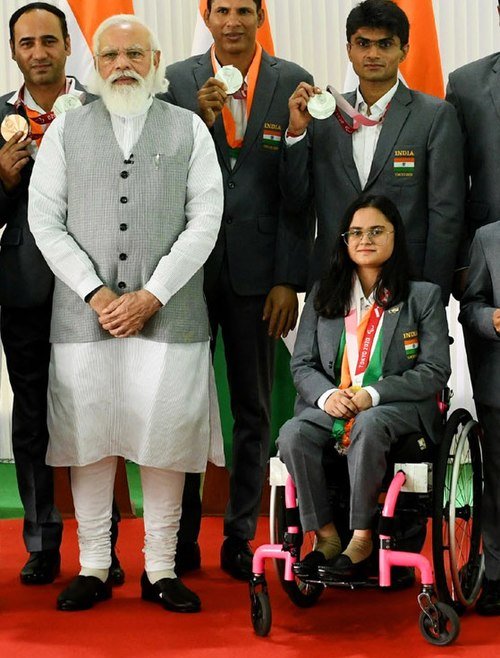
Avani Lakhera – Paralympics medalist
Image courtesy: Wikimedia Commons
🎯 THE MOMENT THAT CHANGED EVERYTHING
September 2012. The Jaipur highway outside the city smelled of hot tarmac, diesel fumes, and distant roadside chai stalls — the ordinary soundtrack of a Rajasthan family road trip. Eleven-year-old Avani Lekhara sat in the backseat when another vehicle collided. The impact was sudden, violent. When the dust settled, Avani had a severed spinal cord. She would never walk again. The metallic tang of blood mixed with burning rubber lingered in the air long after the ambulances left.
But eight years later — August 30, 2020 — that same girl stood on the Asaka Shooting Range podium in Tokyo. Wheelchair positioned. Indian tricolor rising. National anthem echoing. Score: 249.6 in the Women’s 10m Air Rifle Standing SH1 final. Gold medal. India’s first-ever by a woman at the Paralympics. Four years on, Paris 2024: she defended it with 249.7, a new Paralympic record. The crisis moment did not end her story; it redirected it toward precision no one anticipated.
To understand how Avani got here, we need to rewind — to the hospital silence, to the months when the future felt like a locked door.
🌱 THE GROUND THEY STOOD ON
Born in 2001 in Jaipur, Rajasthan, Avani grew up in an educated, aspirational middle-class family. Her father Praveen, a government officer, instilled structure and curiosity; her home was filled with books and quiet ambition. Young Avani was kinetic — dancing at family functions, running with friends, full of the restless energy of childhood.
The constraint arrived suddenly: December 2012 spinal cord injury. Paraplegia. Wheelchair. Permanent. The doctors were clinical; the prognosis clear. What followed was the shadow phase — 18–24 months of liminal darkness. Avani withdrew. Physiotherapy felt pointless some days. The girl who once danced now stared at walls, grieving a body and identity that no longer existed. Medals on someone else’s wall; dreams belonging to a past self. For over a year she existed in that in-between — no longer the old Avani, not yet anything new. The spark dimmed, threatening to extinguish.
The discovery moment came quietly. Her father, refusing to let despair win, took her to watch adaptive sports. At a Jaipur shooting range, something clicked. The absolute stillness required — breath control, mental anchor — spoke to a mind already learning silence through trauma. Shooting didn’t demand legs. It demanded focus. And focus, at least, was still hers.
📈 THE QUIET YEARS
THE BINDRA BLUEPRINT (2015)
At fourteen, Avani read Abhinav Bindra’s “A Shot at History” like a technical manual. She reverse-engineered his mental conditioning, pre-shot routine, variable elimination. She decided: 10m Air Rifle would be her path. Bindra’s system became her operating system — borrowed, but soon owned.
NATIONAL BREAKTHROUGH & SETBACK (2017–2019)
Avani won national para-shooting titles, but the grind was non-linear. In 2018, scores plateaued inexplicably. Pressure dissolved her mental architecture. She later admitted doubting if the framework was truly hers or just a borrowed costume. She contemplated quitting three times that winter. The response: return to foundations — rebuild routines layer by layer until they belonged to her. This setback tested internalization; passing it made the system unbreakable.
TOKYO 2020 & PARIS 2024
Tokyo: 249.6 — gold, first Indian woman Paralympic champion. Paris: 249.7 — defense, back-to-back dominance. The sterile range air matched the internal stillness she had engineered over eight years.
🧠 THE UNIVERSAL PRINCIPLE: THE PRECISION CODE
Avani didn’t invent shooting psychology. She emulated Bindra’s — process over outcome, ruthless variable elimination, pre-shot anchors — then rebuilt it for her reality: wheelchair posture, Indian infrastructure limits, post-trauma mind. This is emulation, not imitation: extract architecture, reconstruct internally, execute superiorly.
The Disciplined Mind begins with the best model available, tests it under unique pressure, modifies as evidence demands, compounds results. Two consecutive golds are the return on a fourteen-year-old’s library decision. Beyond sport: career pivots, skill acquisition, life transitions — borrow excellence, then make it yours.
What we thought was happening (tragic loss → heroic recovery) was actually: constraint → forced stillness → unmatched focus → world-class execution.
⚙️ THE PRECISION CODE FRAMEWORK: 3 STEPS TO EMULATE & OWN EXCELLENCE
STEP 1: Audit & Identify the Highest-Fidelity Model
Audit available successes. Select not the closest, but the absolute best — Bindra for Avani. Map behaviors, routines, logic. Example: Study pre-shot routine, not just medals. Source quality sets your ceiling.
STEP 2: Deconstruct & Rebuild for Your Constraints
Extract underlying architecture. Reconstruct to fit your reality — Bindra stood; Avani engineered seated stability. This step turns borrowing into ownership. Obstacle: ego wanting originality. Navigate: prioritize results over pride.
STEP 3: Test Under Pressure, Iterate Until Native
Stress-test repeatedly. Avani’s 2018 plateau forced foundational rebuild. Measure, document, adjust. These steps aren’t always linear — you may loop back to Step 1 after Step 3. That’s integration, not failure. Sustainability: make iteration a daily ritual.
✨ THE REFRAME
Return to that Jaipur highway in 2012: dust, diesel, wreckage. A child whose future appeared contracted forever. What the accident could not touch was the part of Avani that, three years later, would read a book and decide. The golds are visible architecture of that invisible choice. She didn’t wait for originality. She picked the best map — Bindra’s — and walked her version into uncharted territory. As of 2026, she still calibrates. Still shoots. Still compounds. The Disciplined Mind does not peak. It refines. What’s your borrowed blueprint waiting to be owned? What’s the one system that could accelerate your next level — if you stopped waiting to invent it?
THE ASCENT AUDIT: 3 QUESTIONS FOR YOUR JOURNEY
• Who is your “Bindra”? What highest-fidelity model exists in your domain — and have you studied the system, or only admired the outcome?
• Where are you imitating instead of emulating? Can you articulate the underlying logic of your current framework, or are you copying surface behaviors?
• Has your borrowed system been tested under real pressure? If it hasn’t cracked once, you haven’t pushed it far enough to know if it’s truly yours.
👇 Drop your answer to any one of these in the comments. The #AscentYouTribe learns together.
🔬 THE DEEP WHY: THE NEUROSCIENCE OF BORROWED EXCELLENCE
Mirror neurons fire when we observe experts, simulating performance in our brains as if we were doing it. Avani’s deep study of Bindra activated this: mental rehearsal built high-fidelity schemas faster than physical practice alone. Shooting demands interoceptive mastery — perceiving/regulating heart rate, breath, tremor in real time. Bindra’s framework was interoceptive engineering; Avani recognized its transferability across bodies. The brain registers repetition + specificity + stakes — not origin. Once installed, the Precision Code becomes permanent neural architecture. Understanding this “why” matters: it turns admiration into accelerated transformation.



Comments
4[…] Ascent Code Introduction Episode 2 — Avani Lekhara Episode 1 — Murlikant […]
[…] Episode 2: Avani Lekhara, The Mind-Quiet Precisionists […]
[…] Episode 2 — Avani Lekhara — The Mind-Quiet Precisionists […]
[…] Read → […]