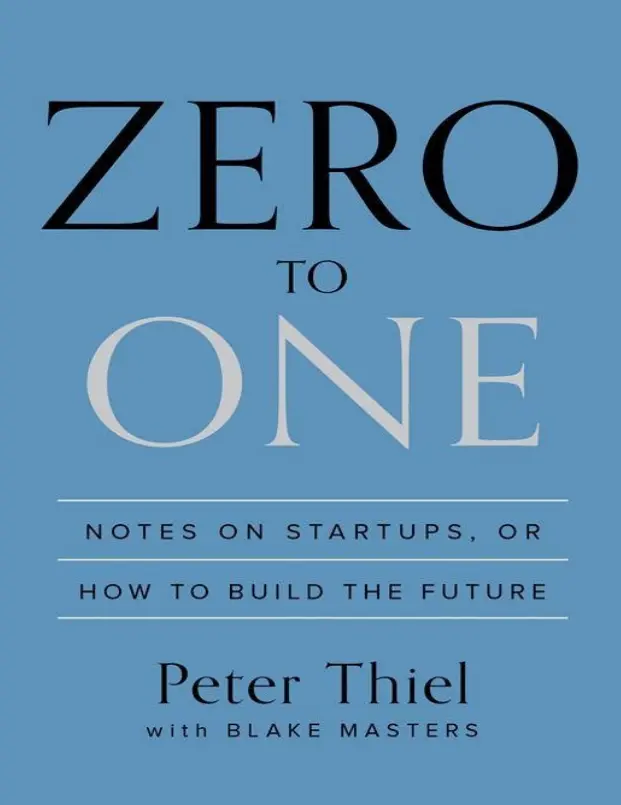
Zero to One teaches that real innovation doesn’t come from copying others—it comes from creating something completely new. Peter Thiel argues that the most successful companies build monopolies through vertical progress, not competition. He offers a bold framework for entrepreneurs: start small, think long-term, embrace contrarian ideas, and build companies that shape the future rather than follow the crowd.
Zero to One is a bold and unconventional guide to entrepreneurship and innovation, written by billionaire investor and PayPal co-founder Peter Thiel , based on his popular Stanford University course.
Unlike most business books that focus on competition and scaling, Thiel argues that true innovation comes from building something entirely new —going from zero to one , not copying what already exists (going from one to many).
He challenges conventional wisdom about startups, competition, monopolies, and the future, offering a provocative framework for how entrepreneurs can create value, build lasting companies, and shape the future.
The central idea of the book is simple yet powerful:
“Progress can take one of two forms: horizontal (copying success) or vertical (doing something new).”
Thiel believes that true entrepreneurs don’t compete—they create new markets where they can dominate and build long-term value.
Key Insight: The best businesses don’t disrupt—they invent.
One of the most controversial ideas in the book is that monopolies are good for innovation —at least when they come from building superior products and dominating a niche market.
Thiel breaks down the difference between:
Important Lesson: In business, competition is for losers.
Monopolies have the freedom and resources to invest in long-term vision, while competitive markets force companies into price wars and short-term thinking.
Thiel debunks several myths commonly held in startup culture:
Reality: The best startups are built slowly and deliberately, with deep focus and long-term planning.
Reality: While luck plays a role, success often comes from strategic decisions and execution—not just timing.
Reality: VC money can help, but it often leads to pressure to scale too fast and lose control.
Reality: It’s better to be the last mover—creating a monopoly in a market you dominate for years.
Key Insight: Founders should aim to build a company that lasts, not just gets big.
Thiel presents a framework to determine whether a startup has real potential:
These questions serve as a checklist for any entrepreneur looking to build a meaningful, scalable business.
Thiel emphasizes the importance of contrarian thinking —the ability to think independently and question widely accepted beliefs.
“The best companies are started by people who ask: What important truth do very few people agree with me on?”
If you believe most people are wrong about something, and you’re right, you may have found a huge business opportunity .
Important Lesson: To build the future, you must be willing to go against the crowd.
Thiel stresses that successful startups aren’t just about products or ideas—they’re about people and culture .
He highlights the importance of:
Key Insight: A great team with a mediocre idea can still build a great company—but not the other way around.
A common mistake among tech founders is underestimating the importance of sales and distribution.
Thiel explains that no matter how good your product is, if you can’t sell it, it won’t succeed .
He introduces the concept of distribution IQ —understanding how to reach customers effectively, whether through advertising, viral growth, sales teams, or direct marketing.
Important Lesson: Great products need great distribution to win.
Throughout the book, Thiel shares insights drawn from his own experiences and investments:
These case studies reinforce the book’s core principles and offer practical lessons for entrepreneurs.
Zero to One is more than a startup manual—it’s a manifesto for how to think differently about the future .
Thiel challenges readers to stop chasing trends and start asking deeper questions:
As he writes:
“We cannot afford to wait passively for the future to happen. We must create it.”
By embracing contrarian thinking, focusing on vertical progress, and building companies with purpose and durability, we can all play a role in shaping the future.