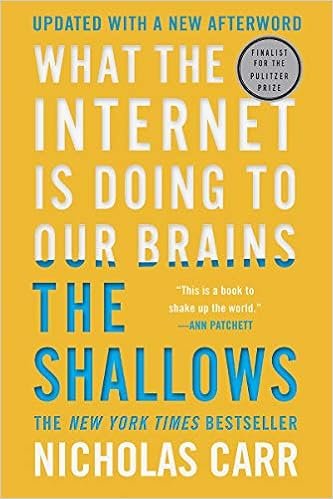
In The Shallows , Nicholas Carr warns that the internet is weakening our ability to focus, think deeply, and retain knowledge. Through neuroscience and cultural analysis, he shows how constant connectivity rewires the brain, replacing deep reading with skimming and reflection with distraction—urging readers to reclaim their capacity for sustained, meaningful thought before it fades away.
🧠 Short summary:
📘 In The Shallows: What the Internet Is Doing to Our Brains , Pulitzer-finalist author and technology critic Nicholas Carr explores how the internet is reshaping the way we think, read, and remember. With compelling research and historical context, Carr argues that the internet, for all its benefits, is making us shallower thinkers , reducing our ability to focus, reflect, and engage in deep reading.
📡 The book is a wake-up call to anyone who spends significant time online—and that includes most of us.
“We are not merely using the Internet; we are becoming part of it.”
Carr draws from neuroscience, psychology, and cultural history to show how each technological revolution—from the printing press to the internet—alters human cognition. He warns that as we outsource memory and attention to machines, we risk losing one of our most essential traits: the capacity for deep, sustained thought .
🧠 Core Message
🔹 The internet is changing our brains—for worse and for better—but mostly in ways we don’t realize.
Carr argues:
🧠 “As the uses we make of our brains change, so do the structures of our brains.”
🧩 Key Themes & Insights
Carr introduces the concept of neuroplasticity —the brain’s ability to rewire itself based on experience.
🔍 Key Points:
🧠 Important Insight: You become what you use your brain for.
Before the internet, reading was an immersive, focused activity. Today, it’s often fragmented and superficial.
📉 Carr explains:
🧠 “The deeper we are engaged with a text, the more we learn.”
The internet constantly pulls our attention in multiple directions, which harms learning and memory.
📊 Studies show:
🧠 Important Lesson: Deep work requires uninterrupted focus.
Carr discusses the “Google Effect ”—our tendency to forget information we know we can easily look up later.
🔍 This means:
🧠 “Knowing where to find something becomes more important than knowing it.”
Carr contrasts the contemplative life of the past—where people spent hours reading, writing, and reflecting—with today’s culture of constant connection.
🕯️ He notes:
🧠 Important Insight: Solitude is essential for creativity and self-understanding.
Carr traces the impact of major technologies—from the map and the clock to the printing press and television—to show how they changed human behavior and cognition.
🌐 The internet is no different—it amplifies distraction, accelerates pace, and favors speed over depth.
🧠 “Each new medium strengthens some cognitive skills at the expense of others.”
Despite popular belief, humans are not built for multitasking. Carr debunks the myth that we can do many things at once effectively.
🛑 Instead:
🧠 Important Lesson: Focus on one thing at a time for maximum performance.
Because we trust external devices (like smartphones and search engines), we’re offloading mental storage.
🧠 Consequences:
📌 “If we don’t encode memories, we can’t build meaning.”
While Carr doesn’t advocate abandoning the internet, he urges readers to be more mindful about how they use it.
🛠️ Suggestions:
🧠 “The key is to use the tools without letting them use you.”
📌 Final Thoughts: Reclaim Your Mind Before It’s Too Late
The Shallows is a must-read for anyone concerned about how digital media affects thinking, learning, and memory. Carr doesn’t reject the internet—but he challenges us to consider what we might be sacrificing in exchange for convenience and speed.
As he writes:
“The net’s challenge to the deep-reader brain is emblematic of a broader shift in human intelligence and culture.”
In a world increasingly dominated by screens and shallow interactions, The Shallows serves as a powerful reminder to protect our ability to think deeply, reflect meaningfully, and live consciously .