
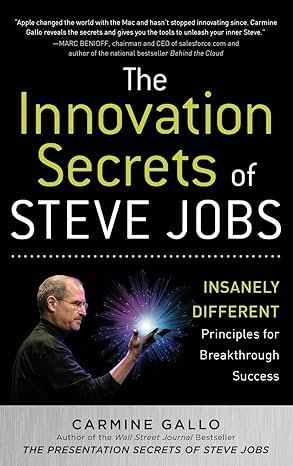
Discover the proven principles behind Steve Jobs’ revolutionary success. The Innovation Secrets of Steve Jobs reveals how passion, simplicity, and storytelling fueled Apple’s greatest breakthroughs. Learn how to think differently, lead with purpose, and create products people love. Backed by insider stories and practical strategies, this book shows that innovation isn’t magic, it’s method. Transform your business, your team, and your ideas by mastering the mindset of one of history’s greatest innovators.
Carmine Gallo’s The Innovation Secrets of Steve Jobs is not just a tribute to one of history’s most iconic innovators, it’s a meticulously researched blueprint for cultivating creativity, driving disruptive change, and building products that don’t just succeed in the marketplace but redefine it. Drawing from over two years of interviews with Apple employees, former colleagues, industry experts, and an exhaustive analysis of Steve Jobs’ public appearances, product launches, and design philosophy, Gallo distills the essence of Jobs’ genius into ten actionable principles that any individual or organization can apply to achieve extraordinary results. What makes this book transformative is its ability to decode the seemingly magical success of Apple, not as the product of a singular visionary genius, but as the outcome of repeatable, learnable behaviors rooted in passion, simplicity, and relentless focus.
At the heart of the book lies a powerful thesis: innovation isn’t accidental; it’s intentional. While many believe that breakthrough ideas emerge from random flashes of inspiration, Gallo demonstrates through compelling evidence that Steve Jobs approached innovation like a disciplined craft—one built on consistent habits, deeply held values, and a unique way of seeing the world. The book dismantles the myth of the “lone genius” and instead reveals Jobs as a master synthesizer who combined art and science, technology and humanity, to create experiences that resonated emotionally while functioning flawlessly.
Gallo structures the narrative around ten core principles, each explored through vivid storytelling, real-world examples, and practical applications. The first principle, “Do What You Love”, lets the tone for everything that follows. Gallo traces Jobs’ journey from his early days building computers in a garage to transforming entire industries, showing how his deep passion for design, music, calligraphy, and user experience fueled his perseverance through failure, criticism, and even exile from Apple. This wasn’t mere enthusiasm; it was obsession. As Jobs famously said, “The only way to do great work is to love what you do.” Gallo emphasizes that true innovation begins not with market research or profit projections, but with authentic passion, a fire that sustains effort through long nights, setbacks, and skepticism.
From there, the book introduces the principle of “Put a Dent in the Universe,” which captures Jobs’ unwavering belief in the power of purpose-driven innovation. Unlike companies focused solely on quarterly earnings, Jobs insisted that Apple exist to make a profound impact, to change how people live, think, and connect. Whether launching the Macintosh, iPod, iPhone, or iPad, every product was framed as part of a larger mission: empowering individuals and enriching lives. Gallo shows how this sense of higher purpose attracted top talent, inspired loyalty, and motivated teams to push beyond perceived limits. He illustrates this with the story of the original Mac team, who worked tirelessly under immense pressure because they believed they were creating something revolutionary, not just another computer.
One of the most influential sections of the book centers on Jobs’ obsession with simplicity, encapsulated in the mantra “Simplicity Is the Ultimate Sophistication.” Gallo reveals how Jobs ruthlessly eliminated clutter, from product features to marketing messages to retail store layouts. When designing the iPod, he didn’t ask engineers to add more buttons; he asked them to remove them. The result? A device with a single scroll wheel that made navigating thousands of songs intuitive. At Apple Stores, he rejected traditional retail models filled with signage and promotions, opting instead for clean spaces where customers could touch and experience products freely. Gallo explains that this commitment to minimalism wasn’t about aesthetics alone, it was strategic. In a world overwhelmed by complexity, simplicity becomes a competitive advantage.
Another cornerstone of Jobs’ approach was his demand for real experiences over abstractions. Gallo highlights how Jobs refused to rely on PowerPoint presentations or spreadsheets when making decisions. Instead, he insisted on prototypes, working models that could be touched, tested, and felt. “You can’t go out and ask people what the next big thing should be,” Jobs once said. “People don’t know what they want until you show it to them.” Gallo uses the development of the iPhone as a prime example: rather than conducting focus groups, Apple created multiple functional prototypes, iterating constantly based on hands-on feedback. This principle underscores a deeper truth: innovation happens through doing, not discussing.
Gallo also explores Jobs’ mastery of storytelling, an often-overlooked skill that became central to Apple’s success. The chapter “Sell Dreams, Not Products” reveals how Jobs transformed product launches into theatrical events that captivated global audiences. His famous phrase, “Today, Apple is going to reinvent the phone,” wasn’t just marketing hype, it was narrative framing at its finest. By positioning the iPhone not as a gadget but as a life-changing tool, Jobs tapped into human emotions, aspirations, and imagination. Gallo breaks down the anatomy of these keynotes, showing how Jobs used suspense, surprise, repetition, and emotional arcs to turn technical specifications into unforgettable stories. This section is particularly valuable for entrepreneurs and leaders seeking to communicate vision with impact.
Equally important is the principle of “Say No to 1,000 Things.” Gallo explains that while most companies try to please everyone by adding features, Jobs achieved greatness by subtracting them. He famously slashed Apple’s bloated product line upon returning in 1997, focusing instead on four core products. This discipline extended to every level of design: the iPhone launched without copy-paste functionality, the iPad had no Flash support, and Apple Watches initially lacked third-party apps. Each decision reflected a deeper philosophy: that innovation requires focus, and focus requires elimination. “I’m as proud of what we don’t do as I am of what we do,” Jobs declared. Gallo argues that saying no is not limitation, it’s liberation, freeing resources and attention for excellence in the few things that matter most.
The book also delves into Jobs’ collaborative genius, challenging the stereotype of him as a lone dictator. Through interviews with designers, engineers, and executives, Gallo paints a picture of a leader who demanded perfection but also empowered others to rise to the challenge. The principle “Create Corazón” (Spanish for “heart”) emphasizes Jobs’ insistence that products reflect soul and emotion. He wanted users to feel something when they interacted with Apple devices, not just satisfaction, but delight, wonder, even love. To achieve this, he fostered a culture where multidisciplinary teams worked closely together: software developers sat beside hardware engineers, marketers collaborated with designers, and everyone shared a common goal. Gallo shows how this integration of diverse talents produced seamless experiences that competitors struggled to replicate.
Another key insight revolves around experience over features. While rivals competed on specs, megapixels, processor speed, memory capacity, Apple focused on how products made people feel. The iPod wasn’t the first MP3 player, but it was the first that made managing and listening to music joyful. The iPhone wasn’t the first smartphone, but it was the first that felt magical. Gallo illustrates this with the anecdote of Jobs rejecting a prototype because the screen didn’t feel responsive enough—even though technically it met all requirements. “It doesn’t feel right,” he said. That sensitivity to subtle human cues became a hallmark of Apple’s design process, proving that innovation must serve people, not just technology.
Gallo dedicates significant space to the role of reality distortion fields, Jobs’ legendary ability to inspire others to achieve the impossible. While often portrayed as manipulation, Gallo reframes this trait as a form of extreme confidence and persuasion rooted in clarity of vision. Jobs didn’t lie; he simply refused to accept conventional limitations. When told something couldn’t be done, he’d challenge assumptions, reframe problems, and push teams to find solutions. The development of the Mac’s graphical interface, the switch to Intel chips, and the creation of the App Store were all deemed unfeasible, until Jobs made them happen. Gallo teaches readers how to harness their own version of this mindset: by combining audacious goals with relentless execution.
The principle of “Master the Message” addresses how Jobs communicated with precision and consistency. Every ad, keynote, and interview reinforced Apple’s core values: innovation, simplicity, elegance. There was no ambiguity. Customers knew exactly what Apple stood for. Gallo analyzes Jobs’ communication style, his pauses, gestures, word choice, and shows how these elements built trust and anticipation. Even silence was used strategically: during product demos, Jobs would pause after revealing a new feature, letting the audience absorb its significance. This mastery ensured that Apple’s brand remained coherent across decades and billions of dollars in revenue.
Finally, the book concludes with “Impute,” a lesser-known but vital concept meaning that people form judgments based on initial impressions. Jobs understood that packaging, store layout, website design, and even font choices shaped perceptions before a product was even used. He insisted that every touchpoint reflect Apple’s commitment to quality. From the moment a customer opened the box, they were immersed in a carefully crafted experience. Gallo uses this principle to emphasize that innovation extends beyond the product itself—it includes every interaction, every detail, every moment of contact.
Throughout the book, Gallo connects these principles to modern challenges faced by professionals, entrepreneurs, and creatives. He provides exercises, checklists, and case studies showing how readers can apply Jobs’ secrets in their own lives, whether launching a startup, leading a team, or developing a personal project. For instance, he suggests conducting a “simplicity audit” of current workflows, asking, “What can I eliminate?” Or using the “dream board” technique to clarify one’s vision before pitching an idea.
What makes The Innovation Secrets of Steve Jobs enduringly relevant is its balance between inspiration and practicality. It doesn’t deify Jobs, he was flawed, demanding, and sometimes difficult, but it extracts timeless lessons from his methods. In an age of distraction, complexity, and short-term thinking, the book serves as a reminder that lasting innovation comes from depth, not breadth; from courage, not conformity; from love of craft, not pursuit of fame.
Ultimately, Gallo’s work is not about copying Steve Jobs, it’s about channeling his mindset. The secrets aren’t hidden in secrecy or genius; they’re embedded in behavior, discipline, and belief. Anyone can innovate like Jobs, not by being him, but by adopting his principles: loving your work, simplifying relentlessly, telling powerful stories, and refusing to settle for anything less than extraordinary. As the final message reminds us: innovation isn’t reserved for the chosen few. It’s available to anyone willing to care deeply, think differently, and do the work.
Summary powered by VariableTribe