
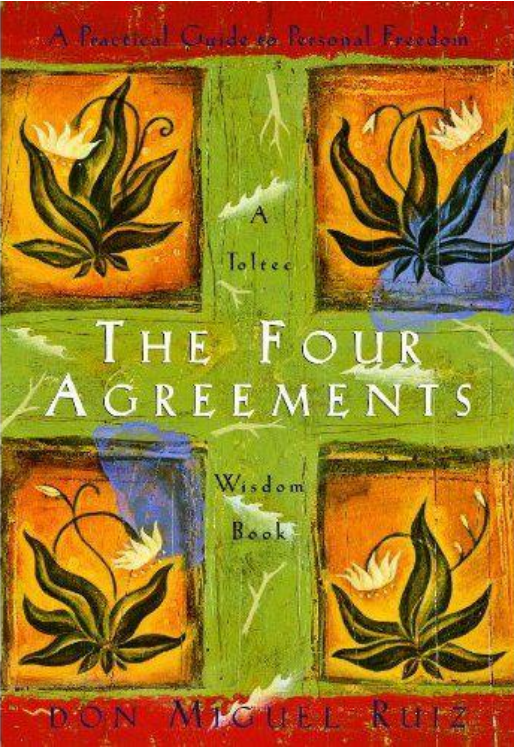
Discover the life-changing wisdom of The Four Agreements by Don Miguel Ruiz. Based on ancient Toltec teachings, this powerful guide offers four simple principles to break free from fear, judgment, and self-limiting beliefs. Learn to speak with integrity, stop taking things personally, avoid assumptions, and always do your best. A timeless roadmap to personal freedom, this book will transform the way you think, communicate, and live. Embrace your truth. Live with courage. Be free. Summary powered by VariableTribe
The Four Agreements by Don Miguel Ruiz is a profound yet accessible guide to personal freedom rooted in ancient Toltec wisdom. With clarity and grace, Ruiz distills a lifetime of spiritual teaching into four deceptively simple principles, agreements, that, when practiced consistently, can liberate individuals from suffering, self-doubt, and fear. The book is not a complex philosophy or religious doctrine, but a practical roadmap for transforming the way we think, speak, and relate to ourselves and others. At its core, it teaches that true freedom comes not from changing the world, but from freeing the mind from the invisible agreements we’ve unknowingly adopted through culture, family, and fear. Summary powered by VariableTribe
Ruiz begins by explaining that from a young age, we are conditioned by society to adopt a set of beliefs and behaviors, what he calls “the domestication of the human.” Parents, teachers, and peers reward conformity and punish deviation, teaching us to seek approval, fear judgment, and suppress our true nature. Over time, we internalize these rules, forming a “book of agreements” that governs our thoughts and actions. Most of these agreements are limiting and untrue, yet we live by them as if they are absolute laws. The result is emotional suffering, jealousy, shame, guilt, anger, and fear, all stemming from a mind trapped in illusion.
To break free, Ruiz proposes adopting four new agreements—conscious choices that replace the old, destructive patterns:
This first agreement is about the power of language. Ruiz teaches that words are not neutral, they carry energy and create reality. When we use words to gossip, judge, or speak against ourselves, we generate negative energy that harms both ourselves and others. Being “impeccable” means speaking with integrity, truth, and kindness. It means using words to uplift, inspire, and build trust. It also means not using your word against yourself through self-criticism or negative self-talk. Your word is a tool of creation; use it wisely. When you speak with honesty and love, you align with your higher self and contribute to a more peaceful world.
This agreement addresses one of the greatest sources of emotional pain: the tendency to interpret others’ actions and words as a reflection of our worth. Ruiz explains that what others say and do is a projection of their own reality, their own beliefs, fears, and conditioning. When someone insults you, yells at you, or ignores you, it is not about you, it is about them. If you take it personally, you give them power over your emotions. By recognizing that everyone is living in their own dream, you free yourself from unnecessary suffering. This agreement does not mean becoming indifferent; it means developing emotional resilience and inner stability. When you stop taking things personally, you stop reacting and start responding with clarity and compassion.
Assumptions are the root of most conflict, misunderstanding, and heartbreak. Ruiz points out that humans have a tendency to assume they know what others are thinking or feeling, often without asking. We create entire stories in our minds—“They didn’t text me back because they hate me,” “My boss is ignoring me because I’m not good enough”, and then react as if these stories are true. These assumptions lead to drama, resentment, and broken relationships. The solution is simple but radical: ask questions. Communicate openly and honestly. Clarify intentions. When you stop assuming and start inquiring, you replace fear with understanding. This agreement fosters trust, intimacy, and effective communication in all relationships.
The final agreement is about action and self-compassion. Ruiz reminds us that our “best” is not a fixed standard, it changes from moment to moment depending on our energy, health, and circumstances. Some days your best may be running a marathon; other days, it may be getting out of bed. The key is to do your best without judgment or comparison. When you commit to doing your best, you eliminate self-criticism and regret. You stop punishing yourself for not being perfect. This agreement encourages consistent effort without attachment to outcome. It’s not about striving for excellence at all costs, but about showing up fully, authentically, and kindly in each moment.
Throughout the book, Ruiz weaves these four agreements into a cohesive philosophy of personal freedom. He explains that when you live by these principles, you begin to break the spell of the “dream of the planet”—the collective illusion of fear, competition, and scarcity. You awaken to your true nature: a being of love, awareness, and infinite potential. The agreements are not commandments; they are practices. Mastery comes not from perfection, but from repetition, awareness, and gentle correction.
One of the most powerful insights in the book is that your entire emotional life is shaped by agreements. You suffer not because of what happens to you, but because of the meaning you assign to it. By changing your agreements, you change your reality. For example, if you no longer agree that you need others’ approval to feel worthy, you become free from the need to please. If you stop agreeing that failure is shameful, you become free to take risks and grow.
Ruiz also emphasizes that self-love is the foundation of all freedom. When you stop judging yourself, stop taking things personally, and do your best without self-criticism, you begin to treat yourself with the same kindness you might offer a dear friend. This shift in self-relationship transforms every other relationship in your life.
The tone of the book is gentle, poetic, and deeply wise. Ruiz writes not as a distant guru, but as a fellow traveler who has faced his own struggles. His teachings are rooted in Toltec spiritual tradition, but presented in a universal way that transcends religion. The simplicity of the four agreements makes them easy to remember and apply in daily life—whether in a heated argument, a moment of self-doubt, or a quiet decision to speak kindly.
In the final chapters, Ruiz invites readers to make these agreements a daily practice. He suggests journaling, meditation, and mindfulness as tools to increase awareness and reinforce the new beliefs. He also warns that the mind will resist, old habits die hard. But with patience and persistence, the new agreements become second nature, and freedom becomes your default state.
The Four Agreements is more than a self-help book, it is a spiritual toolkit for living with authenticity, peace, and courage. It doesn’t promise a life without challenges, but it offers a way to navigate them without losing yourself. In a world of noise, comparison, and external validation, this book is a quiet revolution, a return to inner truth and personal power. Summary powered by VariableTribe