
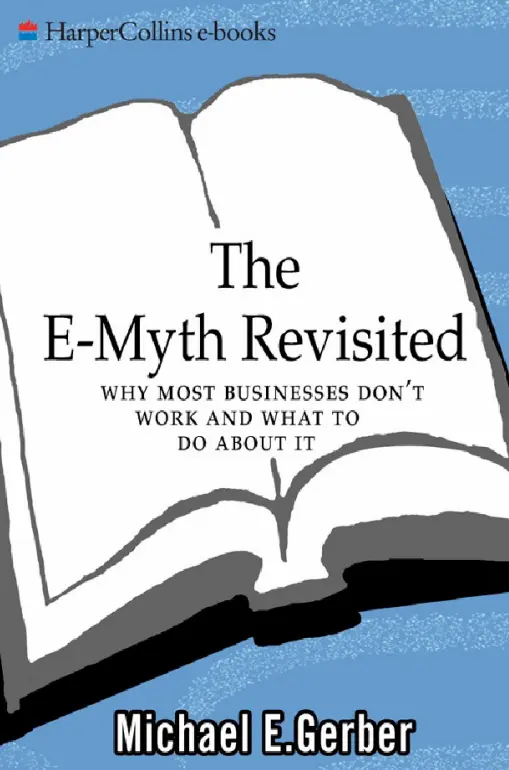
The E-Myth Revisited reveals why most small businesses fail—and how to build one that works. Michael E. Gerber explains that most entrepreneurs are actually technicians who love doing the work, not managing a business. By building systems, documenting processes, and working on your business—not just in it—you can escape burnout, scale effectively, and build a company that thrives independently.
The E-Myth Revisited is a groundbreaking book that challenges the myth that most entrepreneurs start businesses because they want to be entrepreneurs.
Instead, author Michael E. Gerber argues that most small business owners are actually technicians —people who love doing the work (like baking, plumbing, or coding), but who mistakenly believe that opening a business means doing more of what they love.
Gerber introduces a powerful framework for building businesses that run without the owner’s constant involvement—what he calls the “Turn-Key Revolution.”
He explains why most small businesses fail , why owners end up working harder than ever, and how to build a company that truly works—for you, not against you.
The E-Myth stands for the Entrepreneurial Myth —the false belief that most people who start small businesses do so because they want to be entrepreneurs.
In reality:
“You’re not an entrepreneur—you’re a technician with a dream.”
This is the root cause of stress, burnout, and failure in many small businesses.
Gerber introduces a model that exists in every business:
Most small business owners are stuck in the Technician role , which keeps them from growing their business or stepping away from daily operations.
Key Insight: To build a successful business, you must lead with the Entrepreneur mindset —even if it doesn’t come naturally.
One of the most transformative ideas in the book is the concept of the Franchise Prototype —building your business as if you were going to franchise it someday.
Even if you never plan to open multiple locations, this mindset forces you to create:
“If your business depends on you, you don’t own a business—you have a job.”
By systematizing everything, you free yourself from being the only person who can do the work.
Important Lesson: Great businesses aren’t built—they’re designed.
Gerber outlines a step-by-step process for transforming your business into a well-oiled machine:
Create time to think strategically by scheduling dedicated “entrepreneur time.”
What is the ultimate purpose of your business? This should guide every decision.
Set a clear, long-term goal—e.g., “Become the #1 provider in our region within five years.”
Design your business structure based on roles and functions—not just people.
Implement processes, metrics, and accountability structures.
Write down every task, no matter how small. Standardize, then delegate.
Treat your business like a lab—always testing, refining, and improving.
Key Insight: If you can’t explain how something works, you don’t really understand it.
Gerber makes a bold claim:
“Your real product isn’t what you sell—it’s your business itself.”
A true business creates value through its systems and processes , not just its products or services.
Think of McDonald’s:
Important Lesson: The more predictable and repeatable your business is, the more valuable it becomes.
Gerber encourages business owners to adopt a mindset of continuous improvement .
He introduces the idea of the “Reengineering Cycle” :
This cycle ensures that your business constantly evolves and improves—even when you’re not directly involved.
Key Insight: Innovation isn’t about big breakthroughs—it’s about small, consistent improvements.
Throughout the book, Gerber shares real-life examples of businesses that transformed by applying these principles:
These stories reinforce that any business—no matter how small—can benefit from system thinking .
The E-Myth Revisited is especially valuable for:
Gerber shows that freedom and success come from designing your business intentionally , not just working hard.
Important Lesson: Freedom comes from systems, not effort alone.
Gerber ends with a powerful reflection:
“Your business is a mirror of who you are.”
If your business is chaotic, it’s likely because your thinking is unfocused. If your business is thriving, it’s because you’ve taken ownership of its design.
The E-Myth Revisited isn’t just a book about business—it’s a book about personal transformation.
As Gerber writes:
“Change the way you look at things, and the things you look at change.”