
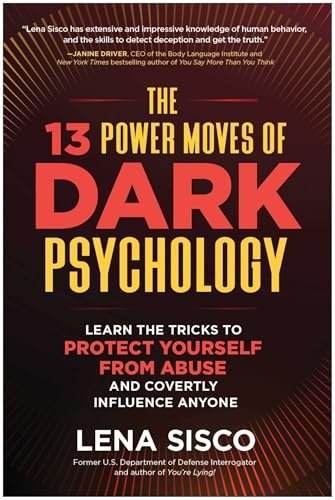
The 13 Power Moves of Dark Psychology by Lena Sisco reveals the hidden tactics manipulators use to control others. From gaslighting to love bombing, this book teaches you how to spot abuse, protect your mind, and reclaim your power. With practical strategies and real-life examples, it empowers you to navigate relationships and life with clarity, confidence, and emotional resilience. A must-read for anyone ready to see through deception and live freely.
The 13 Power Moves of Dark Psychology is a bold and eye-opening guide that reveals the hidden tactics used by manipulative people, and how you can defend yourself or even use subtle influence ethically.
Written by Lena Sisco, a behavioral analyst and self-development author, this book dives into the shadowy world of dark psychology: the study of manipulation, coercion, deception, and emotional control.
“Understanding dark psychology doesn’t make you manipulative, it makes you un-manipulatable.”
Sisco’s goal is not to teach you how to exploit others, but to:
This summary walks you through the core ideas of the book, offering a clear, practical breakdown of the 13 power moves, their real-world applications, and how to guard against abuse.
Dark psychology refers to the covert techniques some people use to gain power over others without their awareness.
These aren’t always malicious, but they are often unethical when used for selfish gain.
Common elements include:
Sisco explains that these tactics are used in:
“You don’t need to become dark to beat darkness, you just need to see it clearly.”
Her message is one of empowerment through awareness.
Sisco presents two sides of the same coin:
Learn how manipulators operate so you can:
Understand human psychology so you can:
“Knowledge of dark psychology becomes dangerous only when misused. In wise hands, it’s a tool for freedom.”
She stresses that ethical influence respects autonomy—while manipulation undermines it.
Here’s a detailed breakdown of the 13 key strategies discussed in the book:
Subtly copying someone’s body language, tone, or speech patterns to build trust and rapport.
“People like those who resemble them.”
Use: To create connection.
Misuse: To deceive or gain false intimacy.
Making someone doubt their memory, perception, or sanity through denial, misinformation, or contradiction.
“That never happened.”
“You’re too sensitive.”
“You’re imagining things.”
Protect yourself by trusting your instincts and documenting interactions.
Overwhelming affection, attention, and praise early in a relationship to create dependency.
Common in cults, abusive relationships, and manipulative sales tactics.
“If it feels too good to be true at the start—it probably is.”
Bringing a third person into a conflict to gain control, create jealousy, or avoid direct accountability.
Example: “Even your mom thinks you’re overreacting.”
Break the cycle by refusing to engage in gossip or comparison games.
Using emotional pressure to make someone feel bad for not complying.
“After all I’ve done for you…”
“I guess you don’t care about me.”
Defense: Recognize guilt as a manipulation tactic, not a moral obligation.
Withholding communication as punishment or control.
It’s emotional blackmail disguised as indifference.
“No reaction is a reaction.”
Respond by refusing to chase validation.
Portraying oneself as suffering to avoid responsibility and gain sympathy.
Manipulators use victimhood to deflect blame and manipulate rescuers.
“Everyone’s against me.”
Don’t enable, hold them accountable.
Accusing others of the very behaviors they themselves are guilty of.
A narcissist might say, “You’re the one who’s selfish,” while draining everyone around them.
“What you hate in others may reflect what you deny in yourself.”
Creating anxiety to push someone into quick decisions.
Used in scams, authoritarian parenting, and fear-driven marketing.
“If you don’t act now, you’ll lose everything.”
Stay calm. Delay decisions. Ask: Who benefits from my fear?
Giving rewards unpredictably, like a slot machine, to keep someone hooked.
Seen in addictive relationships: hot-and-cold affection keeps victims chasing approval.
“Hope is the hook.”
Recognize the pattern. Walk away.
Cutting someone off from friends, family, or support systems to increase dependence.
Classic tactic in abusive relationships and cults.
“They don’t understand us.”
Fight back by maintaining outside connections.
After idealizing someone, suddenly criticizing or belittling them to erode self-worth.
Part of the narcissistic abuse cycle: Idealize → Devalue → Discard.
“You were never good enough.”
Healing starts when you realize the problem was never you.
Unspoken expectations (“You should know what I want”) used to set others up for failure.
“If you loved me, you’d do this.”
Break the trap by asking for clarity: What exactly do you expect?
Sisco offers practical tools to protect your mind and heart:
Learn to identify your feelings and where they come from.
Your subconscious often detects danger before your conscious mind does.
Say no firmly. Block toxic people. Stop justifying your limits.
“A boundary isn’t a negotiation, it’s a declaration.”
Keep records of messages, emails, and conversations.
Watch interactions like a scientist, without emotional investment.
“When you observe the game, you stop playing it.”
While the book exposes dark methods, Sisco encourages readers to use this knowledge for good:
Use mirroring and empathy to connect, without deception.
Lead through vision and values, not fear or guilt.
Replace passive aggression with honest dialogue.
Help people make informed choices, don’t manipulate outcomes.
“True power doesn’t need tricks. It attracts through integrity.”
The book shows how dark psychology operates in everyday settings:
Red flags:
Healthy love is consistent, respectful, and freeing, not chaotic or controlling.
Toxic bosses may use:
Protect yourself by documenting work, building alliances, and knowing your worth.
Sisco includes guidance for recovery:
Addictive attachment to an abuser due to cycles of abuse and reward.
Breaking free requires:
Years of manipulation can erase your sense of self.
Ask:
“You are not broken,you were conditioned.”
Throughout the book, Sisco shares stories from clients and research:
These examples illustrate how subtle and insidious dark psychology can be.
Sisco draws from:
She teaches that:
Sisco provides exercises you can start today:
Track interactions that leave you feeling confused, drained, or guilty.
Patterns reveal manipulation.
Before reacting emotionally, pause for 10 minutes.
Prepare phrases for common situations:
Questions to ask when doubting yourself:
“Clarity is your greatest weapon.”
Sisco encourages powerful mental shifts:
These shifts restore agency and inner strength.
The 13 Power Moves of Dark Psychology is not a manual for exploitation—it’s a survival guide for the emotionally aware.
It teaches that:
As Sisco writes:
“Once you see the strings, you can cut them.”
And once you’re free, you can choose to live with integrity, peace, and power.