
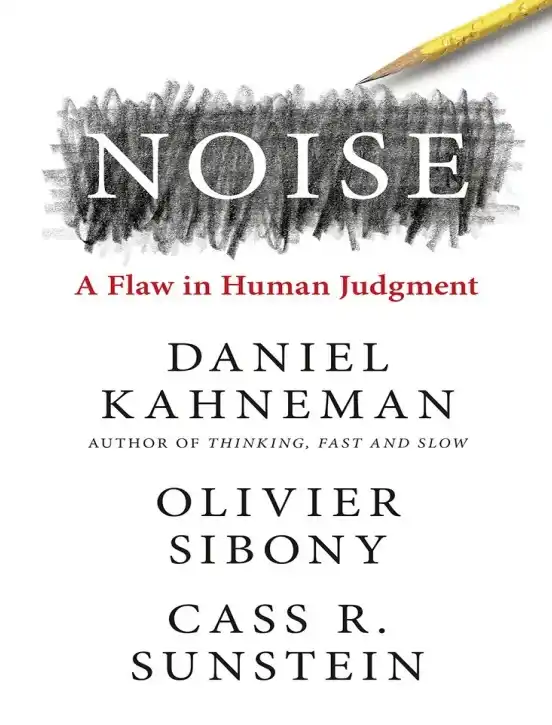
In Noise: A Flaw in Human Judgment , Kahneman, Sibony, and Sunstein reveal how inconsistency in decision-making—called “noise”—leads to errors in law, medicine, finance, and more. Through real-world examples and behavioral science, the book shows how to identify and reduce noise to improve fairness, accuracy, and organizational performance. A must-read for leaders, professionals, and critical thinkers.
Short Summary:
📖 Overview
🧠 Noise: A Flaw in Human Judgment is a groundbreaking book that explores an often-overlooked source of error in human decision-making—noise , or the unwanted variability in judgments that should be identical.
Written by Nobel Prize-winning psychologist Daniel Kahneman , business professor Olivier Sibony , and legal scholar Cass R. Sunstein , this book reveals how inconsistent decisions across fields like medicine, law, hiring, finance, and education lead to serious consequences —from misdiagnoses to unfair sentencing.
📊 “Wherever there is judgment, there is noise—and more of it than you think.”
The authors combine decades of research in behavioral science and decision-making to show why people make different choices in identical situations—and what can be done about it.
🔍 Core Message
The central idea of the book is:
Bias gets all the attention. But noise is just as dangerous—and much harder to detect.
While bias refers to systematic error (like always overestimating risk), noise is random error —the inconsistency in judgments made by different people, or even the same person at different times.
📉 This leads to:
🧠 “If two doctors give different diagnoses for the same patient, or two judges hand down wildly different sentences for the same crime, something has gone wrong.”
🧩 Key Themes & Insights
Noise is the variability in judgment where uniformity is expected .
Examples:
📊 The problem isn’t just that people are wrong—it’s that they’re inconsistently right or wrong .
While bias is a systematic deviation from accuracy , noise is random scatter around the truth .
📉 Think of it like this:
🔑 Important Insight: You can have noise without bias—and bias without noise. Both reduce accuracy.
Noise is everywhere—but it’s especially damaging in high-stakes decision-making environments .
Common Areas Include:
📌 “You don’t want your fate to depend on which judge happens to hear your case.”
To fix noise, you must first measure it.
The authors introduce the concept of a “noise audit” —a process where multiple professionals evaluate the same set of cases independently.
📊 The results reveal how much variation exists in their judgments—providing a baseline for improvement.
🧠 “What gets measured gets managed.”
One of the most effective ways to reduce noise is through decision rules, checklists, and scoring systems .
✅ Benefits:
📝 Example: Structured interviews with fixed questions significantly reduce variability in hiring decisions.
When it comes to consistency, algorithms win every time .
They don’t get tired, distracted, or influenced by mood or personal biases.
🤖 Key Findings:
💡 “Algorithms don’t eliminate error, but they do eliminate variability.”
Even subtle changes in mood or environment affect judgment.
📉 Examples:
🧠 “Your current state of mind influences your decisions more than you realize.”
Contrary to popular belief, group discussions don’t always improve decision-making—they can actually increase noise due to conformity, dominance, or anchoring effects.
👥 Problems in Group Decision-Making:
🗣️ “Groups tend to end up more extreme than individuals.”
The authors offer a toolkit for reducing noise while preserving expertise.
🛠️ Practical Solutions:
🧠 “Noise reduction doesn’t mean eliminating judgment—it means improving its quality.”
📌 Final Thoughts: Accuracy Matters More Than We Realize
Noise is not just another behavioral economics book—it’s a wake-up call for organizations and individuals who care about fairness, consistency, and sound decision-making.
As the authors conclude:
“Judgment is hard. It is hard because people differ, and the same person differs at different times.”
Understanding and addressing noise is essential to making better decisions—in business, in justice, and in life.