
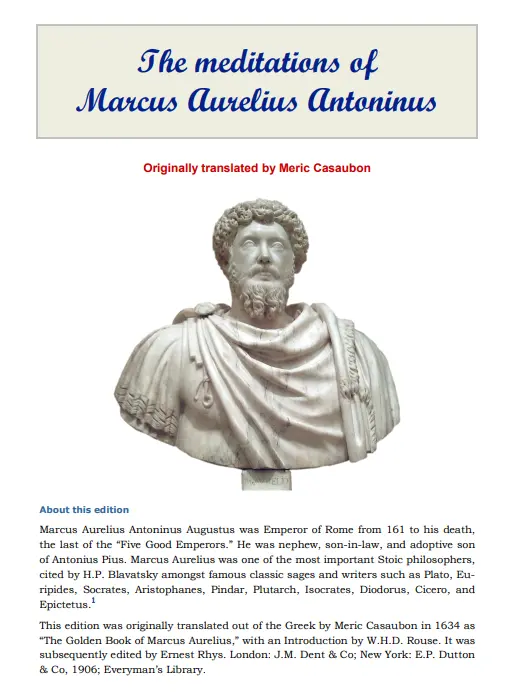
Meditations is a series of private reflections by Roman Emperor Marcus Aurelius. It teaches Stoic principles: control your thoughts, embrace adversity, serve others, and live with virtue. Written as personal notes, it remains a powerful guide for modern life—helping readers find peace in chaos, strength in hardship, and clarity in confusion.
Meditations is a timeless collection of personal writings and reflections by Marcus Aurelius , the Roman Emperor from 161 to 180 CE.
Unlike most books on leadership or philosophy, Meditations was never intended for public consumption—it was written by Marcus for himself , as a way to reflect on life, virtue, duty, and how to remain calm and just in the face of adversity.
It is one of the most profound examples of Stoic philosophy in action—offering insights into:
“You have power over your mind – not outside events. Realize this, and you will find strength.” – Marcus Aurelius
This summary provides a clear, engaging breakdown of the core themes and wisdom found in Meditations , perfect for modern readers seeking guidance in life, work, and inner peace.
Marcus Aurelius was not only a ruler of one of the greatest empires in history—he was also a devoted student of Stoic philosophy .
Known as one of the “Five Good Emperors” of Rome, he ruled during times of war, plague, and political instability. Despite all that, he remained committed to living a life of virtue, discipline, and service .
His Meditations were written while on military campaigns, late at night, in the midst of chaos. They were meant to guide him—not for fame or glory, but to help him become a better person and leader.
“Be content with what you have. Wishing pulls you into distraction; gratitude brings you peace.”
Key Insight: True leadership begins within—with self-awareness, reflection, and discipline.
Marcus believed that the best life is lived in harmony with nature and reason. This doesn’t mean forests and rivers—it means aligning with universal laws, rational thought, and our human nature.
“Accept whatever comes to you woven in the pattern of your destiny, for what could more aptly weave your fabric?” – Book II
He teaches that happiness lies not in controlling external events, but in responding wisely to them .
A recurring theme is the idea that everything is temporary —life, people, power, even our own bodies.
Marcus reminds himself constantly:
“You could leave life right now. Let that determine what you do and say and think.” – Book II
Important Lesson: Knowing that time is limited makes us more intentional with every moment.
One of the central ideas of Stoicism—and of Meditations —is the distinction between what is within your control and what is not.
“If you are distressed by anything external, the pain is not with the thing itself, but with your estimate of it. And it is in your power to wipe out that estimate at any moment.” – Book IV
Key Insight: Peace comes when you stop fighting things you can’t change.
Rather than avoiding suffering, Marcus saw hardship as an opportunity to grow stronger.
He often writes about:
“The impediment to action advances action. What stands in the way becomes the way.” – Book I
Important Lesson: Your greatest challenges are your greatest teachers—if you respond with wisdom.
Despite being emperor—the most powerful man in the known world—Marcus wrote about the importance of humility, simplicity, and serving others .
He reminds himself to avoid pride, vanity, and the pursuit of luxury.
“Do not act as if you were going to live ten thousand years. Death hangs over you. While you live, while it is in your power, be good now.” – Book IV
Key Insight: Power without virtue is meaningless. Greatness is defined by character, not titles.
Marcus believed that how you interpret the world determines your experience .
He encourages:
“Our life is what our thoughts make it.” – Book IV
Important Lesson: You don’t need to change the world—just how you see it.
In Meditations , Marcus repeatedly returns to the idea that other people’s behavior is not your problem—they’re doing their best with what they have.
“When you wake up in the morning, tell yourself: the people I will meet today will be meddling, ungrateful, arrogant, dishonest, jealous, and surly.” – Book II
But instead of anger, he urges understanding. People act badly because they don’t know better.
Key Insight: Compassion toward others—even difficult ones—is a form of strength.
Though written nearly 2,000 years ago, Meditations offers surprisingly modern and actionable advice :
These habits helped Marcus lead a vast empire under constant pressure. Today, they help leaders, entrepreneurs, athletes, and thinkers live more meaningful lives.
Even though Meditations was written in a vastly different time, its lessons apply deeply to modern life.
Here’s how to use its wisdom today:
“Waste no more time arguing about what a good man should be. Be one.” – Book X
For Marcus, virtue was the highest goal. He believed that a good life is built on four key virtues:
These are not just ancient ideals—they are practical guides for living well.
“To the wise, life is not empty; it is full of meaning.” – Book XI
Key Insight: A life of virtue brings fulfillment far beyond wealth, status, or pleasure.
As emperor, Marcus understood the weight of responsibility. He reminded himself constantly to:
“To bear wrongs patiently is godlike; to be wronged is not.” – Book IX
His leadership style reflects a rare combination of strength and humility , which is still studied and admired by modern leaders.
Marcus didn’t ignore pain—he faced it head-on. He lost many loved ones, fought wars, and dealt with betrayal.
Yet he taught that:
“Everything that happens, happens as it should, and if you observe carefully, you will find this to be so.” – Book IV
Important Lesson: Suffering is part of life—but you decide whether it breaks you or builds you.
Meditations has inspired countless people across centuries—from philosophers to CEOs, soldiers to artists.
Notable fans include:
They credit Meditations with helping them stay grounded, focused, and resilient in high-pressure environments.
Meditations is not a book to read once and forget—it’s a daily companion for those who want to live with intention, discipline, and clarity.
It teaches that:
As Marcus wrote:
“Do not act as if you were going to live ten thousand years. Death hangs over you. While you live, while it is in your power, be good.”