🧠 Comprehensive Analysis
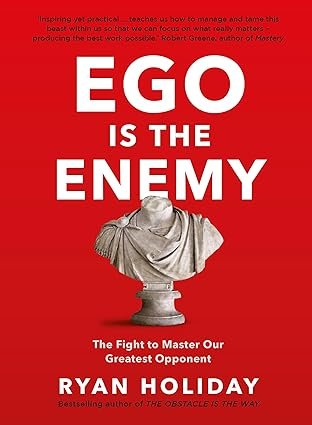
Ryan Holiday’s Ego Is the Enemy is not a self-help manual filled with empty affirmations or quick-fix hacks. Instead, it is a sobering, historically grounded meditation on one of the most insidious obstacles to human excellence: the ego. Drawing from Stoic philosophy, military strategy, business case studies, and biographical sketches of towering historical figures, Holiday constructs a compelling three-part framework, Aspire, Success, Failure, to demonstrate how ego infiltrates every stage of our journey and quietly sabotages our potential.
At its core, the book defines ego not in the Freudian sense, but as “an unhealthy belief in our own importance”, a state of arrogance, self-absorption, and entitlement that distorts reality and disconnects us from truth, humility, and genuine connection. Holiday argues that while talent, ambition, and drive are essential, they become liabilities when fused with unchecked ego. The real enemy, he insists, isn’t external competition or bad luck, it’s the voice inside us that craves validation, fears obscurity, and mistakes confidence for competence.
The first section, Aspire, addresses those at the beginning of their journey, young, hungry, and eager to prove themselves. Here, ego manifests as premature self-satisfaction, excessive talk, and a fixation on image over substance. Holiday uses the example of William Tecumseh Sherman, who, despite his eventual fame as a Civil War general, began his career in quiet service, deferring to superiors and focusing on mastery rather than recognition. In contrast, George McClellan, a man equally gifted on paper, was paralyzed by his own grandiosity, endlessly planning but never acting, convinced of threats that didn’t exist and victories that hadn’t happened. The lesson is clear: early success is fragile, and ego turns potential into performance art. Holiday urges readers to “be lesser, do more,” to adopt what he calls the “canvas strategy”, clearing the path for others so that you may learn, contribute, and grow without the burden of needing to be seen as special.
Crucially, Holiday challenges the modern obsession with passion. While society glorifies “following your passion,” he warns that untempered passion often masks insecurity and leads to impulsive, unsustainable decisions. Eleanor Roosevelt, John Wooden, and other exemplars weren’t driven by fiery emotion but by purpose, discipline, and a commitment to something larger than themselves. Passion, in this view, is form without function; purpose is function with direction. Similarly, Holiday debunks the myth of the self-made genius. Kirk Hammett, after joining Metallica, didn’t rest on his laurels, he sought out a guitar teacher to refine his fundamentals. True students, Holiday argues, remain learners for life, always seeking feedback, embracing criticism, and subordinating their ego to the pursuit of mastery.
The second section, Success, explores the paradox that achievement often sows the seeds of downfall. When we “make it,” ego whispers that we’ve arrived, that the rules no longer apply, that we deserve more. Howard Hughes serves as the book’s central cautionary tale: a mechanical genius and visionary whose empire collapsed not from lack of talent, but from unchecked ego, paranoia, and a refusal to listen. His story illustrates how success can intoxicate, leading to entitlement, control issues, and a distorted sense of reality. In contrast, George C. Marshall, architect of the postwar Marshall Plan, consistently deferred honors, declined personal glory, and prioritized mission over self. His humility wasn’t weakness; it was strategic clarity.
Holiday emphasizes the danger of narrative-making: the tendency to retroactively frame our success as inevitable, as if we “knew it all along.” Bill Walsh, who transformed the San Francisco 49ers from laughingstock to Super Bowl champions, rejected this myth. His turnaround wasn’t due to a grand vision but to a “Standard of Performance”, a relentless focus on small, daily disciplines: how players stood, how routes were run, how practices were scheduled. It was the mundane, not the magnificent, that built greatness. Yet once the team won, ego crept in; players believed they were special, standards slipped, and performance declined, until they returned to the basics. The takeaway: facts beat stories. Real success is built on systems, not self-mythology.
Maintaining sobriety in success requires constant vigilance. Angela Merkel, the unassuming German chancellor, embodies this. She doesn’t rely on charisma but on calm analysis, patience, and principle. In a world that rewards bluster, her quiet competence has made her one of the most effective leaders of the 21st century. Holiday reminds us that power doesn’t corrupt, it reveals. And what it often reveals is an ego that can’t handle the weight of its own success.
The final section, Failure, confronts the inevitable setbacks every person faces. Here, ego takes a different form: self-pity, blame-shifting, and the refusal to accept responsibility. Katharine Graham, thrust into leadership of the Washington Post after her husband’s suicide, could have folded under pressure. Instead, she faced down Nixon’s White House, union strikes, and market skepticism with quiet resolve. Her strength wasn’t bravado, it was the willingness to endure, to make hard choices, and to serve a cause greater than herself.
Holiday introduces the concept of “alive time versus dead time.” In prison, Malcolm X chose alive time, devouring books, teaching himself, transforming confinement into education. Others, in similar circumstances, choose dead time, bitterness, stagnation, or doubling down on destructive patterns. The choice is always ours. Similarly, Belisarius, the great Roman general betrayed by his emperor, never complained. He did his duty, knowing that doing the right thing was enough, regardless of reward or recognition. This internal scorecard, Holiday argues, is essential: measure yourself not by applause, but by your own standards of integrity and effort.
The book concludes with a powerful call to love, not just as sentiment, but as a strategic antidote to ego’s hatred and resentment. Orson Welles, attacked by William Randolph Hearst for Citizen Kane, responded with humor and grace, not vengeance. Hate, Holiday writes, is a cancer that consumes the hater far more than the hated. Love, forgiveness, empathy, letting go,is liberation.
Throughout, Holiday weaves personal vulnerability into his analysis. He recounts his own brush with ego-driven collapse, watching mentors fall, feeling his own work unravel, and how these experiences led him to tattoo “EGO IS THE ENEMY” on his arm. This isn’t theoretical; it’s hard-won wisdom.
Summary powered by VariableTribe
📌 Key Lessons from Ego Is the Enemy
- Silence is strength: Talking about your goals depletes the energy needed to achieve them. Do the work quietly.
- Be a student forever: Mastery requires humility, feedback, and the willingness to learn from anyone, even those “beneath” you.
- Passion is overrated: Purpose, discipline, and realism are more reliable drivers of lasting success.
- Clear the path for others: The “canvas strategy” builds influence, relationships, and skills without demanding credit.
- Restraint is power: Like Jackie Robinson, sometimes the greatest strength is not fighting back, even when you’re right.
- Beware early pride: Accomplishments are milestones, not finish lines. Complacency kills momentum.
- Work relentlessly: Ideas are cheap; execution is everything. Greatness is built in the unseen hours of practice.
- Reject the narrative: Success is rarely linear or preordained. Focus on systems, not stories.
- Maintain your own scorecard: Judge yourself by internal standards, not external validation.
- Choose alive time: In adversity, use the moment to grow, not to wallow.
- Respond with love: Letting go of resentment frees you to move forward with clarity and peace.